
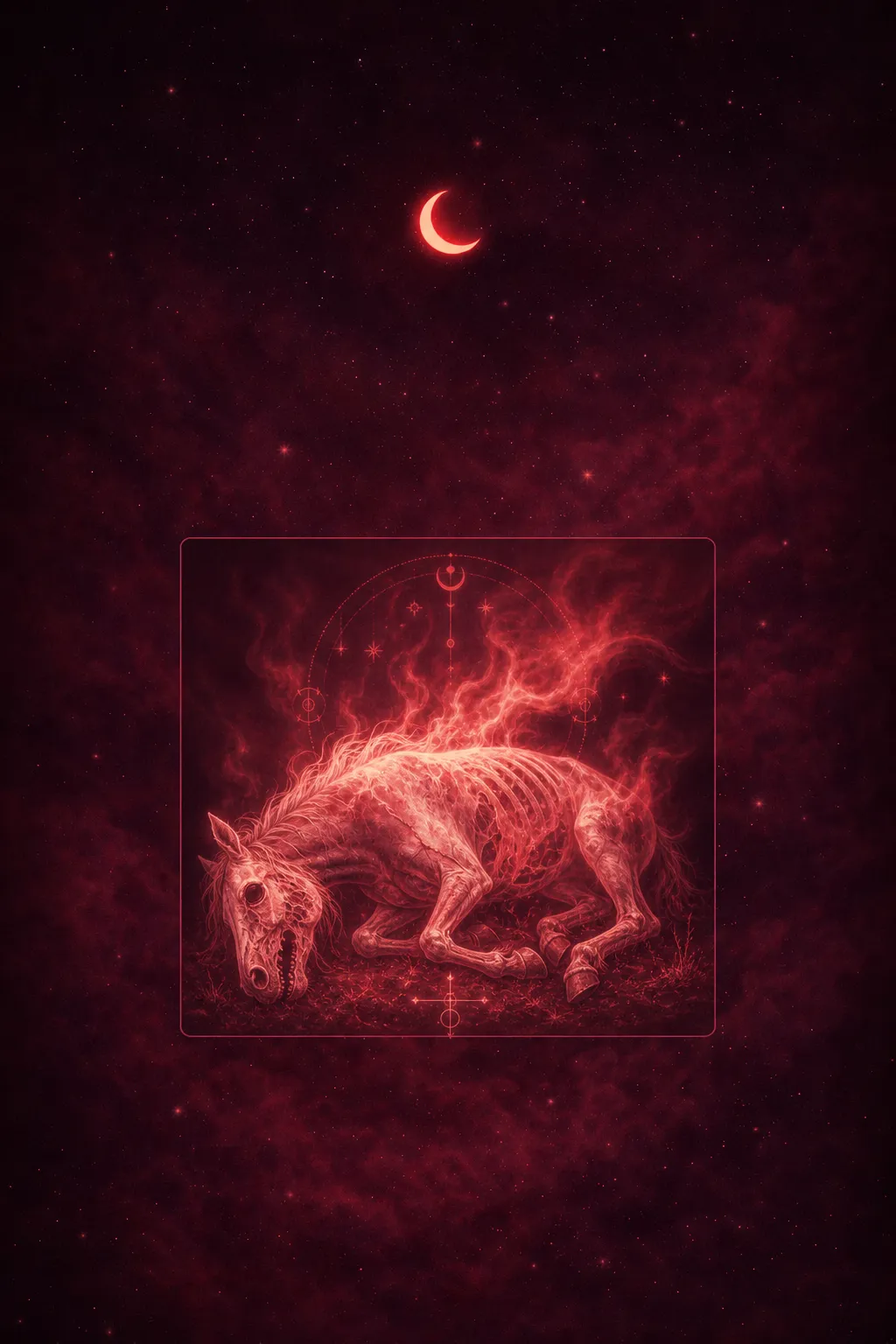

A dead horse in a dream meaning centers on wasted effort, missed opportunities, or a situation in your waking life that has run its course and can no longer be revived, urging you to release what no longer serves you and redirect your energy toward goals that still hold genuine potential for growth.
In under a minute you could read what your exact dream means for you, and see a picture of it. Free.
If they came to you in that dream, you already know it felt like more than a dream.
This page can't tell you what the visit meant for you. The free app gives you the warm, spiritual reading of your own dream — gently, in plain words.


A dream still on your mind? Get your personal reading.
Describe your dream in a line or two. In seconds you get a reading of your exact dream, a picture drawn from your own words, and every symbol explained.
Free. No sign-up. Takes 10 seconds. Your dream stays private.
0%
Analyzing your dream…
Something went wrong. Please try again in a moment.
Your dreams deserve more than a dictionary
Common Dead Horse Dream Scenarios and What They Mean
The specific way a dead horse appears in your dream shifts its meaning considerably. The most frequent scenario — simply stumbling upon a dead horse — tends to reflect a confrontation with something already over. You may already sense, on some level, that a project, relationship, or ambition has lost its momentum; the dream forces that recognition into plain sight. Similarly, if your own horse dies while you are riding it, the imagery is sharply personal: an abrupt halt to a direction you were actively pursuing, often surfacing when real-life stress around career stagnation or a collapsing plan is running high. At Dream Book we explore this symbol in depth.
- Beating or trying to revive a dead horse: The classic waking idiom plays out literally here. This scenario points to a refusal to accept a finished situation — pouring energy into something that can no longer deliver results, whether a fading relationship, a dead-end job, or an outdated goal.
- Watching a horse slowly weaken and die: A drawn-out, anxious dream that often mirrors real fears about gradual decline — eroding motivation, a relationship cooling over time, or health concerns quietly building.
- A field of many dead horses: Suggests a broader, systemic sense of collapse — wasted potential on multiple fronts, or a feeling that several areas of life have stalled at once.
- The dead horse revives: A rare but hopeful reversal. Renewed energy, a second chance, or a goal you had written off suddenly showing signs of life again.
Was yours a sign? Find out.
Across all variants, your emotional response inside the dream is a reliable guide: grief signals genuine loss, while calm or relief often hints that, deep down, you are ready to let go and redirect your drive.
What this dream could look like
Tap an image to open it full screen
Example images. Only you can see what you write in Dream Book.
The Psychological Reading: Drive, Depletion, and the Push to Let Go
From a psychological standpoint, a dead horse in a dream is a striking image of burnout. The horse represents the internal engine — ambition, momentum, creative energy — and its death signals that this engine has stalled. Psychologists recognize this as the subconscious surfacing what waking life often masks: that the effort you are pouring into a goal, role, or relationship is drawing on reserves that are already spent. Modern anxiety culture makes this pattern especially common; high achievers are conditioned to push harder precisely when stopping would serve them better, and the dreaming mind cuts through that conditioning bluntly.
There is also a grief dimension at work. The psyche often rehearses endings symbolically before the conscious mind is willing to accept them. A dead horse can stand in for a former identity, a chapter of life, or an attachment that has quietly closed — the dream inviting you to mourn it rather than revive it. If you experience yourself as the horse in the dream, the emotional charge tends to shift toward fear: a dread of losing vitality, freedom, or creative potency. That self-identification is worth sitting with, as it often points to a crisis of self-image rather than an external situation.
Across these readings, the psychological signal is broadly consistent:
But what does your version mean?
- Recognize depletion early — the dream flags exhaustion before it becomes collapse.
- Distinguish effort from investment — continued pushing may be a control response to anxiety rather than genuine progress.
- Treat the image as a release cue — the unconscious is nudging you to redirect energy toward something still alive.
General meanings end here. Read your own dream.
Describe your dream in a line or two. In seconds you get a reading of your exact dream, a picture drawn from your own words, and every symbol explained.
Free. No sign-up. Takes 10 seconds. Your dream stays private.
0%
Analyzing your dream…
Something went wrong. Please try again in a moment.
Your dreams deserve more than a dictionary
Every dream you log starts to connect.
Dream Book keeps your dreams in one place and reveals the threads between them over time — your private dream journal. Free to start.
Cultural Traditions and Folk Beliefs: The Dead Horse in Anglo Memory
In Anglo-American cultural tradition, no image lands quite as hard as the idiom "flogging a dead horse" — the act of pouring energy into something that has already failed beyond saving. When this phrase bleeds into dream imagery, it carries centuries of folk wisdom behind it: communities that depended on working horses understood viscerally that a dead animal meant a halted livelihood, a broken promise of motion. To dream of a dead horse, then, is to tap into a deeply embedded cultural memory about wasted effort and the stubbornness of refusing to accept an ending.
The horse also carries a distinctly American weight. Frontier mythology built an entire identity around the horse as a symbol of freedom, self-reliance, and forward momentum. In that cultural frame, a dead horse is more than personal loss — it is the collapse of an aspirational self-image. For many dreamers shaped by this heritage, the image quietly asks whether a cherished version of themselves — independent, driven, unstoppable — has quietly expired while they were not paying attention.
- Folk wisdom on futility: Traditional Anglo communities treated the dead horse as a blunt signal to cut losses and redirect resources rather than grieve indefinitely.
- Protestant work-ethic tension: A residual cultural belief that persistence is always virtuous can make accepting a "dead horse" moment feel like moral failure — when in reality it may signal healthy self-knowledge.
- Modern-anxiety echo: In an era defined by hustle culture and fear of falling behind, this dream symbol often surfaces as a pointed cultural corrective — a reminder that not every stalled effort deserves revival.
Spiritual Meaning: Release, Transition, and Sacred Endings
For dreamers with a Christian frame of reference, horse imagery carries unmistakable biblical weight. The pale horse of Revelation 6:8 — bound to death and consequence — can lend an almost prophetic gravity to this dream, though scripture-literate readers tend to receive it less as a literal omen and more as an urgent spiritual prompt: something in your life has run its course, and continuing to resist that truth puts you at odds with a larger unfolding. The invitation is not dread but discernment — a call to honest self-examination about where you are still clinging to a season God may already be closing.
Beyond biblical imagery, most spiritual traditions read death in dreams as transition rather than termination — the end of one form so another can emerge. Seen through this lens, the dead horse is not a punishment but a threshold. The driving force you have relied on — a vision, a relationship, a long-held identity — has completed its purpose. Spiritually, the dream challenges the very modern anxiety around control: the belief that effort alone should be enough to keep something alive.
A bad dream isn't a bad sign.
- Releasing surrendered will: letting go of outcomes you cannot force is framed in many traditions as an act of faith, not failure.
- Marking an ending with intention: spiritually honoring what a chapter gave you before moving forward.
- Trusting the transition: accepting that new momentum cannot arrive while you are still tied to what is spent.
Related Dream Meanings
nightmares
Death Dream Meaning: Transformation, Loss & Change
5 min read
nightmares
Funeral Dream Meaning: End, Loss & New Beginnings
5 min read
animals
Snakes Dream Meaning: Fear, Change & Hidden Threats
5 min read
nightmares
Prison Dream Meaning: Confinement, Freedom & Inner Struggle
5 min read
nightmares
Dead Fish Dream Meaning: Loss, Stagnation & Clarity
5 min read
nightmares
Dreaming of a Sword Meaning: What Your Dream Reveals
6 min read
nightmares
Dream of Being Attacked with a Knife: Meaning and Interpretation
6 min read
nightmares
Explosion Dream Meaning: Emotions, Change & Turmoil
5 min read
Practical Takeaways: What to Do After This Dream
A dead horse dream rarely arrives without reason. Before you move on, take a few honest minutes to ask yourself where, in waking life, you are still pushing hard on something that no longer has momentum. The anxiety of sunk costs — time, money, identity — can keep people locked in draining situations long after the warning signs appear. This dream is your mind's bluntest way of flagging that pattern.
- Name the dead horse. Write down one project, relationship, habit, or goal that you privately suspect is finished. Putting it on paper strips away the vague dread and makes the choice feel real and manageable.
- Audit your energy. Track where the bulk of your effort goes over the next week. If a significant portion flows toward something with no realistic return, that is your shortlist for what needs a hard conversation or a clean exit.
- Set a decision deadline. Control anxiety thrives on open loops. Give yourself a specific date — two weeks, one month — by which you will make a defined call: continue with a changed strategy, or let go entirely.
- Replace, don't just remove. Letting go of a spent goal leaves a motivational gap. Identify a new source of drive — a fresh project, a dormant skill, a relationship worth investing in — so forward momentum is restored rather than simply abandoned.
The dream is not a verdict; it is a prompt. Acting on it quickly, while the feeling is still vivid, is almost always more productive than waiting for circumstances to force your hand.
Was yours a sign? Find out.
Keep the ones that matter close.
The free app saves your most meaningful dreams and reads the signs across them — so a visit or a sign is never lost. Free to start.
People Also Ask
A dead horse typically symbolizes the end of something that once had great power or momentum in your life. It can represent a failed relationship, a lost opportunity, or an ambition that has run its course. The image urges you to stop investing energy in something that can no longer move forward.
Dreaming of a horse dying often signals a significant transition or loss. It may reflect the collapse of a major goal, the end of a partnership, or exhaustion from overexertion. Rather than purely negative, it can also mark necessary closure, clearing space for new beginnings and a healthier direction in your waking life.
Spiritually, a horse represents freedom, vitality, personal power, and the untamed life force within you. In dreams it often reflects your drive and passions. When alive and vibrant, it signals alignment with your purpose; when dead, it warns that your spiritual energy or personal drive may be depleted and in need of renewal.
Not necessarily. While unsettling, a dead horse dream is more a message than a curse. It highlights areas of life where you may be clinging to what no longer serves you. Interpreters often view it as a prompt to release outdated habits, relationships, or beliefs so genuine growth and forward momentum can return.
Curious what your dream would look like?