
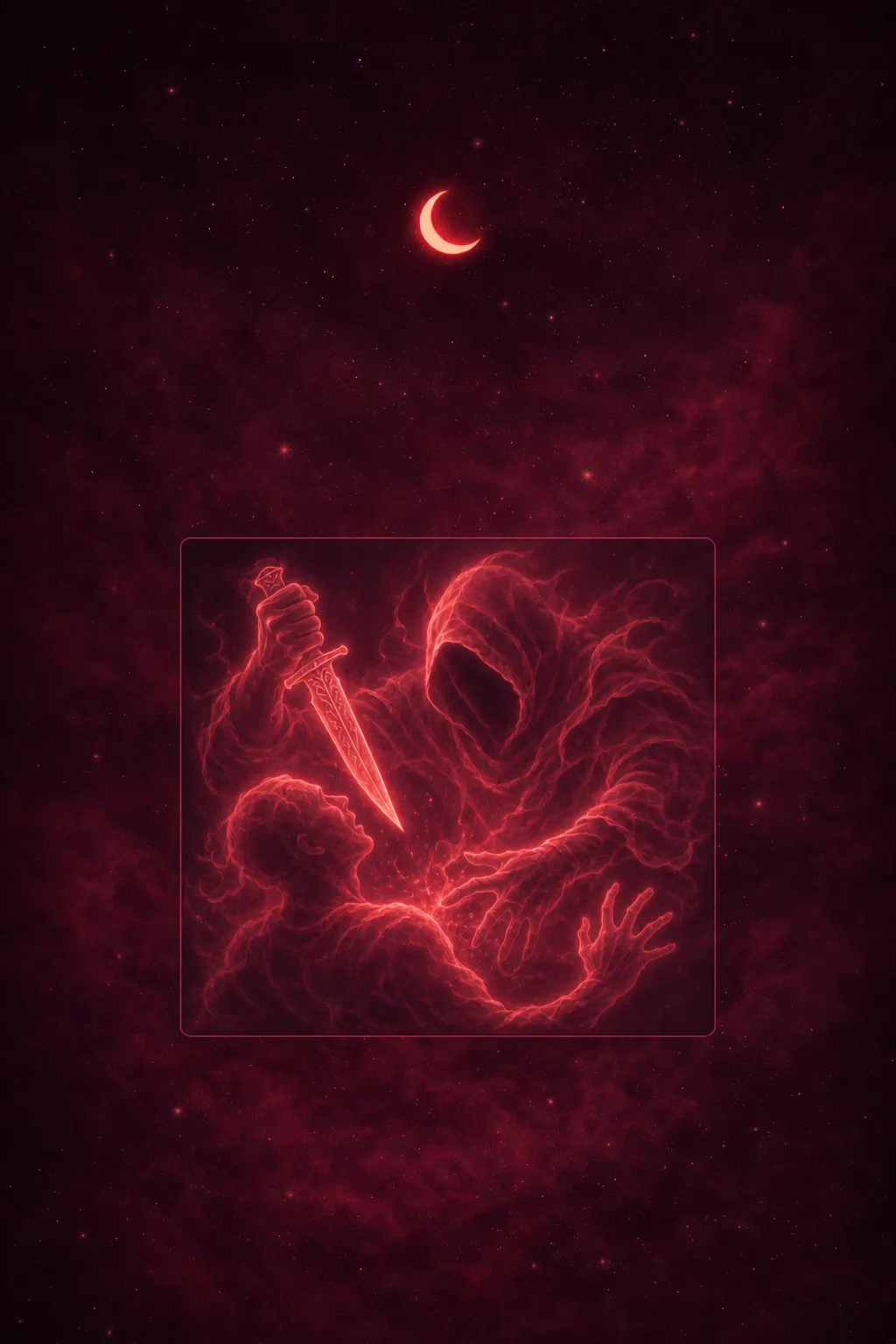

A dream of being attacked with a knife often reflects feelings of vulnerability, betrayal, or sharp emotional conflict in your waking life, symbolizing a threat—real or perceived—to your sense of security, identity, or relationships, and urging you to identify who or what is making you feel cornered, wounded, or powerless so you can confront that tension directly.
In under a minute you could read what your exact dream means for you, and see a picture of it. Free.
A dream still on your mind? Get your personal reading.
Describe your dream in a line or two. In seconds you get a reading of your exact dream, a picture drawn from your own words, and every symbol explained.
Free. No sign-up. Takes 10 seconds. Your dream stays private.
0%
Analyzing your dream…
Something went wrong. Please try again in a moment.
Your dreams deserve more than a dictionary
Common Knife-Attack Dream Scenarios and What They Mean
The identity of the attacker is often the most revealing detail. When a stranger comes at you with a knife, the threat has no clear face — a pattern that mirrors diffuse, modern stress where the pressure feels real but the source is hard to pin down. Much like dreams of being relentlessly chased, an anonymous assailant often represents an internal state — anxiety, overwhelm, or a sense of losing control — rather than any literal person. By contrast, when someone you know is holding the knife — a partner, coworker, or close friend — the dream is working through trust erosion or unspoken conflict. The classic "stabbed in the back" idiom is rarely accidental here; your sleeping mind may be flagging a relationship that feels unsafe, much as dreams of teeth falling out often signal fear of losing standing or trust in a close bond.
- You escape or survive the attack: Resilience is active. You retain agency under pressure, which is a constructive sign that your coping resources are engaged even when waking life feels overwhelming.
- You are cut or wounded and feel it: The emotional hurt has already landed. Where the wound lands on your body can reflect where you feel most vulnerable — a chest wound often points to heartbreak or grief; a back wound echoes betrayal.
- You watch someone else get attacked: This scenario centers helplessness or guilt — check whether you are carrying real concern for a specific person in your waking life who feels at risk.
- You cannot move or cry out: A high-distress marker signaling acute powerlessness, reminiscent of the frozen helplessness that appears in falling dreams. If this recurs, it is worth addressing the underlying waking stressor rather than waiting it out.
- You disarm or overpower the attacker: A shift toward empowerment. Confronting the threat directly in the dream often reflects a readiness — conscious or not — to face what has been avoided.
A bad dream isn't a bad sign.
Across all these variants, the central question is one of control: how much agency you retain inside the scenario tends to mirror how equipped you feel to handle the pressures shaping your waking life.
What a dream about being attacked with a knife could look like
Tap an image to open it full screen
Example images. Only you can see what you write in Dream Book.
What Your Psyche Is Processing
From a psychological standpoint, dreaming of a knife attack is your subconscious staging a crisis it cannot yet resolve while you're awake. The felt powerlessness in the dream maps almost directly onto waking states of overwhelm — a deadline that won't move, a relationship fracturing at the edges, a life change arriving faster than you can absorb it. Psychologists recognize this as the mind's threat-response system running a rehearsal: the attacker gives shapeless anxiety a body so the nervous system can at least react to something concrete. Other classic vulnerability dreams — like dreaming your teeth fall out or the stomach-dropping sensation of suddenly falling — operate on the same principle, converting diffuse dread into a scene the sleeping mind can process.
A second layer worth sitting with is internalized aggression. When the attacker carries no face you recognize, the figure may be a projection of your own unexpressed anger or self-critical voice — emotions that feel too dangerous to own while awake. Conversely, when the attacker is someone you know, the dream often signals a buried fear of betrayal; the "stabbed in the back" idiom exists for good reason, and the subconscious borrows it literally. Many people who carry a faith background find this reading resonant — Scripture repeatedly names the heart as the seat of hidden conflict, and these dreams can surface precisely what the waking mind has been reluctant to confess or confront.
- Control loss: The knife strips your defenses — ask where in waking life you feel similarly cornered or overmatched.
- Boundary exposure: Repeated knife-attack dreams often track periods of thin personal boundaries or persistent feelings of pursuit you haven't named yet.
- Severed connection: The cutting motion can symbolize a relationship or identity you fear losing abruptly.
- Suppressed anger: Notice whether the dream shifts — becoming the one holding the knife — as that reversal often signals anger turning inward rather than outward.
Every dream you log starts to connect.
Dream Book keeps your dreams in one place and reveals the threads between them over time — your private dream journal. Free to start.


Cultural and Folk Traditions Around Knife-Attack Dreams
In Anglo-American folk belief, sharp-edged weapons have long carried an omen of conflict and broken trust. The everyday idioms embedded in English-speaking culture quietly reinforce this: to be "stabbed in the back" is one of the most vivid shorthand phrases for betrayal, and dreaming of a knife attack often surfaces precisely when a waking relationship feels dangerously one-sided or dishonest. The related expression "twist the knife" captures how emotional wounds can be reopened, and dreamers who experience a repeated or drawn-out knife-attack dream may find the imagery mirrors a real-life situation where hurt is being compounded rather than healed — much as dreams of teeth falling out tend to spike during periods of social anxiety and loss of confidence.
But what does your version mean?
From a broadly Christian folk perspective, the knife can echo biblical imagery of spiritual trial and moral testing — a cutting away of what no longer serves. In this reading, surviving the attack in the dream carries quiet redemptive weight, suggesting the dreamer may be moving through a season of hardship toward greater clarity or self-knowledge. This sits comfortably alongside mainstream cultural assumptions that nightmares, however frightening, are the mind's way of processing unresolved pressure rather than literal prophecies of harm — a view shared by those who study death-related dreams as symbols of transition rather than literal endings.
- Betrayal scripts: Anglo culture's "stabbed in the back" idiom means knife-attack dreams are frequently linked to trust issues at work or in close relationships.
- Media influence: Saturation of crime and thriller narratives in film and news shapes the visual vocabulary many dreamers draw on, making knife imagery feel culturally loaded with urgency and danger.
- Self-defense awareness: Growing mainstream conversation around personal safety and boundaries means the dream can reflect a waking desire to regain a sense of control when life feels threatening.
Spiritual Meaning of a Knife-Attack Dream
Within a US Christian framework, dreaming of being attacked by a knife can feel less like random imagery and more like a vivid picture of spiritual warfare — the sense that unseen forces or toxic influences are pressing in on your peace. Ephesians 6:11–17 describes putting on the "armor of God" precisely because believers understood life as involving real spiritual assault. Waking up shaken from this dream may be an invitation to examine where you feel spiritually exposed or unguarded, whether through exhausting relationships, moral compromise, or simple burnout that leaves your inner defenses thin — much like the raw vulnerability that surfaces in dreams of teeth falling out.
Scripture also connects sharp blades directly to the power of words. Psalm 57:4 describes enemies whose "tongues are sharp swords," and that metaphor lands with surprising precision here: if someone in your life has been cutting you down with harsh criticism, gossip, or cruelty, your dreaming mind may translate that wound into a literal blade. This frames the knife not as a physical threat but as a spiritual one — the kind of harm that leaves you feeling perpetually on the run without ever seeing the source clearly. In a similar vein, some believers connect this imagery to the creeping dread found in dreams centered on death, where the dreaming self confronts mortality or loss of safety head-on.
Was yours a sign? Find out.
- Sense of spiritual attack: Consider whether prayer, community, or a reassessment of draining relationships might restore a sense of protection.
- Words as weapons: Reflect on whose speech has been wounding you — or whether your own words toward yourself have grown sharp and self-destructive.
- Call to self-knowledge: Spiritually, the dream may be less a warning than a prompt — an urge to name what is genuinely threatening your wellbeing and to reclaim some measure of intentional control over your inner life.
Related Dream Meanings

nightmares
Being Chased Dream Meaning: Anxiety & Avoidance
5 min read

body health
Teeth Falling Out Dream: Anxiety, Loss & Vulnerability
5 min read

common dreams
Falling Dream Meaning: Insecurity, Fear & Loss of Control
5 min read

nightmares
Death Dream Meaning: Transformation, Loss & Change
5 min read

nightmares
Dog Biting Me in Dream Meaning: Interpretation and Symbolism
6 min read

nightmares
Dead Grandmother Dream: Guidance, Grief & Hidden Feelings
5 min read

nightmares
Sleep Paralysis Dream Meaning: Helplessness & Anxiety
5 min read

nightmares
Zombies Dream Meaning: Fear, Anxiety & Overwhelm
5 min read
Practical Takeaways: What to Do After a Knife-Attack Dream
Because these dreams tend to spike during periods of real-life stress or strained relationships, your first move is a simple audit: rate your current pressure load honestly. Are deadlines, finances, or a difficult colleague quietly overwhelming your coping capacity? Writing down the answer — even a rough paragraph — can shift the threat from a vague, nameless dread (much like dreams of being relentlessly chased) into something concrete enough to address. Recurring threat imagery often clusters with other unsettling dreams — if you've also been experiencing dreams about your teeth falling out, that combination frequently signals a broader anxiety spike worth taking seriously.
Once you've named the stressor, focus on the control you do have rather than the control the dream stripped away. Small, deliberate actions rebuild that sense of agency:
- Identify the "attacker" in waking life. Is it a person, a situation, or your own unvoiced anger? Naming it removes some of its power.
- Set or reinforce a boundary. If the dream echoed betrayal at work or at home, choose one clear, calm boundary to communicate this week.
- Reduce physiological arousal before bed. Recurrent knife-attack dreams often fade when overall anxiety drops — try a consistent wind-down routine, limiting news intake, or a brief breathing exercise.
- Talk it through. Whether with a trusted friend, a pastor, or a therapist, voicing the dream out loud tends to shrink its emotional charge faster than replaying it alone.
A bad dream isn't a bad sign.
If the dreams recur frequently or leave you anxious well into the day, consider a few sessions with a counselor trained in stress or trauma — not because one nightmare is alarming, but because persistent threat imagery is your mind's way of signaling that something unresolved genuinely needs attention. Dreams of falling alongside violent imagery are another common pairing that counselors recognize as a stress cluster worth unpacking together.
If it keeps coming back, the app helps you understand the pattern.
Log each recurring dream and the free app shows you what's underneath — calmly, over time. Free to start.
People Also Ask
Knives in dreams typically symbolize conflict, division, or a need to cut away something harmful in your life. They can represent sharp words, betrayal, or emotional pain. Context matters greatly — a knife can also signal the need for decisive action, clarity, or severing ties with toxic people or situations.
Spiritually, being attacked in a dream often signals an inner battle between opposing forces — fear versus courage, or vulnerability versus strength. It may reflect external pressures threatening your sense of peace. Many traditions view such dreams as calls to strengthen boundaries, confront unresolved fears, or pay attention to people draining your energy. Dreams involving <a href="/dream-dictionary/fire/">fire</a> can carry a similar urgent, purifying spiritual message.
Spiritually, a knife represents duality — the power to protect or to harm. It symbolizes truth, as a blade can cut through deception. In many spiritual traditions, knives signify transformation and sacrifice. Dreaming of one may suggest you are being called to make a difficult but necessary cut in your waking life.
Dreaming of being chased with a knife usually reflects a threat you feel unable to confront in waking life. The pursuer often represents a person, emotion, or situation you are avoiding. Much like a classic <a href="/dream-dictionary/being-chased/">being chased dream</a>, it urges you to stop running and face what is causing you anxiety, as avoidance rarely resolves the underlying tension.
Curious what your dream would look like?