
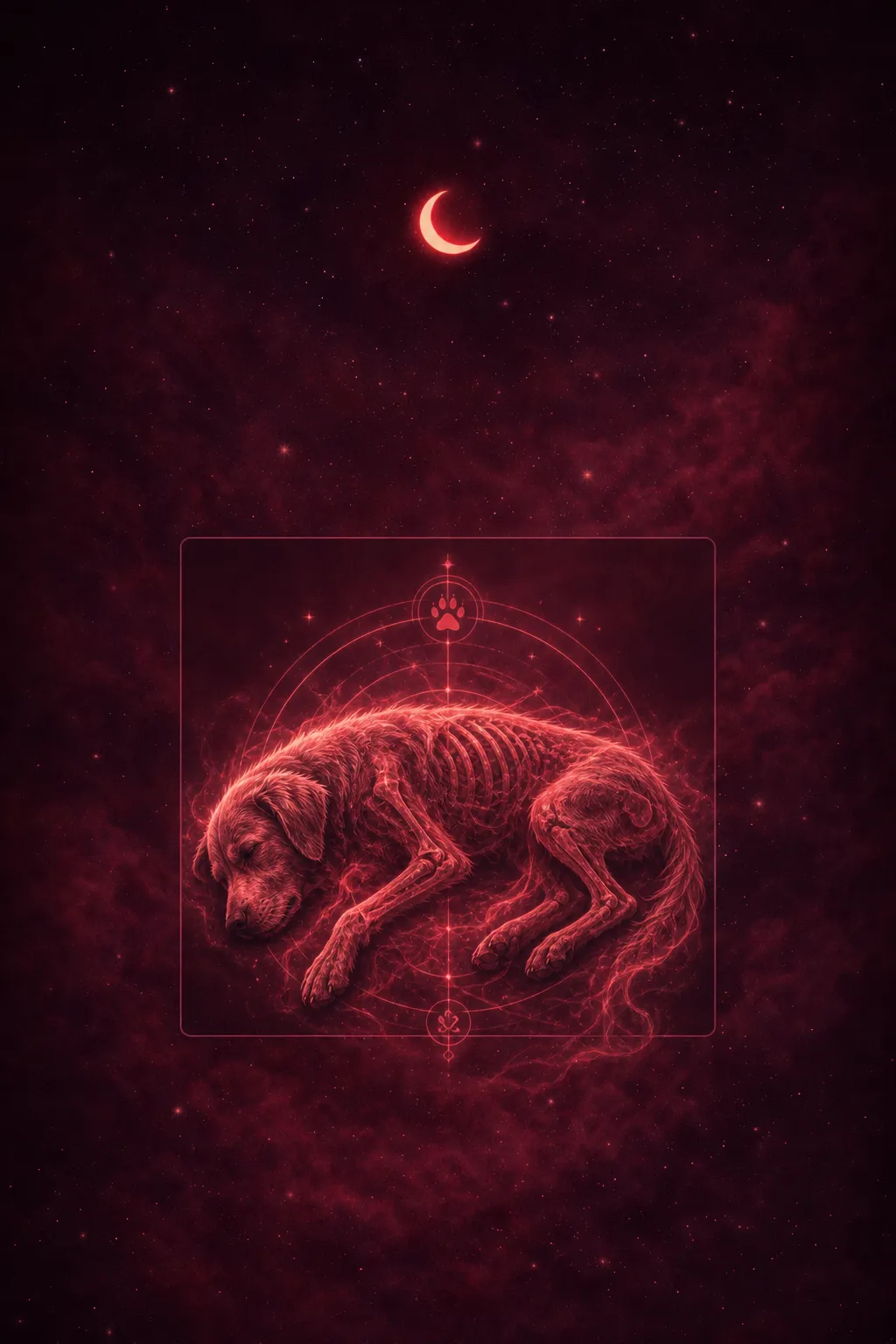

Dreaming of a dead dog often symbolizes the loss of a loyal relationship, the end of a friendship, or a significant emotional transition in your life. It can reflect grief you have not fully processed or a part of yourself — your trust, devotion, or protective instincts — that feels threatened. Rather than a literal omen, this dream usually invites you to examine which bonds or personal qualities need healing or renewal.
In under a minute you could read what your exact dream means for you, and see a picture of it. Free.
A dream still on your mind? Get your personal reading.
Describe your dream in a line or two. In seconds you get a reading of your exact dream, a picture drawn from your own words, and every symbol explained.
Free. No sign-up. Takes 10 seconds. Your dream stays private.
0%
Analyzing your dream…
Something went wrong. Please try again in a moment.
Your dreams deserve more than a dictionary
Common Dead Dog Dream Scenarios
Your Own Dog Dying in the Dream
When the dog in the dream is yours — one you know, one you love — the emotional weight lands differently. This dream often surfaces during periods of real-world change: a friendship cooling, a relationship ending, a version of your daily life disappearing. The dog represents devotion, and watching it die in a dream is your psyche's way of acknowledging that something devoted and familiar is gone.
If you've recently lost a pet in waking life, this is grief doing its work. But if your dog is alive and well, look at what the dog means to you specifically. Loyalty, protection, unconditional love — whatever quality you associate with that animal is the quality your subconscious is mourning.
Was yours a sign? Find out.
Finding a Dead Dog You Don't Recognize
Stumbling across a dead dog you've never seen before carries a different charge. You feel the weight of loss without the personal attachment, which often points to a more abstract grief — the death of an ideal, a belief, or a hope you didn't realize you were still carrying. It can also reflect a fear of abandonment, the sense that loyalty itself is fragile.
If you've been dreaming of dogs in other contexts too, consider the full picture. A strange dead dog can also appear when you're processing news about someone else's pain — a friend's breakup, a family member's illness — and your sleeping mind is mapping their loss onto a symbol it can hold.
A Dead Dog Coming Back to Life
This one cuts deep. The dog dies, and then it moves again — and the feeling is rarely clean relief. Dreams of resurrection often carry an uncanny quality, somewhere between joy and dread. This scenario tends to emerge when you're reconsidering something you thought was finished: an old relationship, a career path, a version of yourself you thought you'd left behind.
It can also be a visitation-adjacent dream, especially if the dog was a beloved pet who has genuinely passed. Many people report these dreams feeling different — more vivid, more settled — than ordinary nightmares. If you've experienced talking to the dead in dreams, you'll recognize that particular quality of presence.
Being Unable to Save a Dying Dog
You're there, you're watching, and you can't do anything. This scenario is one of the more distressing dead dog dreams precisely because it layers helplessness on top of grief. It points directly at guilt — the feeling that you should have done more, been more present, held on tighter to something that mattered.
It's worth asking what in your waking life feels like it's slipping away while you stand by. Sometimes this dream is less about loss and more about the fear of it — the anticipatory grief that comes before something actually ends. If death imagery is showing up frequently in your dreams, this is your nervous system processing something it finds genuinely threatening.
What a dream about a dead dog could look like
Tap an image to open it full screen
Example images. Only you can see what you write in Dream Book.
Psychological Interpretation
Freud would have looked at a dead dog dream and asked what the dog represents in your personal history — not the animal itself, but the emotional charge it carries. For Freud, death in dreams is rarely literal. It's the mind's way of expressing a wish, a fear, or a buried feeling that can't surface cleanly in waking life. The dog, as a symbol of loyalty and domesticity, often stands in for a relationship or a role you've accepted without question. Its death in the dream is the unconscious finally saying: this is over, or this needs to be.
Jung took a wider view. Dogs appear across the collective unconscious as symbols of instinct, guidance, and the boundary between the known and unknown worlds — in mythology, dogs guard the threshold between life and death. When a dog dies in a dream, Jung would see it as a signal from the Self that an instinctual part of your nature is being suppressed or has been lost. It's the kind of dream that appears during individuation, when you're being asked to integrate something you've been ignoring. If shadow work resonates with you, consider what the dog represents in terms of qualities you've disowned — protectiveness, unconditional love, raw loyalty.
But what does your version mean?
Calvin Hall's decades of content analysis across more than 50,000 dream reports found that animals appear in roughly one in three dreams, and that their deaths almost always correlate with feelings of helplessness or loss of control in the dreamer's waking life. He noted that the emotional tone of the dream — grief, relief, numbness — is often more diagnostically useful than the symbol itself. Ernest Hartmann, whose work focused on dreams as emotional memory processing, would say that the dead dog dream is your brain doing exactly what it's designed to do: taking a painful emotional experience and wrapping it in a metaphor that's safe enough to feel. The dream is the therapy.
Hobson and McCarley's activation-synthesis model offers a more neurological frame: the brain, during REM sleep, fires randomly and constructs a narrative from whatever emotional and memory fragments are most activated. If you've been carrying grief, guilt, or anticipatory loss, those are the emotional circuits most likely to fire — and a dead dog is one of the most emotionally resonant symbols your mind can assemble from them. The dream isn't random noise; it's your brain's best attempt at making meaning from a very real emotional signal. If dog biting dreams have also appeared recently, the two are often part of the same emotional thread — a relationship that felt safe becoming something that hurt you.
Every dream you log starts to connect.
Dream Book keeps your dreams in one place and reveals the threads between them over time — your private dream journal. Free to start.


Cultural & Spiritual Meaning
In Western traditions, dogs have long been associated with loyalty, protection, and the passage between worlds. Cerberus guards the underworld in Greek mythology; Anubis, the jackal-headed god of ancient Egypt, guides souls through death. A dead dog in a dream, in this frame, isn't just a loss — it's a threshold symbol. Something is crossing over, and you're being asked to witness it.
Ibn Sirin, the 8th-century Islamic dream interpreter whose work remains one of the most referenced in the tradition, interpreted dogs in dreams as symbols of enemies who are nonetheless loyal, or of a person in your life who serves you faithfully despite their flaws. A dead dog, in his reading, could signal the end of a conflict, the passing of a difficult person from your life, or the resolution of a long-standing tension. The death isn't necessarily a tragedy — it can be a release. This interpretation sits interestingly alongside the dead baby symbolism in the same tradition, where death in dreams often signals transformation rather than literal ending.
A bad dream isn't a bad sign.
In many Indigenous traditions across the Americas and parts of Asia, dogs are spirit guides and protectors of the home. A dead dog dream in these frameworks is taken seriously as a message from the spirit world — a warning to pay attention to your relationships, your home, or your own spiritual health. In Chinese folk interpretation, dreaming of a dead dog can signal the end of a difficult period, particularly one involving conflict or betrayal. The loss, paradoxically, carries the seed of relief.
Related Dream Meanings
animals
Dogs Dream Meaning: Loyalty, Protection & Friendship
5 min read
nightmares
Talking to Dead: Meaning and Interpretation
6 min read
nightmares
Death Dream Meaning: Transformation, Loss & Change
5 min read
nightmares
Dog Biting Me in Dream Meaning: Interpretation and Symbolism
6 min read
nightmares
Dead Baby Dream Meaning: Loss, Change & New Beginnings
5 min read
nightmares
Dead Pet Dream Meaning: Grief, Loss & Unresolved Emotions
5 min read
nightmares
Dead Relative: Meaning and Interpretation
5 min read
nightmares
Intruder in House: Meaning and Interpretation
5 min read
What to Do After This Dream
First, sit with the feeling before you chase the meaning. The emotional texture of a dead dog dream — whether it left you devastated, numb, or strangely peaceful — tells you more than any symbol alone. Write it down while it's fresh. Note what the dog looked like, whether you knew it, and what you felt in your body when you woke.
Ask yourself honestly: what relationship, habit, or part of your identity feels like it's ending right now? Dead dog dreams rarely arrive without a real-world anchor. If you've been avoiding a difficult conversation, delaying a decision, or grieving something you haven't let yourself fully grieve, this is your subconscious handing you the bill.
If the dream keeps returning, that repetition is worth paying attention to. Recurring death imagery — especially involving animals you love — is your psyche's way of insisting that something unresolved needs your attention. You might also find it useful to look at connected symbols: dead pet dreams share a lot of emotional territory, and dead relative dreams often carry the same undertone of unfinished grief.
If you want to go deeper than a dictionary can take you, Dream Book lets you describe your dream in detail and ask follow-up questions — so the interpretation reflects your specific dog, your specific loss, your specific life. The symbol is just the door. What's behind it is yours.
Was yours a sign? Find out.
Understanding your dead dog dream is the first step. The next is asking what it means for your life right now — that's where a personalized interpretation goes deeper than any dictionary.
Keep the ones that matter close.
The free app saves your most meaningful dreams and reads the signs across them — so a visit or a sign is never lost. Free to start.
People Also Ask
Dreaming about a dog that has actually passed away often reflects grief that's still being processed, or a longing for the comfort and loyalty that animal represented. These dreams can also be what many people describe as visitation experiences — vivid and emotionally settled in a way that feels different from ordinary nightmares.
Not necessarily. While the dream can signal loss or the end of something meaningful, many cultural traditions — including Islamic dream interpretation — see a dead dog as a sign that conflict or difficulty is coming to an end. The emotional tone of the dream is usually your best guide to whether it carries a warning or a release.
Recurring dreams of a dog dying usually point to unresolved grief, guilt, or a fear of losing something you love. Your subconscious repeats the scenario until the underlying emotion is acknowledged and processed. It's worth reflecting on what in your waking life feels fragile or already lost.
Across many spiritual traditions, dogs represent loyalty, protection, and the threshold between worlds. A dead dog in a spiritual context often signals the end of a chapter — a relationship, a phase of life, or a belief system — and an invitation to cross into something new.
Curious what your dream would look like?