
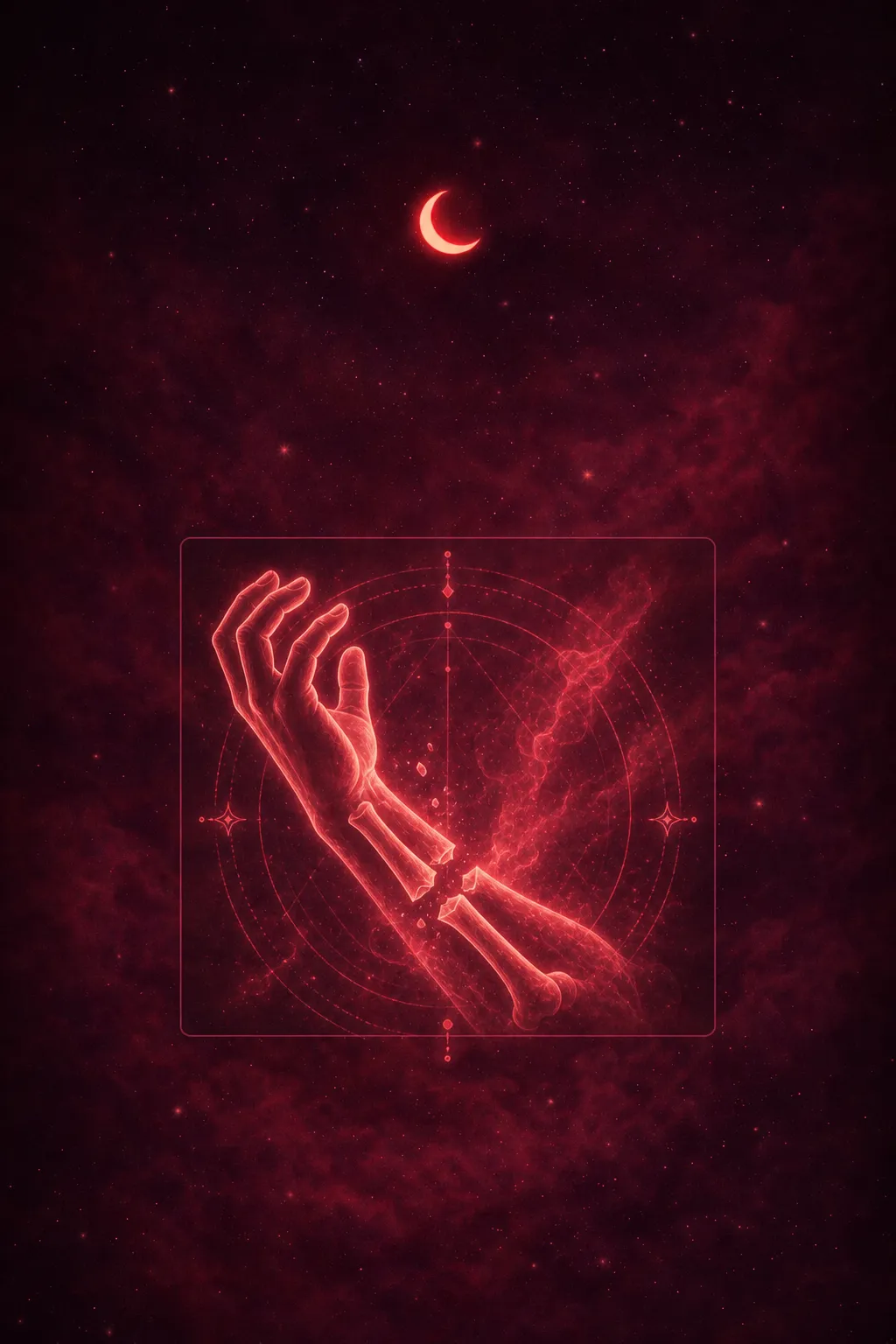

Dreaming about a broken arm typically means you feel weakened, limited, or unable to take action in some area of your waking life, often reflecting a loss of capability, a fear of helplessness, or unresolved emotional pain that is preventing you from reaching out, creating, or asserting yourself with full confidence.
In under a minute you could read what your exact dream means for you, and see a picture of it. Free.
A dream still on your mind? Get your personal reading.
Describe your dream in a line or two. In seconds you get a reading of your exact dream, a picture drawn from your own words, and every symbol explained.
Free. No sign-up. Takes 10 seconds. Your dream stays private.
0%
Analyzing your dream…
Something went wrong. Please try again in a moment.
Your dreams deserve more than a dictionary
Common Dream Scenarios Involving a Broken Arm
The specific details of a broken-arm dream shift its meaning considerably. When it is your own arm that is broken, the dream most often reflects a felt loss of personal agency — the sense that you are no longer able to carry your current workload or responsibilities on your own. In today's high-pressure culture this frequently surfaces during burnout or job strain, your sleeping mind flagging that something has to give. If the arm is useless or impossible to move, the imagery tilts toward paralysis: a goal feels stalled, a deadline is slipping, and forward momentum has collapsed — an experience closely related to dreaming of being unable to move. When the break falls specifically on the dominant or right arm, the loss feels sharper still — your chief means of getting things done is compromised, pointing to anxiety about losing a key role, resource, or person you rely on heavily, much as dreams focused on the hands often signal worries about competence and control.
- Someone else's arm is broken: Worry about a person in your care; guilt over feeling unable to protect or support them — caregiver strain made visual.
- Arm in a cast, already healing: A more hopeful signal — limitation is acknowledged and recovery is underway, but the dream may be nudging you to accept help and pace yourself rather than push through alone.
- Witnessing the moment of the break: Sudden shock and abrupt loss of control; often tied to fear of unexpected setbacks or rapid change disrupting a stable situation.
- A child's arm is broken: Protective anxiety at its most acute — a fear of failing to shield someone vulnerable, or a sense that your control over their safety is slipping.
But what does your version mean?
Across all these variants, the common thread is a tension between what you feel you should be able to handle and what your current capacity actually allows — a gap that waking life pressure tends to widen.
What this dream could look like
Tap an image to open it full screen
Example images. Only you can see what you write in Dream Book.
Psychological Meaning of a Broken Arm in Dreams
From a psychological standpoint, dreaming of a broken arm cuts straight to the subconscious mind's relationship with control and competence. The arm is the body's primary instrument of action — reaching, building, holding, protecting — so a fracture in dream space typically signals that some part of the psyche feels overwhelmed, overextended, or forcibly stopped. Mainstream psychology frames this as a disruption to self-efficacy: the inner belief that you can handle what life is demanding of you right now.
Modern anxiety culture adds a sharper edge to this reading. In an era of always-on productivity and relentless responsibility, the dreaming mind may stage a broken arm as a blunt message: you cannot keep pushing at this pace. Rather than a warning of literal injury, it is the subconscious dramatizing exhaustion, signaling that something must give before something truly breaks. For those with a faith background, this forced pause can carry a quieter undertone — a reminder that human strength has limits and that leaning on others, or on something greater than oneself, is not weakness but wisdom.
Key psychological themes to reflect on after this dream include:
Was yours a sign? Find out.
- Helplessness and frustration — Are you in a situation where your effort feels blocked or ineffective?
- Anxiety about dependence — Does asking for help feel threatening to your sense of identity?
- Forced transformation — Bones that break can heal stronger; the unconscious may be framing disruption as necessary growth.
- Vulnerability as insight — Acknowledging limits is often the first step toward genuine self-knowledge.
Every dream you log starts to connect.
Dream Book keeps your dreams in one place and reveals the threads between them over time — your private dream journal. Free to start.


Cultural and Traditional Readings of a Broken Arm Dream
Across Western folk tradition, the arm has long symbolized strength, productivity, and one's ability to provide — values deeply embedded in cultures that prize self-reliance and hard work. A broken arm in a dream was historically read as a warning: something in your waking life is about to demand more than you can deliver alone. In broadly Christian-influenced communities, the image sometimes carries a humbling undertone, echoing the biblical theme that human strength is finite and that seasons of forced rest can redirect a person toward reflection and renewed purpose rather than relentless striving. Folk traditions also linked arm-injury dreams to broader bodily omens; dreams about broken or fragile bones in general were taken as signals that the dreamer's foundations — physical, financial, or relational — needed urgent attention.
Modern folk psychology has absorbed these older ideas and reframed them through a stress-and-control lens. When life feels like an endless series of demands — career pressure, financial responsibility, family obligations — the broken arm becomes a culturally legible shorthand for burnout. Many people instinctively describe overwhelming periods by saying their hands are tied or they simply can't handle any more, and the dream literalizes exactly that idiom. Dreams about feeling paralyzed or unable to move carry a similar cultural charge, suggesting the mind is processing a real loss of forward momentum.
- Folk warning sign: Traditional belief often treated injury dreams as prompts to slow down before real harm arrived.
- Dependence and pride: Cultural anxiety around needing others' help gives the broken arm extra emotional weight in individualistic societies.
- Forced pause as gift: Some faith-based traditions reframe the symbol positively — a necessary interruption that restores perspective and humility.
Spiritual Meaning of a Broken Arm in Dreams
In biblical imagery, the arm is one of Scripture's most direct symbols of strength and sovereign power — phrases like "the arm of the Lord" appear throughout the Old Testament as shorthand for divine might and intervention. When a broken arm surfaces in a dream, a spiritually oriented reading sees that fracture as a pointed reminder that human strength has limits. Rather than a purely negative omen, many Christian traditions interpret this kind of dream as an invitation: a moment where self-reliance cracks open just enough to let faith enter. The forced helplessness that dominates a broken-arm dream mirrors a consolation theme found across mainstream Christian teaching — that weakness, however uncomfortable, can redirect trust away from personal capacity and toward something larger than the self.
A bad dream isn't a bad sign.
This reading resonates especially well with modern-anxiety pressures around control and productivity. When life feels like a constant demand to perform, hold everything together, and never drop the load, a dream of a broken arm may function spiritually as a kind of enforced surrender — the psyche and spirit collaborating to signal that pushing harder is not the only path forward. Much like the experience of paralysis in dreams, the image strips away the illusion of total self-sufficiency. Even the vulnerability of dreaming about broken or failing body parts carries a similarly humbling spiritual charge — a reminder that control is, at best, partial.
- Humbling and growth: A broken arm can symbolize a season of being brought low before a renewal of genuine strength.
- Shifting reliance: The dream may prompt reflection on where you place your ultimate trust when your own abilities fall short.
- Forced rest as grace: Spiritually, the pause imposed by injury is sometimes framed as necessary stillness rather than failure.
Related Dream Meanings
nightmares
Paralysis Dream Meaning: Helplessness & Loss of Control
5 min read
body health
Hands Dream Meaning: Creativity, Control & Connection
5 min read

body health
Bones Dream Meaning: Strength, Mortality & Hidden Truths
5 min read

body health
What Does It Mean to Have a Headache in a Dream
5 min read
body health
Giving Birth in Dreams: Meaning and Interpretation
5 min read

body health
Teeth Falling Out Dream: Anxiety, Loss & Vulnerability
5 min read
body health
Pregnancy Dream Meaning: Creativity & New Beginnings
5 min read

body health
Hair Dream Meaning: Identity, Growth & Change
5 min read
What to Do After a Broken-Arm Dream
Rather than brushing the dream off, treat it as useful feedback from your own mind. A broken-arm dream almost always surfaces when real-life demands are outpacing your capacity — so the first practical step is an honest audit of your current load. Write down every commitment, project, or responsibility sitting on your plate and ask which ones you are genuinely equipped to handle alone right now.
- Identify the pressure point. Pinpoint one specific area — work, finances, a relationship — where you feel least in control. The dream is rarely about everything at once; it tends to flag one primary stressor.
- Practice deliberate delegation. If a sense of being stuck or unable to act keeps recurring in your dreams, it may be a signal to actively hand off tasks rather than waiting until you are overwhelmed.
- Set a realistic boundary this week. Choose one obligation to scale back or decline. The broken arm is your subconscious urging a pause — build that pause in consciously before life forces one on you.
- Notice patterns in related dreams. Recurring images of losing control over your body alongside a broken arm point to a broader anxiety cluster worth paying attention to.
- Talk it through. Share the pressure you are carrying with a trusted friend, colleague, or counselor. Dependence is not weakness; the dream itself is pointing you toward that lesson.
But what does your version mean?
Think of the dream less as a warning and more as a check-engine light — it does not predict disaster, but it does ask you to slow down, assess what is straining under the surface, and make one small, concrete adjustment before the stress compounds further.
One dream is never the whole picture.
The free app remembers your dreams, draws them, and connects the threads over time — so the next one means even more. Free to start.
People Also Ask
Spiritually, a broken arm often signals a loss of personal power or an inability to act on your goals. It may suggest you feel blocked from giving or receiving help. Some traditions view it as a call to rest, reassess your direction, and allow yourself time to heal before moving forward again.
Seeing yourself injured in a dream typically reflects emotional vulnerability, self-doubt, or a situation in waking life that has left you feeling weakened. It can point to unresolved stress or fear of failure. Rather than a literal warning, it usually asks you to acknowledge where you feel hurt and need support.
Dreaming of breaking a bone suggests that something you rely on for stability has been compromised. Bones represent core structure and strength, so a break can symbolize a shattered plan, a relationship under strain, or a confidence crisis. It often encourages you to examine what foundational area of your life needs attention and rebuilding.
Arms in dreams generally represent your ability to take action, reach your goals, and connect with others. A healthy arm signals capability and confidence, while a damaged or restricted arm suggests frustration, helplessness, or feeling cut off from opportunities. Pay attention to which arm appears, as left and right can carry different symbolic meanings.
Curious what your dream would look like?