
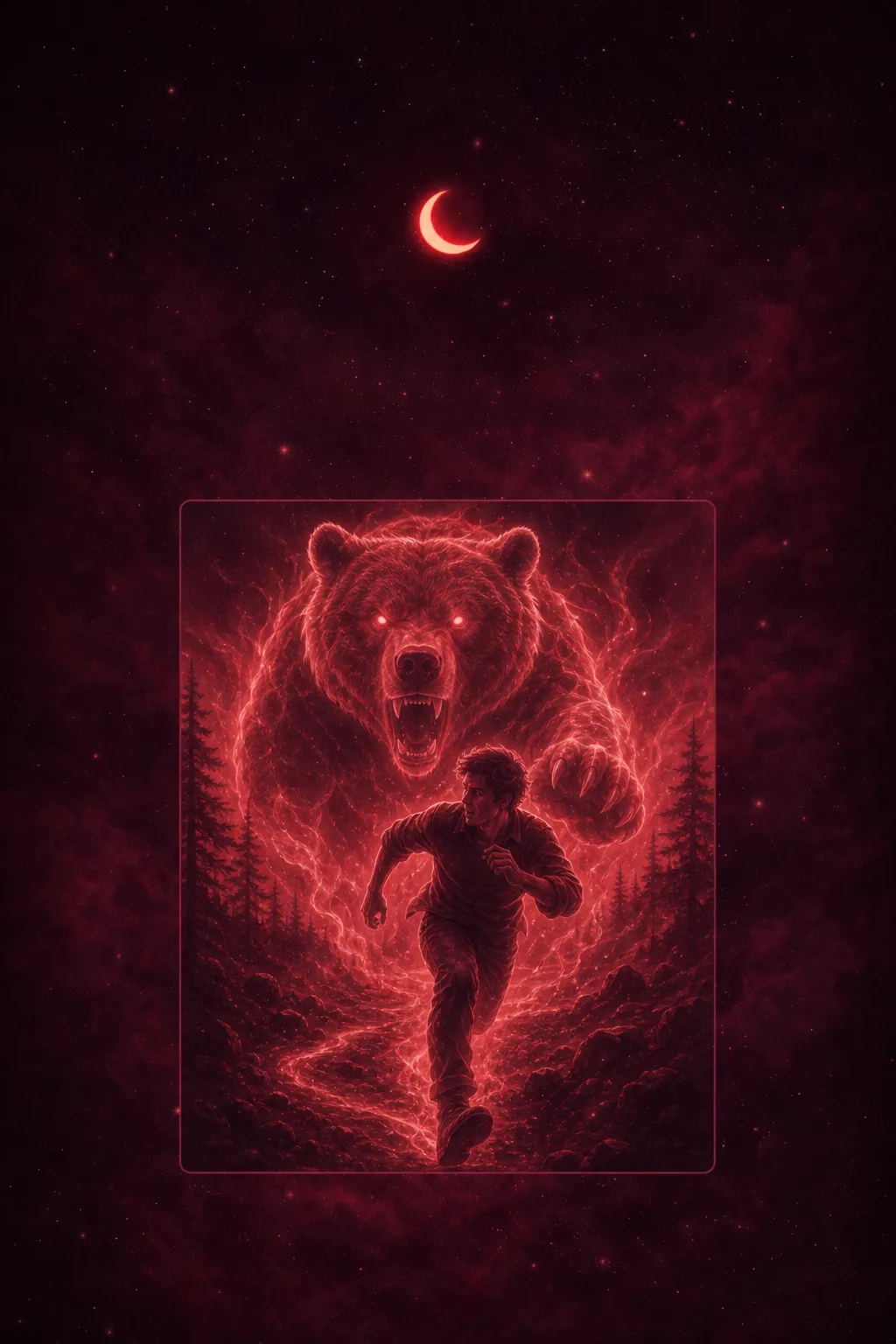

Dreaming about being chased by a bear typically means you are avoiding a powerful threat, overwhelming emotion, or intimidating person in your waking life, as the bear symbolizes raw fear or aggression you feel unable to confront, urging you to face rather than flee whatever challenge or situation is causing you significant anxiety and stress.
In under a minute you could read what your exact dream means for you, and see a picture of it. Free.
Bad dream? See exactly what you dreamed — turned into a picture.
Just describe it and Dream Book paints your dream as a real image, plus a reading of what it means for you. Free, and it takes under a minute.


Common Bear-Chase Dream Scenarios
The specific details of the chase shape its meaning considerably. In the most frequent version — running, hiding, or barely slipping away — the dream mirrors a waking-life pressure the dreamer is actively dodging: a difficult conversation, a mounting deadline, or an emotion that feels too large to sit with. Much like classic chase dreams, the bear variant amplifies that avoidance with a sense of raw, natural power that cannot be reasoned with or outrun for long. The dread can feel as visceral as falling dreams, where the body registers lost control before the mind catches up. At Dream Book we explore this symbol in depth.
- The bear catches or attacks you: The avoided problem has finally "landed." This scenario often signals that a confrontation is reaching a breaking point in waking life — note whether you feel injured and helpless or whether you survive, since survival hints at hidden resilience.
- You stop running and face the bear: A meaningful shift. Turning to confront the bear — even if frightening — typically feels empowering upon waking and suggests a growing readiness to tackle whatever pressure you have been sidestepping.
- You are protecting children or loved ones: Caregiver anxiety takes center stage here. The dreamer fears failing those in their care when a large, uncontrollable threat closes in — common during periods of family stress or financial uncertainty.
- The bear circles your home or tries to get inside: The threat is testing a boundary — your privacy, your domestic security, or your personal space. Something feels like it is encroaching on your safe zone, echoing the helpless paralysis of being unable to move when danger presses close.
- Multiple bears pursue you: Compounding pressures are ganging up simultaneously, leaving the dreamer feeling outnumbered and without a clear path forward.
What this dream could look like
Tap an image to open it full screen
Example images. Only you can see what you write in Dream Book.
Psychological Reading: The Bear as Mirror of Avoidance and Inner Pressure
From a psychological standpoint, being chased by a bear is the sleeping mind's threat-simulation at full volume. When waking stress — a suffocating workload, financial instability, or a relationship that feels like it's closing in — exceeds what feels manageable, the brain stages a literal pursuit. The bear's sheer size translates the dreamer's sense of powerlessness: this isn't a problem you can outrun or reason with, and your unconscious knows it. Much like other chase dreams, the flight response itself is the real message — the dreamer is postponing something rather than facing it. That same paralysis surfaces in dreams of being unable to move, where the body enacts what the mind already feels: frozen in the face of something overwhelming.
A bad dream isn't a bad sign.
The identity of the pursuer deserves closer attention. Bears carry a striking psychological duality: the ferocious predator and the fiercely protective mother-bear exist in the same animal. That tension can reflect an ambivalent relationship with a dominant figure — a controlling parent, an overbearing boss — whose care and threat feel inseparable. Alternatively, Jungian-influenced thinking suggests the bear may be the dreamer's own suppressed anger or aggression, externalized and given claws. In that reading, being chased is being confronted by a part of yourself you've refused to acknowledge — not unlike the way snake dreams often surface hidden fears or instincts the conscious mind would rather ignore.
- Avoidance signal: fleeing rather than fighting points to a problem being actively postponed in waking life.
- Projected emotion: the bear may embody internalized rage, grief, or shame the dreamer hasn't owned.
- Control anxiety: modern stressors — debt, health fears, job insecurity — often manifest as a predator that feels too large and too fast to escape.
- Caregiver ambivalence: the nurturing-yet-threatening bear can mirror conflicted feelings toward a protective but controlling relationship.
General meanings end here. Read your own dream.
Describe your dream in a line or two. In seconds you get a reading of your exact dream, a picture drawn from your own words, and every symbol explained.
Free. No sign-up. Takes 10 seconds. Your dream stays private.
0%
Analyzing your dream…
Something went wrong. Please try again in a moment.
Your dreams deserve more than a dictionary
Cultural and Traditional Readings of Being Chased by a Bear
Across Western folk tradition, the bear has long occupied a dual role: a symbol of raw, untameable power and, paradoxically, of dormant strength waiting to be awakened. In North American frontier culture, encountering a bear was among the most visceral tests of nerve a person could face, and that cultural memory has seeped into the dream imagery many people carry today. Traditional dream almanacs from the 18th and 19th centuries frequently listed bear-chase dreams as omens of a powerful adversary or a situation about to demand more courage than the dreamer felt they possessed — a reading that maps neatly onto modern anxieties about losing control at work, in relationships, or over one's own emotional life. Interestingly, these almanacs placed bear-chase imagery alongside other pursuit nightmares involving spiders, noting that all such dreams pointed to a threat the sleeper had not yet brought into the open.
But what does your version mean?
Within a broadly Christian folk framework, the bear occasionally appears as a figure of divine testing — a trial sent to reveal hidden weakness or to prompt the dreamer toward growth through confrontation rather than flight. This reading encourages a moment of honest self-examination: what is the bear standing in for, and why does running feel like the only option? That question is also central to being chased dreams more broadly, where folklore across cultures consistently frames the pursuer as something the dreamer has refused to acknowledge.
- Power and threat: Folk traditions associate bears with authority figures, overwhelming life pressures, or unresolved anger — forces that feel too large to confront head-on.
- Avoidance as warning: Many folk interpreters read the act of fleeing as the dream's central message: the chase continues until the dreamer turns and faces what pursues them.
- Modern resonance: Today's stress culture amplifies these older readings — the bear often stands for deadline panic, social anxiety, or the fear of losing control over outcomes that matter most.
Spiritual Meaning: A Trial Calling for Faith Over Flight
In the Christian tradition, the bear is never a neutral creature. Scripture deploys it as an instrument of danger and divine reckoning — David wrestles one to prove his readiness for Goliath (1 Samuel 17), and the bears in 2 Kings 2:24 arrive as agents of judgment. For believers who hold that dreams can carry spiritual weight, being chased by a bear may read less as random nightmare imagery and more as an invitation: stop fleeing and face the trial in front of you. The very act of running, in this frame, reflects a lack of trust that the threat can be met — a spiritual posture worth examining in waking life. This parallels the dread found in dreams touched by mortality and loss, where avoidance of a hard truth only deepens the unease.
Was yours a sign? Find out.
Beyond the biblical lens, the bear carries a broader archetypal charge as a symbol of raw, dormant power. Being chased by that power can signal that something inside the dreamer — a suppressed conviction, an unacknowledged calling, or an unresolved moral tension — is demanding attention rather than avoidance. In that reading, the dream functions as a kind of soul-level alarm: what are you refusing to turn around and confront? A similar dynamic appears in dreams of being frozen and unable to move, where the body's paralysis mirrors the soul's refusal to act.
Taken together, both frames point in the same direction: genuine self-knowledge begins the moment the flight stops. Whether the bear represents a divine trial, an unintegrated part of the self, or the weight of a moral decision being deferred, the spiritual counsel is consistent — courage and honest reckoning offer a path through that avoidance alone cannot.
Related Dream Meanings
nightmares
Being Chased Dream Meaning: Anxiety & Avoidance
5 min read

nightmares
Being Unable to Move: Meaning and Interpretation
5 min read
animals
Snakes Dream Meaning: Fear, Change & Hidden Threats
5 min read
animals
Spiders Dream Meaning: Fear, Creativity & Entrapment
5 min read

nightmares
Death Dream Meaning: Transformation, Loss & Change
5 min read

nightmares
What Does It Mean to Eat Poop in a Dream - Dream Interpretation
6 min read

nightmares
Water Rising Dream Meaning: Overwhelm, Emotion & Change
5 min read

nightmares
Afterlife Dream Meaning: Closure, Loss & the Unknown
5 min read
Practical Takeaways: Turning the Chase Into a Cue for Change
Because bear-chase dreams tend to spike during periods of genuine overload, the most useful first step is naming the pressure you have been sidestepping. Grab a notebook the morning after the dream and answer one blunt question: What am I avoiding right now? It might be a conversation you keep postponing, a financial decision you are not ready to make, or anger you have been swallowing. Getting it out of your head and onto paper strips away some of its size — much the way the bear in the dream feels enormous partly because you never stop running long enough to look at it clearly.
A bad dream isn't a bad sign.
- Map the threat honestly. Is the pressure coming from outside (a demanding boss, a strained relationship) or from inside (self-criticism, anxiety about the future)? The answer changes what you do next.
- Pick one small confrontation. You do not have to resolve everything at once. Choose the smallest version of the avoided situation and act on it within 48 hours — a brief email, a short honest conversation, one overdue task completed.
- Notice your stress baseline. Recurring chase dreams are often a signal that everyday anxiety has quietly climbed too high. Sleep quality, screen time before bed, and workload are practical levers worth adjusting. If the dream shifts into being unable to move, that is a sign the sense of powerlessness has deepened and deserves closer attention.
- Watch for companion symbols. Bear-chase dreams sometimes arrive alongside imagery of sudden loss of ground — a cluster worth noting in your journal, as it often points to a broader fear of losing control rather than one isolated stressor.
- Reframe control. You cannot always remove the pressure, but you can shift from passive avoidance to deliberate choice — which is the psychological difference between being chased and deciding to stand your ground.
If it keeps coming back, the app helps you understand the pattern.
Log each recurring dream and the free app shows you what's underneath — calmly, over time. Free to start.
People Also Ask
Not at all. Bear chase dreams rarely signal real danger. They typically reflect internal pressures — stress, avoidance, or unresolved emotions. Think of the bear as a messenger urging you to face something you've been running from. Recognizing the symbolic meaning can actually bring relief and valuable self-awareness.
Bears commonly symbolize raw power, instinct, protection, and primal emotions. They can represent an overwhelming person or situation in your waking life, or even a forceful part of your own personality. In many traditions, bears also symbolize introspection, maternal energy, and the need to set stronger personal boundaries.
It can be surprisingly positive. While frightening in the moment, a bear in a dream often signals strength and transformation. Being chased suggests you are becoming aware of a powerful force in your life. Facing that energy rather than fleeing is frequently the first step toward growth and resolution.
A grizzly bear amplifies themes of dominance, aggression, and overwhelming challenge. Being chased by one often points to a particularly intimidating situation or authority figure you feel unable to confront. It may also reflect your own suppressed rage or fierce protective instincts demanding acknowledgment and healthy expression in waking life.
Curious what your dream would look like?