
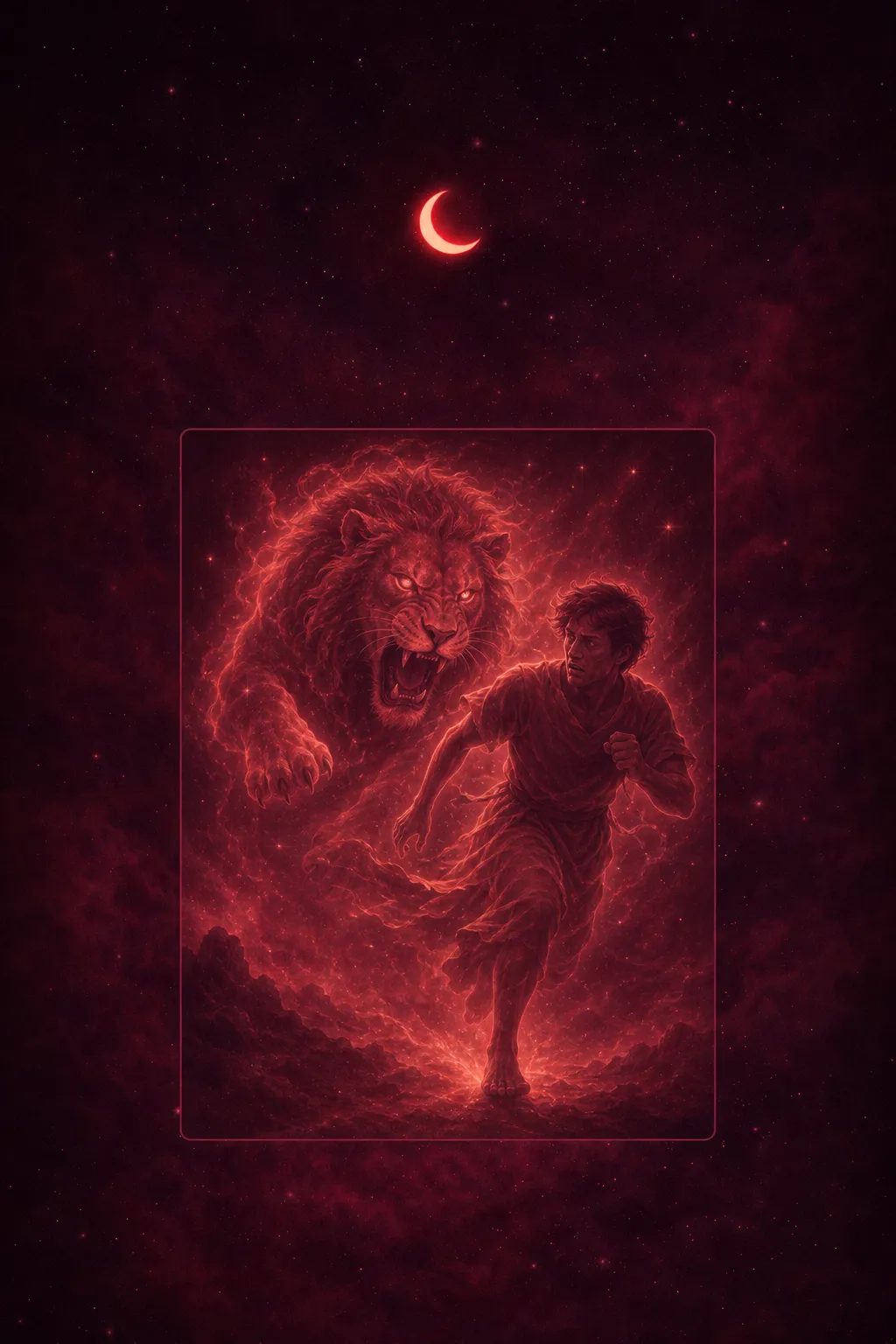

Dreaming about being chased by a lion typically signals that you are avoiding a powerful source of fear, pressure, or aggression in your waking life — whether an intimidating person, an overwhelming responsibility, or a fierce aspect of your own nature that you have yet to confront and integrate.
In under a minute you could read what your exact dream means for you, and see a picture of it. Free.
Bad dream? See exactly what you dreamed — turned into a picture.
Just describe it and Dream Book paints your dream as a real image, plus a reading of what it means for you. Free, and it takes under a minute.


Common Dream Scenarios: Being Chased by a Lion
The most frequent version — running but never escaping — reflects an unavoidable stressor you keep pushing aside. Much like the classic being-chased dream, the harder you flee, the larger the threat looms, mirroring how deferred responsibilities compound under modern pressure. If you wake up mid-sprint, ask yourself what deadline, relationship conflict, or career demand you have been putting off. At Dream Book we explore this symbol in depth.
- Hiding while the lion prowls nearby: You are aware of the threat but not yet ready to engage it. This acute avoidance posture often surfaces when anxiety is high but the internal resources to act feel thin — similar to the helpless freeze that accompanies falling dreams, where loss of control dominates the emotional tone.
- The lion catches or attacks you: A confrontation has reached a breaking point. Something you have been avoiding — a difficult conversation, a health concern, a financial reality — may be demanding immediate attention.
- Turning to face the lion: A hopeful shift. Stopping and standing your ground signals growing readiness to reclaim agency and address whatever waking-life pressure the lion represents.
- The lion chases someone you love: Your own anxiety is displaced onto a person you feel protective toward. The dream may reflect worry about someone else's struggles rather than your own — a dynamic also common when dogs appear as threatening figures in dreams about the people closest to us.
- Reaching safety or a barrier stopping the lion: Your coping resources are holding. A boundary, support network, or personal limit is providing real relief — and your unconscious recognizes it.
What this dream could look like
Tap an image to open it full screen
Example images. Only you can see what you write in Dream Book.
Psychological Meaning of Being Chased by a Lion
From a psychological standpoint, this dream activates the brain's threat-response system in a vivid, concentrated way. The lion functions as an amplified predator signal — your sleeping mind has selected an apex hunter precisely because the waking-life pressure it represents feels overwhelming rather than manageable. Like the broader pattern seen in being-chased dreams, the chase dynamic maps directly onto fight-or-flight arousal: your nervous system rehearses danger it cannot yet resolve, and the lion raises the emotional stakes to match how trapped or outpaced you feel in real life. This intensity is comparable to the visceral dread that drives falling dreams, where the subconscious manufactures a physical sensation large enough to mirror a loss of control the waking mind cannot fully articulate.
A bad dream isn't a bad sign.
Psychologically, running from the lion is a vivid picture of avoidance-coping — the mental habit of sidestepping a problem, confrontation, or uncomfortable emotion rather than engaging it directly. The pursuer may represent an authority figure (a demanding boss, a parent, an institution) whose expectations feel crushing, or it may reflect a disowned part of yourself: raw ambition, suppressed anger, or assertiveness you have not allowed expression. In that projection, the lion is not only chasing you — it is you, or at least a version of yourself you find intimidating. Dreams involving other threatening creatures, such as snakes, operate on a similar projection mechanism, where the animal externalises an inner tension the dreamer has not yet named.
- Control anxiety: Being pursued signals a situation that feels as though it is outpacing your ability to steer it.
- Avoidance pattern: The dream tends to recur when a real demand keeps being deferred rather than addressed.
- Shadow projection: The lion's aggression or power may mirror a quality you suppress in your waking self.
- Modern-stress layer: Chronic overload — deadlines, financial pressure, relational conflict — commonly fuels lion-chase imagery as the subconscious searches for a symbol large enough to match the felt threat.
General meanings end here. Read your own dream.
0%
Analyzing your dream…
Something went wrong. Please try again in a moment.
Your dreams deserve more than a dictionary
Cultural and Traditional Readings of Being Chased by a Lion
In Western cultural tradition, the lion has long stood as a symbol of royalty, courage, and supreme authority — woven into heraldry, national emblems, and folk legend as the undisputed king of beasts. When this majestic animal appears in a chase dream, that inherited symbolism adds a particular weight: you are not simply fleeing danger, you are fleeing power itself. Folk belief has historically interpreted such dreams as a sign that the dreamer is dodging a confrontation with someone or something far greater than themselves — a ruler, a judge, or a force of nature demanding to be faced.
But what does your version mean?
Within a broadly Christian cultural frame, the lion carries dual meaning: a symbol of divine majesty and, equally, a figure of formidable threat. This tension maps naturally onto the dream's emotional core — the sense that an imposing, perhaps even righteous, demand is bearing down on you and you are running rather than standing your ground. Many people in this tradition would read the dream as a quiet nudge toward accountability and self-examination rather than continued avoidance — a call to reckon with fear the way dreamers confronting snake dreams are urged to face hidden anxieties head-on.
In contemporary folk interpretation — the kind shared in stress forums, wellness blogs, and pop-psychology spaces — being chased by a lion has become a widely recognized shorthand for work overload, looming deadlines, and the creeping anxiety of life transitions. This modern reading sits comfortably alongside the older symbolic layer: whether the lion represents a feudal lord or a demanding boss, the cultural message remains consistent. Much like the classic being-chased dream, or the vertiginous dread captured in falling dreams, the tradition across eras urges the same response — pause, turn around, and reckon honestly with what is gaining on you.
Spiritual Meaning of Being Chased by a Lion
From a biblical perspective, the pursuing lion carries unmistakable weight. The apostle Peter's warning that the devil prowls "like a roaring lion, seeking whom he may devour" (1 Peter 5:8) gives this dream image a ready spiritual frame: the chase may signal a season of testing, a besetting fear, or a spiritual pressure you have been reluctant to face head-on. In that reading, the dream is less a threat and more an invitation — a nudge toward vigilance and honest self-examination rather than continued avoidance. Much as snake dreams often surface as symbols of hidden temptation or moral unease, the lion arrives loudly rather than covertly.
Yet the Bible also offers a counter-current. Daniel, thrown into the lions' den for his faith, emerged unharmed (Daniel 6) — a story of deliverance precisely when the threat seemed most absolute. If the lion in your dream is fearsome but does not ultimately catch you, some spiritual readers interpret that as reassurance: the pressure is real, but so is your capacity to endure it. That tension between danger and protection sits at the heart of many faith traditions' approach to chase dreams in general.
Was yours a sign? Find out.
For those who hold a more contemplative or broadly spiritual worldview, the pursuing lion can represent the untamed aspects of the self — shadow impulses, unacknowledged ambitions, or moral convictions demanding attention. Spiritual directors and pastoral counselors sometimes compare this to the vertiginous dread found in falling dreams: both confront the dreamer with a loss of control that cannot be reasoned away, only met with courage. Turning to face the lion rather than fleeing it becomes the spiritual practice itself — an act of self-knowledge and, ultimately, of reclaiming a sense of inner control that modern life so often erodes.
Related Dream Meanings
nightmares
Being Chased Dream Meaning: Anxiety & Avoidance
5 min read
common dreams
Falling Dream Meaning: Insecurity, Fear & Loss of Control
5 min read
animals
Dogs Dream Meaning: Loyalty, Protection & Friendship
5 min read
animals
Snakes Dream Meaning: Fear, Change & Hidden Threats
5 min read
animals
Spiders Dream Meaning: Fear, Creativity & Entrapment
5 min read
nightmares
What Does It Mean When You Dream About Being Possessed
6 min read
nightmares
What Does It Mean to Dream About a Witch
6 min read
nightmares
Past Life Dream Meaning: Unresolved Issues & Soul Lessons
5 min read
What to Do After a Lion-Chase Dream
Because this dream almost always points to something you are actively avoiding, the most useful first step is honest identification. Grab a notebook and write down the one obligation, relationship, or decision that felt most present when you woke up — that gut reaction is usually your answer. Avoidance-coping tends to inflate a problem the same way running inflates the lion, so naming the stressor plainly is itself a form of regaining control.
- Break the threat down. Ask whether the pressure is as all-powerful as it feels. Authority figures, looming deadlines, and unresolved conflicts rarely survive a clear cost-benefit look.
- Set one small action for today. The being-chased dream pattern consistently eases when waking behavior shifts from avoidance to even modest forward movement — a single email, one honest conversation, or a scheduled appointment.
- Check your stress load. Lion-chase dreams cluster during high-pressure periods. Audit your sleep, workload, and boundaries; chronic overload keeps the dream on repeat. Notice, too, whether other threat symbols — like snakes or spiders — are appearing alongside the lion, since clusters of pursuit imagery often signal a broader anxiety spike worth addressing.
- Revisit the dream with curiosity, not dread. Journaling what the lion looked like and how close it got can reveal whether the perceived threat is growing or shrinking over time — useful self-knowledge if the dream recurs.
A bad dream isn't a bad sign.
In short, treat the dream as a useful internal alarm rather than a random fright: it is telling you that something real needs your attention, and that facing it directly will quiet the chase far more effectively than any amount of running.
If it keeps coming back, the app helps you understand the pattern.
Log each recurring dream and the free app shows you what's underneath — calmly, over time. Free to start.
People Also Ask
In biblical tradition, a lion chasing you often represents spiritual adversity or the enemy prowling for weakness, referencing 1 Peter 5:8. It can serve as a divine warning to stay alert, strengthen your faith, and confront the spiritual battles or moral challenges currently threatening your waking life.
It depends on context. A lion appearing calmly can symbolize strength, courage, and leadership — a positive sign of personal power. However, an aggressive or chasing lion signals unresolved fears or overwhelming pressures, much like <a href="/en/being-chased">being chased by any powerful force</a>. Overall, lions invite you to examine where you need greater confidence or where something demands your attention.
Running from a lion typically reflects avoidance of a powerful, intimidating situation in real life — a demanding boss, a difficult relationship, or deep inner fear. Similar themes appear when <a href="/en/dogs">dreaming of aggressive dogs</a>. Your subconscious urges you to stop fleeing and face the challenge directly. The faster you run in the dream, the more urgently that issue needs your conscious attention.
A lion silently watching you suggests you feel observed, judged, or evaluated by a powerful authority figure. It may also reflect your own inner critic monitoring your actions. This dream encourages self-awareness — consider who or what holds power over you and whether that dynamic feels threatening or simply demanding greater accountability from you.
Curious what your dream would look like?