
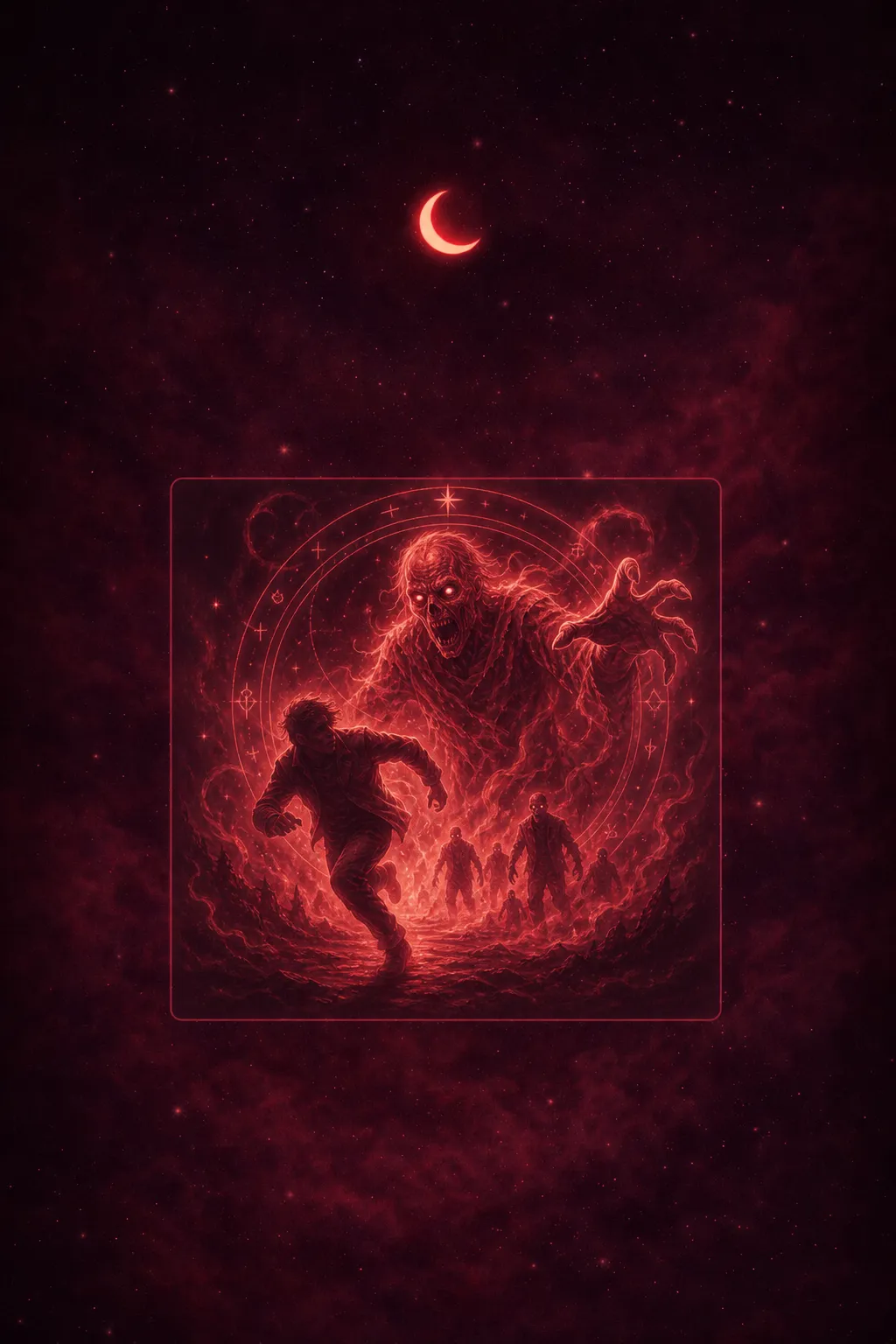

When a zombie chases you in a dream, it typically means you are feeling overwhelmed by stress, toxic influences, or mindless social pressure in waking life that you are desperately trying to escape, as the pursuing zombie often symbolizes a draining situation, person, or habit that threatens to consume your energy, identity, or sense of control.
In under a minute you could read what your exact dream means for you, and see a picture of it. Free.
Bad dream? See exactly what you dreamed — turned into a picture.
Just describe it and Dream Book paints your dream as a real image, plus a reading of what it means for you. Free, and it takes under a minute.


A dream still on your mind? Get your personal reading.
Describe your dream in a line or two. In seconds you get a reading of your exact dream, a picture drawn from your own words, and every symbol explained.
Free. No sign-up. Takes 10 seconds. Your dream stays private.
0%
Analyzing your dream…
Something went wrong. Please try again in a moment.
Your dreams deserve more than a dictionary
Common Zombie-Chase Dream Scenarios
The specific shape a zombie-chase dream takes often reveals exactly which pressure in your waking life is going unaddressed. The most common variant — being pursued by an entire horde — tends to reflect how modern anxiety compounds: one deadline, one unpaid bill, or one unresolved conflict quickly feels like it multiplies into an unstoppable wave bearing down on you all at once. Closely related is the slow-motion running scenario, where no matter how hard you push, your legs simply won't cooperate. This is your mind translating a very real sense of powerlessness — the feeling that your effort and your results have become completely disconnected in waking life, much like the helplessness that surfaces in falling dreams.
- Hiding or barricading yourself: You're buying time rather than solving the problem. The threat is still out there, which mirrors a defensive coping style — short-term relief without long-term resolution.
- A familiar person has turned zombie: A relationship may feel draining, unrecognizable, or even threatening. This variant surfaces when a trusted bond starts to feel like an obligation that consumes rather than sustains you.
- You begin turning into a zombie yourself: A signal worth taking seriously — this points to fear of losing your own identity, energy, or sense of purpose, often under sustained pressure to conform to routine or others' demands. Some readers also connect this unsettling transformation to the dream imagery of death and what it signals about personal change.
- Turning to fight back: A genuinely encouraging sign. Choosing to confront rather than flee suggests emerging agency and a readiness to face whatever you've been avoiding.
- Protecting others during the chase: The dream may be flagging caretaker overload — your sense of self-worth is heavily tied to shielding the people around you, possibly at significant personal cost.
What this dream could look like
Tap an image to open it full screen
Example images. Only you can see what you write in Dream Book.
The Psychological Reading: What Your Mind Is Processing
From a psychological standpoint, being chased by zombies is a textbook stress-response dream — your sleeping mind dramatizing the same fight-or-flight chemistry that fires when real-world pressures feel inescapable. The zombie is the perfect symbol for a stressor you cannot negotiate with: it has no empathy, no reasoning, and no stopping point. Psychologists who study chase dreams consistently link them to avoidance — the dreamer is running from something unresolved rather than turning around to face it. That "something" is usually a mounting obligation, a difficult conversation, or a pattern of behavior the conscious mind keeps postponing.
A bad dream isn't a bad sign.
The modern-anxiety angle sharpens this reading considerably. In an era of 24/7 connectivity, performance pressure, and blurred work-life boundaries, the zombie horde maps almost too neatly onto the experience of overwhelm: each ignored email, unpaid bill, or deferred decision becomes another body in the crowd. The emotional signature — fear, helplessness, urgency, exhaustion — mirrors precisely what chronic stress feels like in the body, much like the physical dread many people associate with dreams of losing teeth, another classic anxiety symbol. From a Christian psychological perspective, this kind of dream can also surface when someone feels spiritually depleted or morally adrift, sensing they are being overtaken by habits or circumstances they have surrendered control over.
- Avoidance signal: The chase intensifies when a real-life problem is being actively ignored.
- Control and agency: Dreams where you successfully escape or fight back often mark a shift toward confronting the stressor directly.
- Exhaustion indicator: Recurring zombie-chase dreams may suggest burnout — your subconscious registering that resources are genuinely depleted.
- Transformation potential: Confronting the zombie within the dream is widely interpreted as readiness for psychological growth and honest self-reckoning.
General meanings end here. Read your own dream.
Describe your dream in a line or two. In seconds you get a reading of your exact dream, a picture drawn from your own words, and every symbol explained.
Free. No sign-up. Takes 10 seconds. Your dream stays private.
0%
Analyzing your dream…
Something went wrong. Please try again in a moment.
Your dreams deserve more than a dictionary
Every dream you log starts to connect.
Dream Book keeps your dreams in one place and reveals the threads between them over time — your private dream journal. Free to start.
Cultural and Folk Traditions: The Zombie as a Symbol of the Unstoppable
The zombie figure has deep roots in Haitian Vodou tradition, where it originally described a person robbed of their will and autonomy — a soul trapped in a body that serves another's agenda. When that image migrated into Western popular culture through horror films and television, it shed its specific religious context but kept its core unease: the horror of agency stripped away. In folk belief terms, being chased by the dead carries a long-standing warning that something left unresolved — a broken promise, a neglected duty, a buried grief — refuses to stay buried. This echoes the same dread that surfaces in classic chase dreams across many cultures: the pursuer is never random.
But what does your version mean?
Within a broadly Christian cultural framework, the walking dead imagery can resonate with ideas of spiritual reckoning: that what we avoid in life will eventually demand to be faced. This reading stops well short of literal prophecy and sits closer to a moral folk instinct — the sense that avoidance has a cost. Paired with the modern-anxiety lens, the zombie horde reads as a near-perfect cultural metaphor for compounding overwhelm: faceless, relentless, and impossible to reason with, much like deadlines or systemic pressures that feel entirely out of your control. Dreams of apocalyptic threat share this quality of representing collapse that feels both inevitable and impersonal.
- Haitian Vodou origin: the zombie as a figure of lost will — a warning about surrendering control of your own life.
- Western folk-horror tradition: the undead as unfinished business that returns until confronted.
- Modern cultural anxiety: zombie imagery now serves as a shared shorthand for systemic, faceless pressure that individuals feel powerless to stop.
Spiritual Meaning: Deadness, Renewal, and the Battle Within
From a Christian spiritual perspective, a zombie-chase dream can function as a vivid metaphor for what many traditions call spiritual warfare — the sense that something hollow, lifeless, or morally corrosive is closing in on you. The zombie's defining quality is its lack of soul: it moves, but nothing living drives it. That image maps naturally onto habits, relationships, or thought patterns that drain rather than renew. Ezekiel's valley of dry bones (Ezekiel 37:1–14) offers a striking counter-image: God breathing life back into what appeared irreversibly dead, much like dreams about death that ultimately point toward transformation rather than ending. Interpreted through that lens, the dream's terror is not the final word — it may be an urgent prompt to seek restoration rather than continue fleeing.
Romans 8:15 reminds believers that they have not received "a spirit of fear, but of adoption." For those who hold that frame, the helplessness signature of a chase dream can feel spiritually diagnostic — a signal that anxiety has quietly displaced trust, and that the soul is running on its own resources instead of something larger. The confrontation the dream seems to demand is not only psychological but devotional: turning to face what is relentless rather than exhausting yourself outrunning it.
Was yours a sign? Find out.
- Spiritual deadness: The pursuer may represent a part of your life that has lost meaning or moral direction and now feels threatening rather than sustaining.
- Call to renewal: The dream can be read as an invitation — however uncomfortable — to restore what has gone numb spiritually or ethically.
- Fear vs. faith: The chase itself may reflect a season in which anxiety has outpaced trust, pointing toward a need for grounding, prayer, or community support.
Related Dream Meanings
nightmares
Being Chased Dream Meaning: Anxiety & Avoidance
5 min read
common dreams
Falling Dream Meaning: Insecurity, Fear & Loss of Control
5 min read
nightmares
Death Dream Meaning: Transformation, Loss & Change
5 min read
body health
Teeth Falling Out Dream: Anxiety, Loss & Vulnerability
5 min read
nightmares
Apocalypse Dream Meaning: Fear, Change & Inner Turmoil
5 min read
nightmares
Eye Falling Out: What It Really Means
5 min read
nightmares
Dreaming of Dead Sister Meaning: Symbolism and Interpretation
6 min read
nightmares
Dead Daughter Meaning
6 min read
Practical Takeaways: Turning the Chase Into a Wake-Up Call
Because zombie-chase dreams almost always map onto something you are actively avoiding, the most useful first step is honest identification. The morning after such a dream, spend five minutes writing down every unresolved obligation, difficult conversation, or creeping worry currently on your plate. Chances are the thing that feels most like an unstoppable, mindless force — the kind you can't reason with — is the exact pressure your dream was flagging. That recognition alone shifts you from helpless to informed.
- Name the horde. Break one overwhelming problem into its smallest, most concrete parts. Anxiety compounds when stressors blur together; separating them restores a sense of control.
- Take one small action today. Chase dreams tend to ease when avoidance ends. Even a brief email, a quick payment, or a scheduled conversation signals to your nervous system that you are moving toward the threat rather than fleeing it — research on recurring chase dreams consistently links resolution to some form of real-world confrontation.
- Audit your recovery habits. Exhaustion is both a trigger and a theme in these dreams. Poor sleep, overloaded schedules, and constant digital stimulation feed the exact brain state that generates zombie imagery — much as teeth-falling-out dreams tend to spike during periods of burnout and loss of control.
- Set a boundary this week. If a person or environment is draining your autonomy — leaving you feeling like you are just going through the motions — treat the dream as a prompt to reassert one clear limit.
A bad dream isn't a bad sign.
Think of the zombie chase less as a nightmare to escape and more as a blunt but honest report card from your own mind. The goal is not to stop the dream by force of will, but to remove the real-world fuel that keeps generating it.
If it keeps coming back, the app helps you understand the pattern.
Log each recurring dream and the free app shows you what's underneath — calmly, over time. Free to start.
People Also Ask
Dreaming of zombies chasing you often reflects real-life stress, anxiety, or feeling overwhelmed by responsibilities. Your mind may be processing a situation where you feel pressured, hunted, or unable to escape a problem. It can also signal emotional exhaustion from dealing with draining people or toxic environments in your waking life.
Zombies typically symbolize mindless routine, fear of losing control, or feelings of emotional numbness. They can represent people in your life who drain your energy, or aspects of yourself that feel suppressed. Much like dreams about being chased, they may also reflect societal pressures pushing you to conform without thinking independently or authentically.
Being attacked by zombies in a dream suggests you feel threatened by overwhelming forces in your waking life — perhaps a toxic relationship, workplace burnout, or mounting fears. It signals that something is actively threatening your sense of identity, wellbeing, or personal boundaries and urgently needs your attention.
Running from zombies in a dream symbolizes avoidance. You may be fleeing a difficult conversation, responsibility, or unresolved emotion. The chase reflects anxiety about something catching up with you. Rather than confronting the issue head-on, your subconscious is highlighting a tendency to escape rather than face challenges directly.
Curious what your dream would look like?