
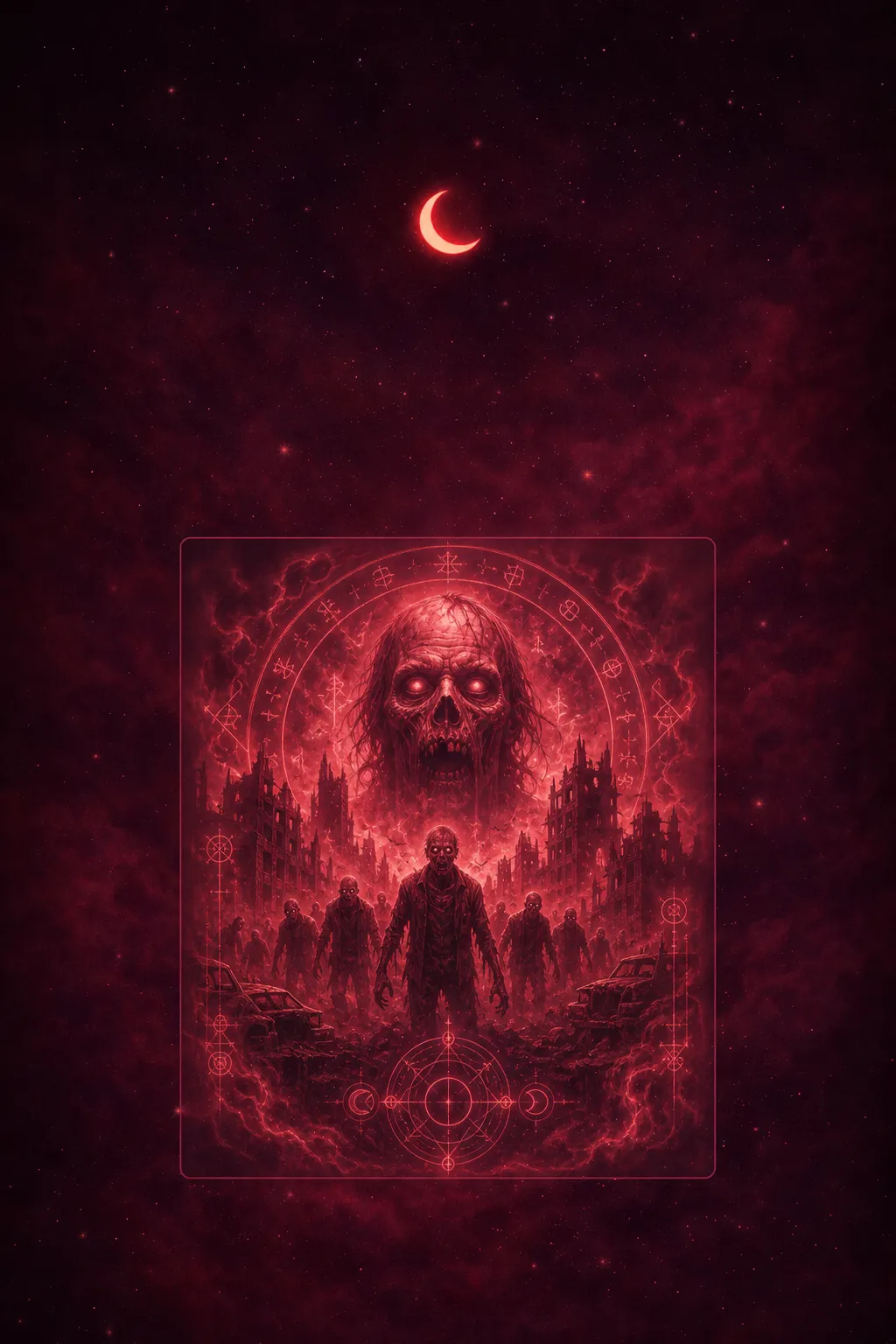

Dreaming about a zombie apocalypse typically means you feel overwhelmed by mindless social pressures, emotional numbness, or a fear of losing your identity to conformity, and your subconscious may be urging you to reclaim autonomy, resist draining influences in your waking life, and confront anxieties about widespread change or personal survival.
In under a minute you could read what your exact dream means for you, and see a picture of it. Free.
A dream still on your mind? Get your personal reading.
Describe your dream in a line or two. In seconds you get a reading of your exact dream, a picture drawn from your own words, and every symbol explained.
Free. No sign-up. Takes 10 seconds. Your dream stays private.
0%
Analyzing your dream…
Something went wrong. Please try again in a moment.
Your dreams deserve more than a dictionary
Common Zombie Apocalypse Dream Scenarios
The most frequent version — running or hiding from zombies — points to avoidance coping: something in waking life feels so overwhelming that retreat seems like the only option. When the threat escalates into a full horde cornering you, the dream is mapping the sensation of cumulative pressure — deadlines, obligations, and small daily stressors all converging at once until you feel outnumbered by your own to-do list.
- Protecting family or a group: Signals a heavy caretaker burden — the terror of failing the people who depend on you.
- Being bitten or turning into a zombie: A striking image of burnout or a toxic influence slowly eroding your identity; the dream asks whether you are still fully yourself.
- Fighting back and winning: A constructive shift — your psyche is rehearsing agency and signaling that you are ready to face the pressure head-on rather than flee it.
- Fortifying a safehouse: Reflects a deep need for boundaries and control over your immediate environment when the outside world feels chaotic.
- A loved one has turned: Often represents grief over a relationship that has changed beyond recognition, or anxiety that someone close is no longer acting like themselves.
- Already surviving the aftermath: Suggests you are in a recovery phase — adjusting to a reality that has been permanently altered by a recent crisis.
A bad dream isn't a bad sign.
Being calm and competent throughout the apocalypse is perhaps the most reassuring variant: it reflects growing resilience and a quiet confidence that, whatever collapse comes, you have the inner resources to adapt.
What this dream could look like
Tap an image to open it full screen
Example images. Only you can see what you write in Dream Book.
Psychological Meaning of a Zombie Apocalypse Dream
At its psychological core, dreaming of a zombie apocalypse is often the subconscious mind externalizing chronic stress and burnout. When daily life leaves you emotionally drained and running on autopilot, the psyche can project that inner numbness outward — populating the dream world with hollow, mindless figures that mirror exactly how you fear you yourself are becoming. Mainstream psychology frames this as threat rehearsal: a high-anxiety mind simulates worst-case collapse scenarios as a way of preparing for dangers it cannot fully name or control. The apocalyptic scale of the setting reflects a felt loss of agency over large, impersonal forces — job insecurity, financial pressure, health concerns, or a turbulent news cycle — circumstances where individual effort seems powerless against systemic collapse.
The zombie horde carries a subtler psychological charge as well: the dread of conformity. The faceless mass embodies social pressure and groupthink, and the terror of being overwhelmed by it can signal an anxiety about losing your individuality to crowd expectations. In a Christian-influenced reading, this maps onto the biblical warning against being "conformed to this world" (Romans 12:2) — a fear of spiritual or moral numbness overtaking personal conviction. Meanwhile, if specific zombies in the dream feel familiar, psychologists often read them as unresolved interpersonal conflicts that keep resurfacing — problems that, like the undead, refuse to stay buried no matter how many times you think you've dealt with them.
- Burnout signal: Feeling zombie-like in waking life — going through the motions — often precedes this dream; it can flag emotional exhaustion or even mild depersonalization worth addressing.
- Control anxiety: The collapsing social order mirrors a perceived inability to influence large forces; the dream invites reflection on what you can realistically manage.
- Conformity fear: Being chased by a relentless pursuer in this context often points to pressure to abandon your values or identity to fit in.
- Recurring threat: Zombies that keep returning suggest an avoided problem or strained relationship that needs direct resolution rather than further retreat.
Every dream you log starts to connect.
Dream Book keeps your dreams in one place and reveals the threads between them over time — your private dream journal. Free to start.


Cultural Meanings of a Zombie Apocalypse Dream
The zombie apocalypse is one of the most media-saturated symbols in modern Western culture, and that saturation matters: decades of films, television series, and video games have handed the dreaming mind a ready-made vocabulary for collapse, threat, and survival. When this imagery surfaces at night, it rarely signals a literal fear of the undead — instead, the brain is borrowing a cultural shorthand to dramatize feelings it cannot easily name. Researchers who track internet search trends have noted spikes in zombie-related anxiety during real-world crises — pandemics, financial downturns, and periods of sharp social division — suggesting that the archetype functions as a collective thermometer for cultural stress.
But what does your version mean?
Within Anglo-American folk belief and popular spirituality, the zombie apocalypse dream is frequently read as a mirror of helplessness in the face of faceless, unstoppable forces — institutions, crowds, or systemic pressures that feel impossible to negotiate with. A loosely Christian-inflected reading sometimes frames the horde as a trial of character: can you hold onto your values when the social order dissolves? That question of moral readiness overlaps neatly with the self-reliance strand common in American prepper culture, where such a dream is almost optimistically interpreted as the mind rehearsing independence and contingency planning.
- Media as dream language: zombie imagery is symbolic borrowing, not literal dread.
- Collective-anxiety marker: dream frequency often mirrors real-world social instability.
- Self-reliance framing: some traditions read the dream as a rehearsal of readiness and personal agency — a call to regain a sense of control when you feel pursued by circumstances.
Spiritual Meaning of a Zombie Apocalypse Dream
For dreamers shaped by a Christian worldview, the imagery of societal collapse and relentless, faceless threat can resonate deeply with biblical apocalyptic tradition. The Book of Revelation describes a world unraveling under forces beyond ordinary human control — and a zombie apocalypse dream can tap into that same visceral sense that the familiar order is disintegrating. This doesn't necessarily mean the dream is prophetic; rather, your mind is borrowing the most dramatic symbolic language available to express just how destabilized you feel right now.
Was yours a sign? Find out.
A quieter scriptural echo comes from Ezekiel's valley of dry bones — a vision of people who have lost all vitality, restored only through divine renewal. If the zombies in your dream feel less like external enemies and more like a mirror, the spiritual question worth sitting with is whether you have been feeling spiritually or emotionally dead inside, going through the motions without genuine presence or purpose. That numbness is exactly what the dry-bones passage frames as a condition calling for awakening, not just willpower.
Across broader spiritual traditions, surviving an apocalyptic dreamscape is often read as a test of inner resilience and moral clarity — who you choose to protect, what you refuse to sacrifice, and whether panic or conscience guides your decisions. From that angle, the dream becomes less a warning about external collapse and more an invitation to examine where you currently stand spiritually: are you one of the living, fully present and self-aware, or have you been drifting on autopilot, closer to the horde than you'd like to admit?
Related Dream Meanings
common dreams
Running Dream Meaning: Escape, Stress & Freedom
5 min read
nightmares
Being Chased Dream Meaning: Anxiety & Avoidance
5 min read
nightmares
Death Dream Meaning: Transformation, Loss & Change
5 min read
nightmares
Choking Dream Meaning: Anxiety, Control & Self-Expression
5 min read
nightmares
Deceased Loved One Dream: Closure, Messages & Grief
5 min read
nightmares
Dead Friend Dream Meaning: Closure & Unresolved Grief
5 min read
nightmares
Grief Dream Meaning: Loss, Healing & Unresolved Emotions
5 min read
nightmares
Dead Pet Dream Meaning: Grief, Loss & Unresolved Emotions
5 min read
What to Do After a Zombie Apocalypse Dream
Because this dream is almost always signaling overload and a felt loss of control, the most useful first step is an honest audit of your current stress load. Ask yourself where, in waking life, you feel outnumbered or unable to keep pace — a punishing workload, a relationship that drains you, a financial pressure that never lets up. Writing it down strips away the vague dread and turns a shapeless horde into a list of actual, manageable problems.
- Name the horde. Identify the two or three specific stressors driving the overwhelm and rank them by urgency. Clarity alone reduces the sense that everything is closing in at once.
- Reclaim one small decision. Helplessness shrinks when you act on something within your control today — even a minor boundary set, a task delegated, or a commitment declined.
- Check your recovery habits. Zombie apocalypse dreams often intensify during periods of poor sleep or social withdrawal — the same conditions that feed recurring chase anxiety in dreams. Restoring basic routines — consistent sleep, real meals, brief time with people you trust — is unglamorous but effective.
- Consider a reality check on consumption. If apocalyptic media is a nightly habit, a short break can quiet imagery that the dreaming mind is simply borrowing from your watch history.
A bad dream isn't a bad sign.
If the dream recurs frequently and waking anxiety is interfering with daily functioning, these are signs worth discussing with a therapist rather than managing alone.
If it keeps coming back, the app helps you understand the pattern.
Log each recurring dream and the free app shows you what's underneath — calmly, over time. Free to start.
People Also Ask
Zombies typically represent feelings of numbness, conformity, or being emotionally drained. They can symbolize people or situations in your waking life that feel mindless or threatening. Sometimes they reflect your own fear of losing identity, autonomy, or control over circumstances overwhelming you.
Being chased by zombies usually signals that you are avoiding something stressful in real life — unresolved anxiety, a toxic relationship, or mounting responsibilities. Your mind uses the chase to dramatize the pressure you feel. Facing what you are running from while awake often reduces these dreams significantly.
Absolutely. Apocalyptic dreams are very common, especially during periods of high stress, global uncertainty, or major personal change. They reflect your mind processing feelings of vulnerability and lack of control. Rather than literal prophecy, they are symbolic expressions of anxiety about the future and your ability to cope.
Reducing stress before bed helps considerably. Avoid horror media in the evening, practice relaxation techniques like deep breathing, and keep a consistent sleep schedule. Journaling your worries before sleeping can offload anxiety. If nightmares persist and disrupt daily life, speaking with a therapist about imagery rehearsal therapy is worthwhile.
Curious what your dream would look like?