
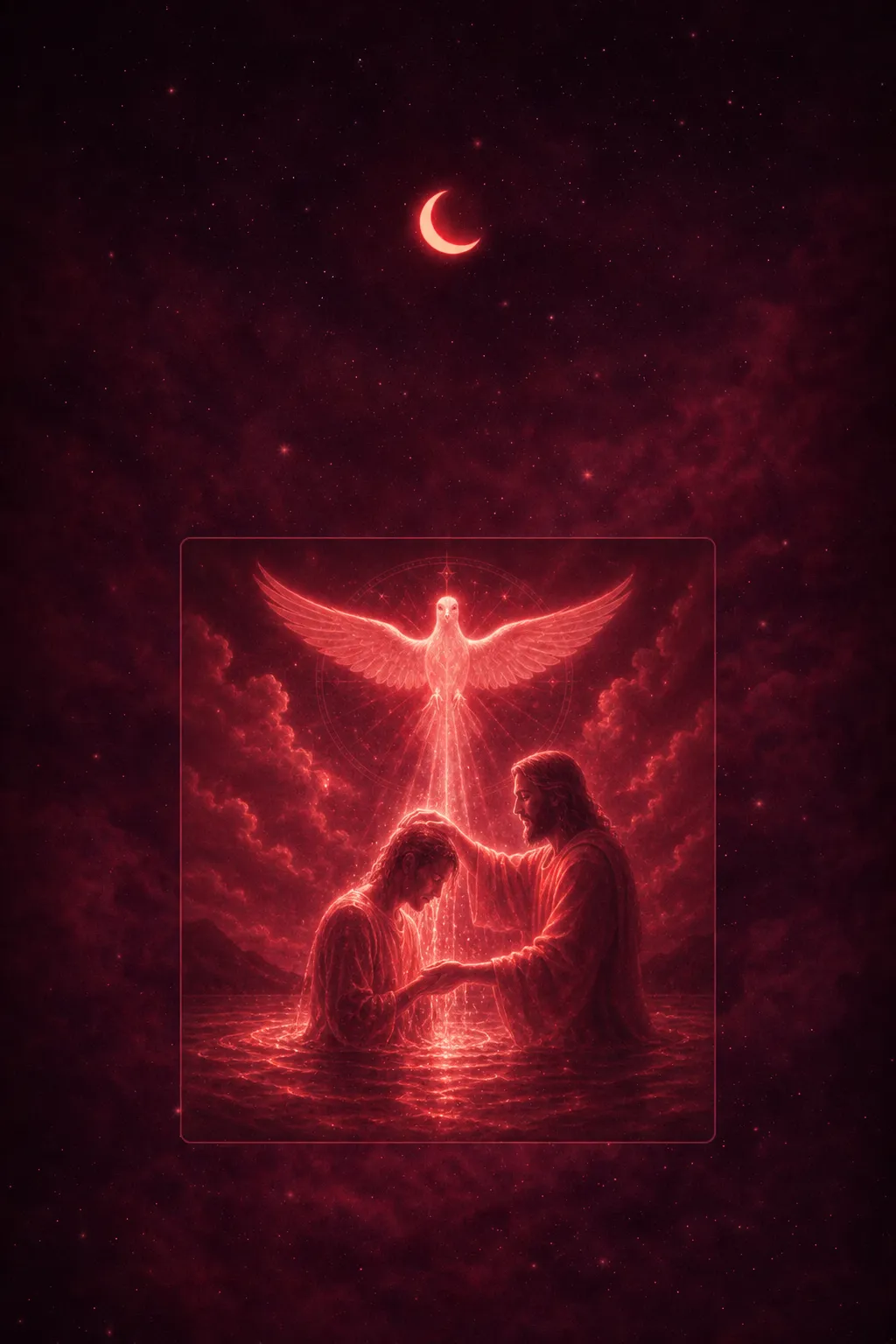

Dreaming of baptism usually symbolizes a deep desire for renewal, purification, or a fresh start in some area of your life. It can reflect feelings of guilt you want to release, a spiritual awakening, or a significant transition you are moving through. The emotional tone of the dream — whether peaceful or anxious — often reveals how ready you feel to embrace that change.
In under a minute you could read what your exact dream means for you, and see a picture of it. Free.
A dream still on your mind? Get your personal reading.
Describe your dream in a line or two. In seconds you get a reading of your exact dream, a picture drawn from your own words, and every symbol explained.
Free. No sign-up. Takes 10 seconds. Your dream stays private.
0%
Analyzing your dream…
Something went wrong. Please try again in a moment.
Your dreams deserve more than a dictionary
Common Baptism Dream Scenarios
Being Baptized Yourself
When you're the one being lowered into the water, the dream is almost always about reinvention. Something in you is ready to be washed away — a version of yourself that no longer fits, a habit you've outgrown, or a chapter of life that's quietly closing. The feeling during the immersion matters enormously here.
If the water feels warm and peaceful, you're probably welcoming this change. If it feels cold or frightening, some part of you is resisting the transformation even while another part knows it's necessary. Pay attention to who is performing the baptism — a stranger, a priest, a parent — because that figure often represents an authority or belief system you're either embracing or questioning.
But what does your version mean?
Watching Someone Else Be Baptized
Witnessing another person's baptism in a dream puts you in the role of observer to someone else's renewal. This often surfaces when someone close to you is going through a major life change and you're processing what that shift means for your relationship with them. It can also reflect a part of yourself — projected onto that other person — that you recognize needs transformation but haven't yet claimed.
If the person being baptized is a baby, the symbolism deepens. Babies in dreams frequently represent new beginnings or creative projects in their most vulnerable early stages. A baby's baptism may be your mind's way of asking: what new thing in your life needs protection and intention right now?
Baptism in Dark or Murky Water
Clear water and dark water carry very different emotional charges. If the water in your baptism dream is murky, dark, or unsettling — think dark water that hides what's beneath — the dream is pointing to transformation that feels uncertain or even dangerous. You want the fresh start, but you can't fully see what you're stepping into.
This version of the dream often appears at genuine crossroads: a career change, the end of a relationship, a move to a new city. The unknown isn't a warning to stop. It's your psyche honestly representing the fact that real change involves real risk.
Refusing or Fleeing Baptism
Dreams where you resist, run from, or refuse to be baptized tend to surface when you're avoiding a necessary reckoning. Something in your waking life is calling you toward change — and you're not ready to answer. This can show up alongside other avoidance dreams, like being chased, where the thing pursuing you is ultimately a part of yourself.
The refusal isn't a character flaw. It's information. What would you have to give up if you allowed the transformation? That's the question worth sitting with.
What this dream could look like
Tap an image to open it full screen
Example images. Only you can see what you write in Dream Book.
Psychological Interpretation
Freud would have been fascinated by the baptism dream — and not primarily for its spiritual content. For him, water was one of the most primal dream symbols, consistently linked to birth, the womb, and the unconscious itself. A baptism, in Freudian terms, is a ritual re-entry into that original state of undifferentiated being — a wish to be reborn, to start over, to undo what has been done. The religious framing, he'd argue, is the mind's way of making that wish feel sanctioned.
Jung took a different angle entirely. He saw baptism as a direct encounter with the individuation process — the lifelong work of becoming fully yourself. The ritual of immersion and emergence maps almost perfectly onto his concept of the death and rebirth of the ego: you go under as one person and come up as another. For Jung, dreaming of baptism was a signal that the psyche is actively working to integrate something — a shadow element, a repressed capacity, an unlived life. It's not a dream to dismiss. It's one to take seriously.
Was yours a sign? Find out.
Calvin Hall, who spent decades analyzing tens of thousands of dream reports, found that transformation themes — including purification and ritual — clustered heavily around life transitions: adolescence, marriage, career shifts, death of a loved one. His content analysis suggested these dreams aren't random. They track the emotional milestones of a life with surprising precision. A baptism dream in Hall's framework is your mind filing a report on where you actually are in your story.
Ernest Hartmann's work on dreams as emotional memory processing adds another layer. He argued that dreaming helps us metabolize experiences that carry strong emotional charge — especially those involving fear, loss, or anticipated change. A baptism dream, on his model, is the brain doing its overnight maintenance work on a transition you haven't fully processed yet. The imagery of water and cleansing isn't arbitrary; it's the most emotionally resonant metaphor your mind could find for what you're going through. If the dream keeps returning, Hartmann would say the emotional work isn't finished.
Every dream you log starts to connect.
Dream Book keeps your dreams in one place and reveals the threads between them over time — your private dream journal. Free to start.


Cultural & Spiritual Meaning
In Christian tradition, baptism is the foundational rite of passage — the moment a person enters the faith community, sins are washed away, and a new identity is conferred. Dreaming of it draws on centuries of collective meaning, whether or not you practice Christianity. The imagery is embedded in Western culture so deeply that even secular dreamers carry it. A church setting, the presence of Jesus, or a blessing spoken over you in the dream all amplify this layer of meaning — pointing toward grace, forgiveness, and the possibility of genuine renewal.
Ibn Sirin, the eighth-century Islamic scholar whose dream interpretations remain influential across the Muslim world, wrote specifically about water rituals in dreams. He interpreted immersion in clean, flowing water as a sign of repentance accepted — a spiritual clearing of debts, both moral and relational. Murky or stagnant water, by contrast, signaled unresolved wrongdoing or a purification that hadn't yet taken root. His framework is remarkably consistent with what modern dreamers report: the quality of the water tells you whether the cleansing has actually landed.
A bad dream isn't a bad sign.
Across Indigenous traditions in North America and parts of Africa, ritual immersion in water carries similar weight — not as a one-time event but as a recurring practice of renewal tied to seasonal cycles and community belonging. In these frameworks, a dream of water ritual isn't primarily about the individual. It's about your relationship to something larger: your lineage, your community, the natural world. If you've been feeling isolated or cut off from something that once anchored you, this dream may be surfacing that disconnection. Paired with dreams of rivers or natural water sources, it often signals a longing to return to something essential.
Related Dream Meanings
common dreams
Water Dream Meaning: Emotions, Intuition & Growth
5 min read

people
Babies Dream Meaning: New Beginnings & Growth
5 min read
common dreams
Dreaming of Dark Water Meaning: What Your Dream Reveals
6 min read

nightmares
Being Chased Dream Meaning: Anxiety & Avoidance
5 min read
nightmares
Death Dream Meaning: Transformation, Loss & Change
5 min read

people
Church Dream Meaning: Spirituality, Guidance & Belief
5 min read
people
Jesus Dream Meaning: Guidance, Hope & Transformation
5 min read
common dreams
What Does It Mean to Dream About Blessings
6 min read
What to Do After This Dream
Start by writing down every detail you can remember — the temperature of the water, who was present, whether you felt relief or dread. Baptism dreams are rich in emotional texture, and the feelings are usually more revealing than the symbols themselves.
Ask yourself honestly: what in my waking life is asking to be released right now? A prayer, a conversation you've been avoiding, a relationship that's run its course, a version of yourself you've been clinging to past its expiration date. The dream is rarely subtle about the direction it's pointing — it's just asking whether you're willing to look.
If the dream carries a strong spiritual charge, it may be worth exploring what encounters with the divine mean to you personally — not doctrinally, but emotionally. What would it actually feel like to be forgiven? To start clean? Those questions are often the real heart of the dream.
If this dream keeps returning or shifting in intensity, it's worth going deeper than a general dictionary entry can take you. Dream Book lets you describe your dream in detail and ask follow-up questions to uncover what your subconscious is specifically working through — not just what baptism means in general, but what it means for you, right now.
But what does your version mean?
Understanding your baptism dream is the first step. The next is asking what it means for your life right now — that's where a personalized interpretation goes deeper than any dictionary.
One dream is never the whole picture.
The free app remembers your dreams, draws them, and connects the threads over time — so the next one means even more. Free to start.
People Also Ask
Dreaming about being baptized typically signals a desire for a fresh start, emotional cleansing, or a significant identity shift. It often appears during major life transitions when part of you is ready to let go of the past and step into something new.
Many people experience baptism dreams as spiritually meaningful, particularly during periods of guilt, grief, or spiritual seeking. Whether or not you're religious, the imagery draws on deep cultural associations with forgiveness, renewal, and belonging to something larger than yourself.
Watching someone else be baptized in a dream often reflects your awareness of a major change happening in that person's life — or a part of yourself projected onto them that's undergoing transformation. It can also signal that you're witnessing, rather than participating in, a renewal you secretly want for yourself.
Recurring baptism dreams usually indicate that an emotional or psychological process is still unfinished. According to Ernest Hartmann's research on dreams and emotional processing, the mind returns to powerful imagery until the underlying feelings have been fully worked through. It's worth exploring what change or release you've been resisting in your waking life.
Curious what your dream would look like?