
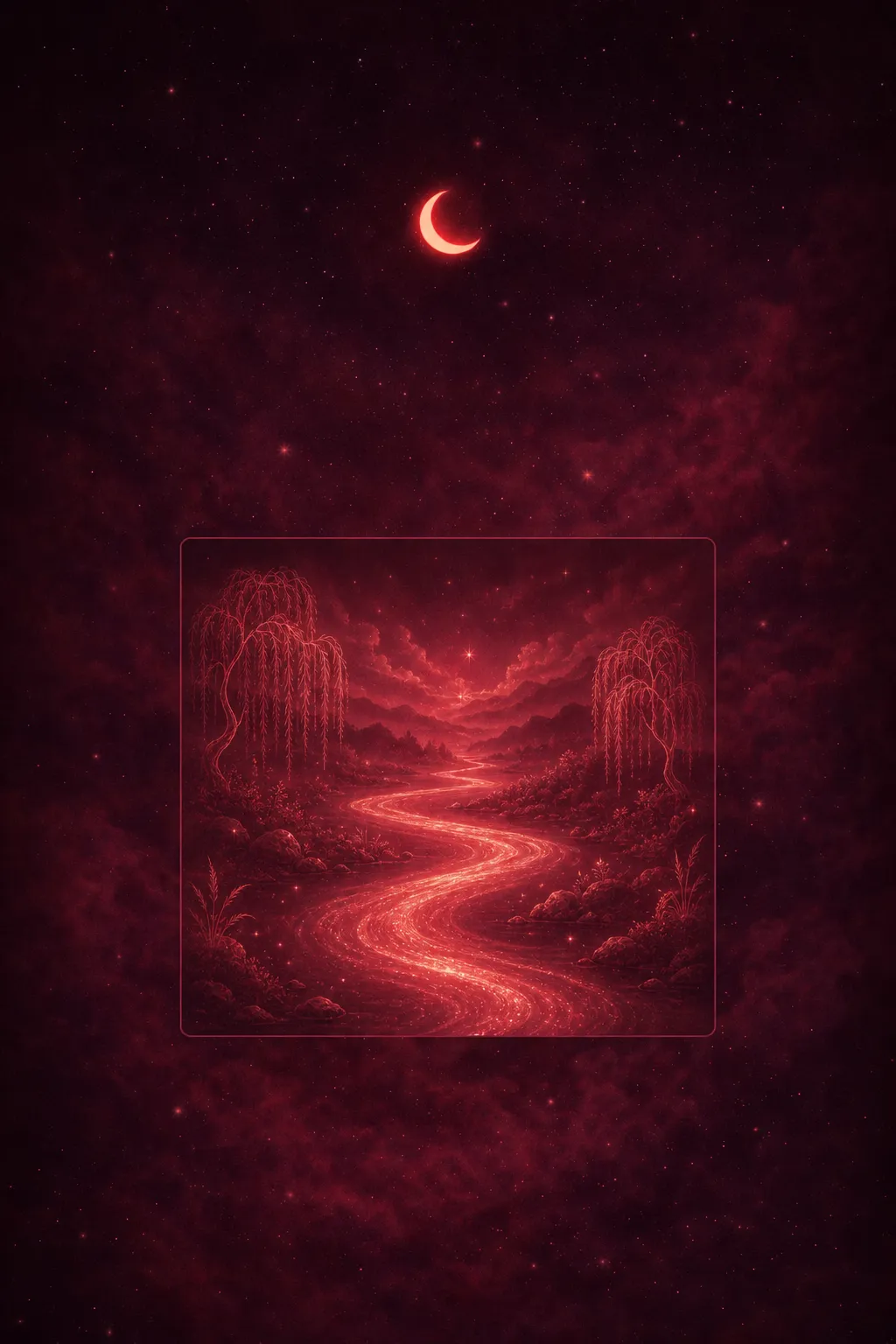

Dreaming about a river typically symbolizes the flow of your emotions, the passage of time, and the journey of life itself, with a calm river reflecting inner peace and clarity, while a turbulent or flooded river warns of overwhelming emotions, uncertainty, or challenges ahead that may require you to adapt and find your footing.
In under a minute you could read what your exact dream means for you, and see a picture of it. Free.
A dream still on your mind? Get your personal reading.
Describe your dream in a line or two. In seconds you get a reading of your exact dream, a picture drawn from your own words, and every symbol explained.
Free. No sign-up. Takes 10 seconds. Your dream stays private.
0%
Analyzing your dream…
Something went wrong. Please try again in a moment.
Your dreams deserve more than a dictionary
Common River Dream Scenarios and What They Mean
The specific conditions of the river in your dream carry the clearest interpretive weight. A calm, clear river you watch or float along typically signals psychological equilibrium — your mind granting itself permission to stop white-knuckling every outcome and trust that life is moving at the right pace. Contrast that with a fast, turbulent current or a flooding river bursting its banks, which both point to stress overload: emotions or external demands exceeding your current capacity to manage them. Flooding in particular echoes the modern experience of being overwhelmed by compounding pressures — work, relationships, finances — with no obvious way to hold the line. A flood dream of this kind is your psyche's alarm signal, not a verdict on your character.
- Crossing a river (by bridge, boat, ford, or swimming) marks a decision point or life transition; how confidently you cross reflects your felt readiness to move forward.
- Falling or being pulled into the river suggests a sudden loss of footing — fear that a change already in motion will sweep away your sense of control.
- A murky or polluted river reflects emotional confusion or a situation that needs clarifying before you can move ahead clearly.
- A dried-up riverbed points to burnout or stalled momentum — a once-reliable source of energy or direction that has run out.
- A stagnant, unnaturally still river signals a waiting phase where suppressed feelings or blocked progress are building beneath the surface.
- Following a river toward its source or the sea suggests deeper self-examination — a search for meaning or a quiet reckoning with where your life is ultimately heading.
But what does your version mean?
Across all these variants, the river asks the same underlying question: are you moving with your life or fighting it? The dream rarely condemns either answer — it simply holds up a mirror to your current relationship with change and control.
What a dream about a river could look like
Tap an image to open it full screen
Example images. Only you can see what you write in Dream Book.
The Psychological Meaning of a River Dream
In psychological terms, a river is one of the mind's most honest self-portraits. Mainstream psychology — drawing on Jungian ideas of the unconscious as a flowing, dynamic system — treats the river as a direct image of your emotional life: its depth, its speed, and its direction all mirror internal states you may not yet have put into words. When the current feels manageable, the dream is often the psyche signaling a healthy relationship with change. When it roars or pulls you under, the unconscious may be flagging emotional overload — the modern-anxiety equivalent of too many demands, too little control, and a life moving faster than you can consciously process.
The river also speaks to self-knowledge and the question of agency. Psychologically, how you engage with the water matters enormously: standing frozen on the bank suggests avoidance or decision paralysis, while swimming deliberately points to active engagement with a life transition. For those in a faith tradition, this can carry a redemptive dimension — water as the medium of renewal, a passage through difficulty that is ultimately purposeful rather than random. That reading sits comfortably alongside secular psychology without displacing it.
Was yours a sign? Find out.
- Murky or polluted water: unprocessed emotion, suppressed anxiety, or a situation you sense is unhealthy but haven't fully examined.
- Being swept away: a loss-of-control signal, often linked to chronic stress or a feeling that circumstances are outpacing your coping capacity — similar to a flood dream's emotional overwhelm.
- Crossing successfully: the psyche rehearsing resolve; the mind building confidence ahead of a real-life threshold moment.
- A river that splits or forks: a subconscious processing of competing life choices, asking you to commit to a direction.
Every dream you log starts to connect.
Dream Book keeps your dreams in one place and reveals the threads between them over time — your private dream journal. Free to start.


Cultural and Traditional Beliefs About River Dreams
Across Western folk tradition, rivers have long served as boundary markers between the known and the unknown — a symbolism that runs from ancient Greek mythology's River Styx separating the living from the dead, to the Jordan River's central role in Christian scripture as a site of baptism, cleansing, and new beginnings. In American Christian culture particularly, "crossing the river" carries a layered resonance: it can mean spiritual renewal, life transition, or even death and passage into the afterlife. A dream of being baptized in or safely crossing a river often maps onto hopes for transformation and divine guidance through uncertain seasons.
Anglo-American folk belief has also treated river dreams as omens of change — specifically, unavoidable change. Dreaming of a river in full flow was historically read as a sign that circumstances were shifting whether you willed it or not, which speaks directly to modern anxieties about control. In a culture that prizes self-determination, the river's indifference to your preferences can feel unsettling. Yet older folk readings framed that same quality as reassurance: the current carries you forward even when your own effort falters. This mirrors the way many people today reach for water imagery when processing stress or burnout — the river becoming a cultural shorthand for releasing the grip on outcomes you cannot steer.
- Christian tradition: rivers symbolize purification, covenant, and spiritual passage — especially the Jordan River as a threshold of new life.
- Western folklore: a flowing river signals inevitable change; a blocked or dry river warns of stagnation or suppressed emotion.
- Modern folk reading: the river's pace — rushing or gentle — is popularly interpreted as a mirror of how in or out of control a person feels in waking life.
The Spiritual Meaning of a River Dream
Within a US Christian framework, the river carries a layered spiritual resonance that speaks directly to questions of trust and transition. Revelation 22:1 describes "a river of the water of life, bright as crystal, flowing from the throne of God" — an image of divine provision that never runs dry. When this archetype surfaces in a dream, many believers intuitively read it as reassurance that their life is held within a larger, purposeful current, even when daily anxieties about career, relationships, or the future make that hard to feel. The Jordan River adds another layer: crossing it in the biblical narrative meant leaving a season of struggle and stepping into something promised. A dream of crossing a river may carry that same threshold energy — a spiritual nudge that a new chapter is not only coming but is already underway.
A bad dream isn't a bad sign.
Beyond explicitly Christian readings, a broader spiritual tradition treats the river as a symbol of surrender — the recognition that some currents run deeper than personal willpower can redirect. In an era shaped by the pressure to optimize and control every outcome, dreaming of a river can function as a quiet spiritual corrective: life, like water, moves according to forces larger than the individual will. This is less about passivity than about discernment — knowing when to navigate deliberately and when to release the grip and trust the flow. The river in this sense becomes an invitation to align with something greater rather than exhaust yourself fighting the current.
Related Dream Meanings
common dreams
Flood Dream Meaning: Emotions, Loss & Need for Change
5 min read
common dreams
Water Dream Meaning: Emotions, Intuition & Growth
5 min read
common dreams
What Does It Mean to Dream About a Boat
5 min read
common dreams
Bridge Dream Meaning: Transition, Change & New Starts
5 min read

common dreams
What Does It Mean When You Dream About Falling Stars
5 min read
common dreams
Shooting Star Dream Meaning: Wishes, Timing & Longing
5 min read
common dreams
Red Sky Dream Meaning: What It Symbolizes in Your Dreams
5 min read

common dreams
What Does It Mean to Dream About a Hospital Room
5 min read
What to Do After a River Dream: Practical Takeaways
Rather than simply filing the dream away, treat it as a low-stakes check-in on where you feel in control — and where you don't. Ask yourself one honest question: is the current in your life right now something you chose, or something that's pulling you along without your consent? That distinction alone can surface a decision you've been avoiding around a relationship, a job, or a habit that no longer fits.
- Name the emotional tone first. Was the river calm, murky, or overwhelming? Match that feeling to a real area of life — work pressure, a relationship in flux, financial uncertainty — and write it down. Naming it moves it from background anxiety into something you can actually address.
- Identify one thing you can steer. Modern stress often comes from fixating on what can't be controlled. Pick one concrete action — a conversation, a boundary, a plan — that puts even a small amount of direction back in your hands.
- Sit with transitions honestly. If you're at a crossroads, a bridge in a dream and a river often appear together in people's dream lives during major life shifts. Journaling for five minutes about what shore you're trying to reach can clarify more than weeks of avoidance.
- For faith-oriented readers: use the dream as a prompt for prayer or reflection around trust — specifically, where you're gripping tightly versus where you might release the outcome.
But what does your version mean?
The river asks a practical question above all else: are you navigating, or just drifting? Answering it honestly is the most useful thing this dream can offer you.
One dream is never the whole picture.
The free app remembers your dreams, draws them, and connects the threads over time — so the next one means even more. Free to start.
People Also Ask
Spiritually, a river represents the flow of life, divine guidance, and the journey of the soul. Many traditions see rivers as sacred boundaries between worlds or as cleansing forces. Dreaming of one often signals a spiritual transition, an invitation to surrender control, and trust the natural current carrying you toward growth.
Generally, water in dreams is considered positive, symbolizing emotion, renewal, and life force. Clear, calm water suggests peace and clarity, while murky or turbulent water may reflect inner turmoil or unresolved feelings. Context matters most — even a stormy river dream can be a healthy signal that deep emotions need your attention.
Standing or swimming in a river suggests you are actively engaged with life's current circumstances. Calm water around you reflects confidence and ease, while struggling against the current points to resistance or conflict in waking life. Being carried gently downstream often signals it is time to release control and trust how events are naturally unfolding.
A river can symbolize the passage of time, emotional flow, change, and life's journey from birth to death. It may also represent opportunity, as rivers historically enabled trade and travel. Depending on its condition — whether flooding, drying up, or flowing steadily — it mirrors your current emotional state and life momentum.
Curious what your dream would look like?