
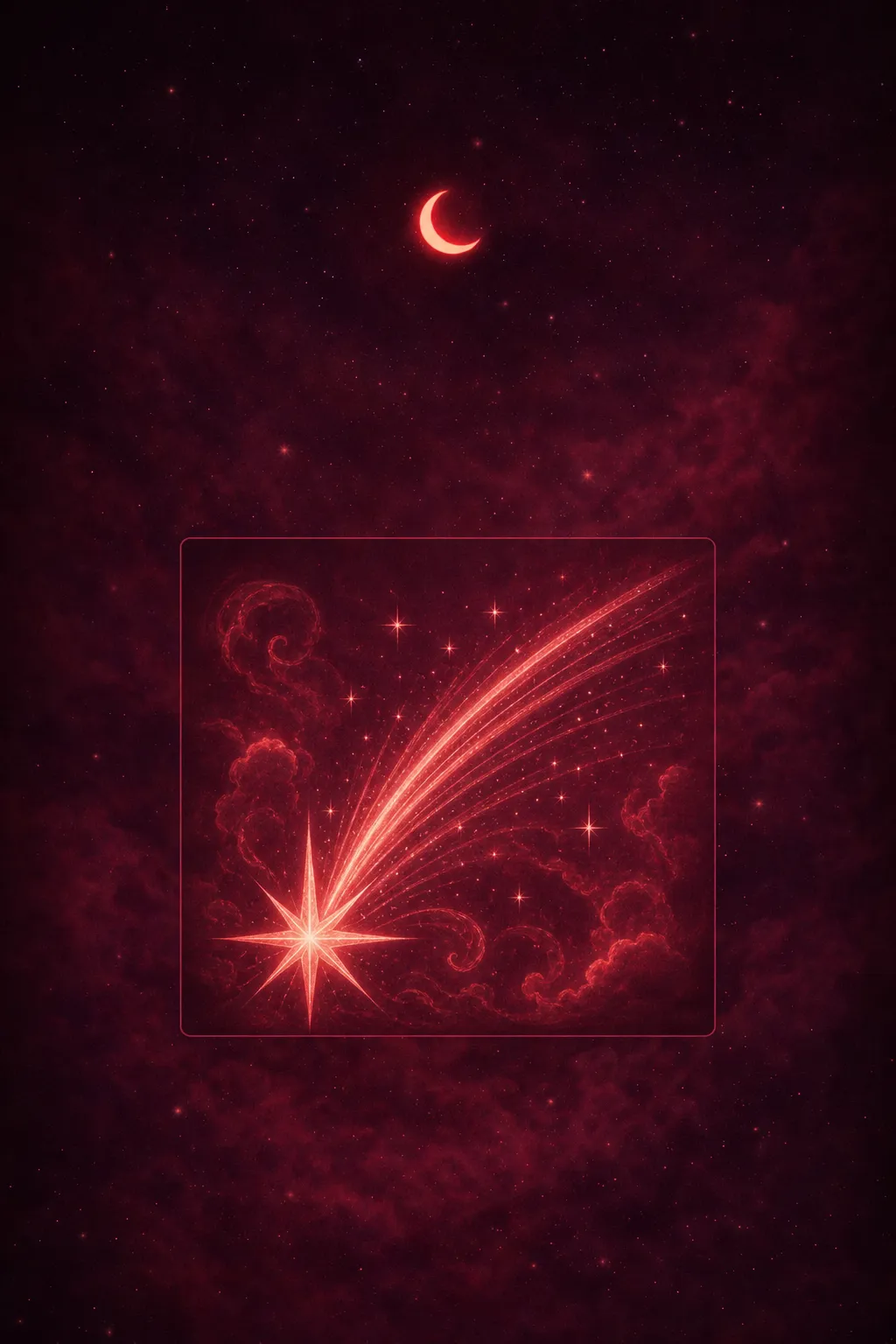

Dreaming of a shooting star often reflects a deep wish, a fleeting opportunity, or a sense that something important is passing through your life right now. It can speak to hope you haven't fully voiced yet, or a moment your instincts say you shouldn't miss. The emotion you felt watching it — wonder, urgency, or loss — may hold the real key to what your dream is telling you.
In under a minute you could read what your exact dream means for you, and see a picture of it. Free.
You read what it can mean. But what did yours mean?
General meanings stop here. In the free app, tell Dream Book your exact dream and get a reading that actually makes sense for you.


A dream still on your mind? Get your personal reading.
Describe your dream in a line or two. In seconds you get a reading of your exact dream, a picture drawn from your own words, and every symbol explained.
Free. No sign-up. Takes 10 seconds. Your dream stays private.
0%
Analyzing your dream…
Something went wrong. Please try again in a moment.
Your dreams deserve more than a dictionary
Common Shooting Star Dream Scenarios
Watching a Shooting Star Streak Across the Sky
You're standing outside — maybe in a field, maybe on a rooftop — and a streak of white light tears across the darkness above you. This is the most classic version of the shooting star dream, and it almost always carries a sense of awe, longing, or sudden hope. Something in you recognizes that moment as significant before your waking mind can explain why.
This dream tends to surface when you're standing at a threshold. A decision is coming, or a window of opportunity is quietly closing. The shooting star isn't just beautiful — it's brief. Your subconscious is handing you a clock.
But what does your version mean?
Making a Wish on a Shooting Star
In this version, you see the light, and you feel the urgent pull to wish — or you already have, before the dream even shows you what you wished for. Sometimes you remember the wish clearly when you wake. Sometimes it dissolves the moment you open your eyes, leaving only the feeling of wanting something badly.
Pay attention to that feeling more than the wish itself. The emotion underneath — desperation, hope, quiet longing — is what your dream is actually about. If you've also been dreaming of flying, the two dreams often work together: one about freedom already felt, one about freedom still desired.
A Shooting Star Falling Toward You
This one shifts the energy entirely. Instead of distant beauty, the star is coming down — toward earth, toward you. It might feel threatening, or it might feel like something sacred descending. The difference in your emotional response matters enormously here.
If there's fear, the dream may connect to anxieties about sudden, uncontrollable change — something like the chaos energy you'd find in dreams of tornadoes or falling stars more broadly. If there's wonder, you may be dreaming about transformation arriving from somewhere outside your ordinary life — a gift you didn't plan for.
A Shower of Shooting Stars
Not one star but dozens, maybe hundreds, lighting up the sky all at once. This is the meteor shower dream, and it tends to feel either ecstatic or overwhelming — sometimes both in the same moment. Your dreaming mind has turned up the volume on whatever the single shooting star represents.
Abundance, overstimulation, a season of rapid change — all of these fit. People often have this dream during periods when too many things are shifting at once: relationships, careers, identity. The space above you in the dream becomes a mirror for the vastness of what you're processing. If the stars feel like rain, ask yourself what you've been praying for that might finally be arriving all at once.
What this dream could look like
Tap an image to open it full screen
Example images. Only you can see what you write in Dream Book.
Psychological Interpretation
Freud would have been interested in the shooting star's trajectory — that sudden, unstoppable arc from one point to another. In his framework, such images often carry the energy of wish fulfillment: the dreaming mind staging what waking life won't allow. The wish you make on the star, the longing you feel watching it disappear — Freud saw these as the unconscious finally getting a moment to speak without the censor of the ego shutting it down. The star is gone in seconds, just like the fleeting desires we refuse to examine in daylight.
Jung took a different angle. For him, celestial imagery in dreams taps into the collective unconscious — the layer of psyche we share across cultures and centuries. The shooting star is an archetypal symbol of the Self breaking through into awareness: a flash of individuation, a moment where something essential about who you are becomes briefly, brilliantly visible. Jung would note that the star's light comes from somewhere ancient and vast, much like the deeper layers of the psyche that most people never consciously visit. If you've been dreaming of the moon alongside shooting stars, Jung would read that as the unconscious staging a full celestial conversation about your inner life.
Was yours a sign? Find out.
Calvin Hall, who spent decades analyzing over 50,000 dream reports, found that dreams of natural phenomena — storms, celestial events, dramatic skies — consistently appeared during periods of life transition in his subjects. Hall's cognitive theory frames the shooting star not as mystical but as the mind's way of dramatizing a concept it can't easily put into words: the feeling that something important is happening fast, and you might miss it. His content analysis also showed that dreams with positive emotional valence — awe, wonder, hope — were strongly correlated with the dreamer's sense of agency in waking life. A shooting star dream with wonder at its center often signals that you believe, somewhere underneath the noise, that things can change.
Ernest Hartmann's research on dreams as emotional memory processors adds another layer. Hartmann argued that vivid, image-rich dreams are the brain's way of stitching new emotional experiences into existing memory networks — essentially, making sense of feelings too large to process consciously. A shooting star, in Hartmann's view, might be the dreaming mind's central image for a feeling of transience: grief at something ending, excitement about something beginning, or the bittersweet recognition that beauty doesn't last. Hobson and McCarley's activation-synthesis model would add that the brain, firing randomly during REM sleep, reaches for the most emotionally resonant image available to make sense of that neural activity — and few images carry more emotional charge than a streak of light across a dark sky. The star isn't chosen arbitrarily. Your brain selected it because it already means something to you.
General meanings end here. Read your own dream.
Describe your dream in a line or two. In seconds you get a reading of your exact dream, a picture drawn from your own words, and every symbol explained.
Free. No sign-up. Takes 10 seconds. Your dream stays private.
0%
Analyzing your dream…
Something went wrong. Please try again in a moment.
Your dreams deserve more than a dictionary
Every dream you log starts to connect.
Dream Book keeps your dreams in one place and reveals the threads between them over time — your private dream journal. Free to start.
Cultural & Spiritual Meaning
In Western folk tradition, a shooting star is a wish-granting omen — you see it, you wish, and if you're quick enough, the wish is sealed. But underneath that charming ritual is something older: the belief that stars are souls, and a falling star is a soul in transit. Ancient Greeks saw shooting stars as gods peering down through the heavens. Medieval Europeans believed they marked the moment a soul left earth for the afterlife. This is why the dream carries such weight even for people who don't consider themselves superstitious — the symbol is wired deep into the Western imagination, long before any of us were born.
In Islamic dream tradition, Ibn Sirin — the 8th-century scholar whose interpretations remain authoritative across the Muslim world — held that seeing a star fall in a dream signifies the death or departure of a great person, or the end of an era of influence. For Ibn Sirin, celestial events in dreams were never trivial; they pointed to shifts in the external world as much as the internal one. A shooting star seen in a dream of peace and beauty, however, could signal that divine favor was being directed toward the dreamer — a blessing in transit, not a loss. The direction of the star and the emotional atmosphere of the dream were everything.
A bad dream isn't a bad sign.
Many Indigenous traditions across North America and Australia view shooting stars as ancestors moving through the spirit world, carrying messages between the living and the dead. In this context, the dream isn't about personal ambition or fleeting wishes — it's about relationship: between you and those who came before, between the visible and invisible worlds. If you've recently lost someone and a shooting star appears in your dream, this framework suggests the dream may be a form of contact rather than coincidence. It sits in the same territory as visitation dreams — not grief alone, but communication.
Related Dream Meanings
common dreams
Flying Dream Meaning: Freedom, Ambition & Escape
5 min read
common dreams
Tornado Dream Meaning: Chaos, Turmoil & Warnings
5 min read
common dreams
What Does It Mean When You Dream About Falling Stars
5 min read
common dreams
Space Dream Meaning: Freedom, Aspiration & the Unknown
5 min read
common dreams
What Does It Mean to Dream About the Moon
5 min read
nightmares
Deceased Visiting Dream: Closure, Guidance & Grief
5 min read
common dreams
Being Fired Dream Meaning: Insecurity & Fear of Failure
5 min read
common dreams
Gold Dream Meaning: Wealth, Success & Self-Worth
5 min read
What to Do After This Dream
Start by sitting with the emotional residue before you reach for meaning. Did you wake up with longing? Relief? A quiet sense of urgency? The feeling is the first clue — more reliable than any symbol catalogue. Write it down before it evaporates, the way the star itself does.
Ask yourself what in your life right now feels like it's moving fast and can't be held. A relationship shifting, a deadline approaching, a version of yourself you're outgrowing. The shooting star often appears when something is in motion that you haven't fully acknowledged yet. It's your subconscious flagging the moment before it passes.
If the dream involved making a wish, try to remember — or reconstruct — what you were wishing for. Not the literal image, but the feeling underneath the wish. That feeling is the message. If the star was falling toward you rather than away, spend some time with what you fear arriving uninvited in your life right now.
If this dream keeps returning or feels particularly charged, Dream Book lets you describe exactly what you saw and felt — and then ask follow-up questions to understand what your subconscious is actually working through. A personalized interpretation goes places a dictionary entry can't.
But what does your version mean?
Understanding your shooting star dream is the first step. The next is asking what it means for your life right now — that's where a personalized interpretation goes deeper than any dictionary.
One dream is never the whole picture.
The free app remembers your dreams, draws them, and connects the threads over time — so the next one means even more. Free to start.
People Also Ask
Dreaming of a shooting star often signals a moment of opportunity, transition, or longing. Your subconscious may be drawing attention to something in your life that is beautiful but brief — a chance, a feeling, or a version of yourself that won't be available forever. The emotional tone of the dream matters as much as the image itself.
In most cultural and psychological frameworks, yes — a shooting star dream tends to carry positive energy around hope, change, and possibility. Islamic scholar Ibn Sirin noted that a peacefully observed falling star in a dream can signal divine favor or blessing in transit. That said, if the star felt threatening or was falling toward you, the dream may be pointing to fears about sudden, uncontrollable change.
The wish itself matters less than the feeling behind it. Freud would say the wish-making moment is the unconscious finally expressing a desire that waking life suppresses. Try to recall the emotional urgency you felt — that longing or hope is what the dream is really about.
Recurring shooting star dreams often appear during extended periods of transition or unresolved longing. Ernest Hartmann's research suggests the brain uses vivid, emotionally resonant images to process feelings too large for conscious thought — if the feeling of transience or missed opportunity keeps returning, the dream will too. It's worth exploring what in your waking life still feels unresolved or time-sensitive.
Curious what your dream would look like?