
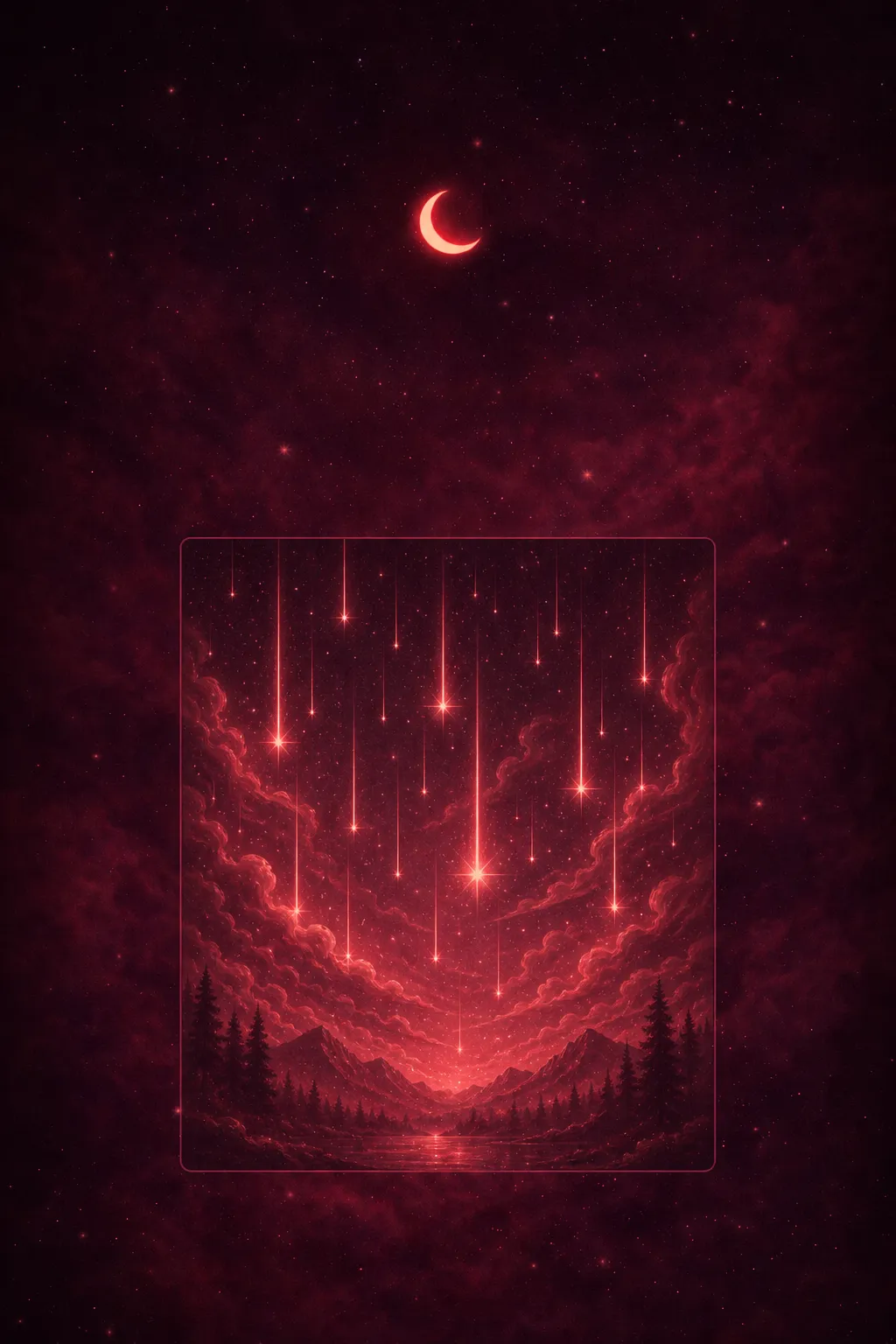

Dreaming about falling stars typically means you are experiencing a powerful moment of wish fulfillment, hope, or transformation, as falling stars in dreams often symbolize fleeting opportunities, the release of old ambitions, or a profound shift in your personal journey that urges you to seize the moment before it passes.
In under a minute you could read what your exact dream means for you, and see a picture of it. Free.
Bad dream? See exactly what you dreamed — turned into a picture.
Just describe it and Dream Book paints your dream as a real image, plus a reading of what it means for you. Free, and it takes under a minute.


A dream still on your mind? Get your personal reading.
Describe your dream in a line or two. In seconds you get a reading of your exact dream, a picture drawn from your own words, and every symbol explained.
Free. No sign-up. Takes 10 seconds. Your dream stays private.
0%
Analyzing your dream…
Something went wrong. Please try again in a moment.
Your dreams deserve more than a dictionary
Common Falling Star Dream Scenarios
The specific details of your dream shift its meaning considerably. A single shooting star streaking across a dark sky is the most familiar scenario — psychologically, it signals a hope or desire pushing its way into conscious awareness, a gentle nudge to name what you actually want. If in the dream you pause and make a wish, that active choice reflects agency: your mind is rehearsing goal-setting and acknowledging an unmet longing rather than leaving it vague. Contrast this with the star fading before you can wish — a scenario closely tied to timing anxiety, the modern fear of missing windows of opportunity before they close.
- Meteor shower (many stars at once): Read by emotional tone. Awe points to abundance and expansive possibility; dread or chaos suggests overwhelm, too many competing priorities pulling your focus.
- Star crashes into the ground: An anxiety spike — fear of a fall from grace, a collapsing ideal, or a sudden ending. This variant often surfaces during high-pressure periods when a valued position or relationship feels unstable.
- Apocalyptic sky full of falling stars: Large-scale loss of control. For dreamers with a Christian framework, the imagery can carry end-times resonance; psychologically it maps onto life-stage transitions where familiar structures feel like they are dissolving all at once.
- Watching with another person: Shared wonder signals emotional investment in a relationship and mutual hopes — a reminder that some aspirations are held collectively, not just privately.
A bad dream isn't a bad sign.
Across all variants, the central tension is control versus surrender: are you the one making the wish, or is the event simply happening to you? Noticing which role you played in the dream is often the most direct route to self-knowledge about where you feel empowered — and where you feel at the mercy of forces beyond your reach.
What this dream could look like
Tap an image to open it full screen
Example images. Only you can see what you write in Dream Book.
Psychological Meaning of Falling Stars in Dreams
From a psychological standpoint, dreaming of falling stars gives voice to material the waking mind rarely examines directly — unspoken desires, fears about losing something cherished, and the quiet dread that good things cannot last. Much like dreams about teeth falling out, a falling star carries a potent sense that something once solid and luminous is slipping beyond your reach. That "something" might be social standing, a career milestone, an admired mentor, or your own self-image — all of which the unconscious can compress into the image of a star descending from its rightful height.
The emotional charge of the symbol pulls in two directions simultaneously. On one side sits hope: the deep cultural reflex to make a wish on a shooting star surfaces genuine aspirations you may not have admitted to yourself. On the other side sits anxiety — particularly in modern life, where uncertainty about the future can manifest as a sky full of falling stars, an image that encodes overwhelm and loss of control. That tension between wishing (an act of agency) and watching a star fall (something that simply happens to you) mirrors a broader psychological struggle between the desire to steer your own life and the reality that many forces lie outside your hands.
- Unspoken longing: the dream may be prompting you to consciously acknowledge a goal you have been suppressing or dismissing as unrealistic.
- Status anxiety: a falling star can represent a fear that you — or someone you look up to — is losing prestige or fading from a once-bright position.
- Processing impermanence: the brief, brilliant arc signals an awareness that a meaningful phase is ending, and that grief or closure needs an outlet.
- Emotional release: the star's trajectory mirrors the arc of letting go — discharging pent-up feeling and finding a kind of resolution in surrender.
General meanings end here. Read your own dream.
Describe your dream in a line or two. In seconds you get a reading of your exact dream, a picture drawn from your own words, and every symbol explained.
Free. No sign-up. Takes 10 seconds. Your dream stays private.
0%
Analyzing your dream…
Something went wrong. Please try again in a moment.
Your dreams deserve more than a dictionary
Every dream you log starts to connect.
Dream Book keeps your dreams in one place and reveals the threads between them over time — your private dream journal. Free to start.
Cultural and Traditional Readings of Falling Stars in Dreams
In mainstream Western culture, the falling star has been polished into one of the most recognizable symbols of hope and aspiration. Songs, films, and childhood rituals have drilled the same instruction into the collective imagination: spot a shooting star, close your eyes, make a wish. That ritual is worth pausing on — it is one of the few folk traditions that explicitly hands control back to the dreamer. You cannot steer the meteor, but you can claim the moment, which speaks directly to modern anxieties about agency in an unpredictable world. When a falling star appears in a dream, that same cultural conditioning tends to surface, framing the image as an invitation to name what you genuinely want rather than what you think you should want.
But what does your version mean?
Yet English carries a darker idiom running alongside the romantic one. A fallen star describes a person who once shone brightly and has since lost their standing — a disgraced celebrity, a faded talent. This folk usage quietly loads the dream symbol with a fear of decline, and it resonates with contemporary anxieties around status, relevance, and reinvention. Dreaming of a star that burns out before it crosses the sky can tap that unspoken worry: am I peaking, or already past it?
- Wish-making tradition: frames the dreamer as an active participant — a rare sense of control over an otherwise uncontrollable spectacle.
- Biblical overtones: in Christian tradition, falling stars occasionally signal divine warning or the end of an era, lending the image a weight beyond mere bad luck.
- "Reach for the stars" idiom: culturally reinforces aspirational readings, but also implies a real risk of falling short.
Spiritual Meaning of Falling Stars in Dreams
Within a Christian frame, falling stars carry unmistakable scriptural weight. Passages such as Revelation 6:13 and Matthew 24:29 describe stars dropping from heaven as signs of upheaval and tribulation, so a dream filled with cascading stars can surface as a subconscious prompt toward spiritual readiness — an inner alarm that something in your life may be reaching a turning point that calls for more than practical problem-solving. That said, a single brilliant star arcing through a dark sky reads very differently: in the same tradition it can feel like divine reassurance, a quiet signal that hope is still alive even when circumstances feel shaky.
Was yours a sign? Find out.
The folk custom of wishing on a falling star adds a secular-spiritual layer that many people carry without quite naming it as religious. Making a wish in a dream taps a genuine act of surrender — you release a desire into something larger than yourself and trust it will be received. For dreamers wrestling with modern anxieties around control, that gesture carries real spiritual significance: it is a rehearsal of letting go, an acknowledgment that not every outcome can be engineered. The falling star becomes a symbol not of failure but of faithful release.
- Mass falling stars: may signal a call to examine spiritual priorities or brace for significant change.
- A single shooting star: often reads as reassurance, hope, or a sense that a sincere desire has been heard.
- Wishing in the dream: points to a healthy spiritual impulse — learning to surrender what you cannot control.
Related Dream Meanings
common dreams
Falling Dream Meaning: Insecurity, Fear & Loss of Control
5 min read
body health
Teeth Falling Out Dream: Anxiety, Loss & Vulnerability
5 min read
common dreams
Stars Dream Meaning: Hope, Guidance & Aspiration
5 min read
common dreams
What Does It Mean to Dream About Heaven
5 min read
common dreams
Heights: Meaning and Interpretation
5 min read
common dreams
Finding a New Room Dream: Growth & Hidden Potential
5 min read
common dreams
Running Dream Meaning: Escape, Stress & Freedom
5 min read
common dreams
School Dream Meaning: Anxiety, Nostalgia & Growth
5 min read
Practical Takeaways: What to Do After a Falling Star Dream
The most grounded step you can take is to treat the dream as a prompt for honest self-inventory. Ask yourself: what hope or goal have you been quietly carrying without naming it out loud? Falling star dreams often surface precisely when a wish has been left unspoken for too long. Writing it down — even one sentence in a notes app — moves it from vague longing into something you can actually evaluate and act on.
Because these dreams also tap into modern anxieties around control and impermanence, it helps to separate what is genuinely within your reach from what is not. A quick exercise: draw two columns labeled I can influence this and I cannot control this, then sort your current stressors between them. Falling stars happen to the dreamer — but your waking response is yours to direct.
A bad dream isn't a bad sign.
- Name the wish. Identify one aspiration the dream may be pointing at and write a single concrete next step toward it.
- Check for grief. If the dream felt like loss rather than wonder, consider whether something — a relationship, a role, an expectation — has quietly ended and hasn't yet been mourned.
- Audit your pressure load. Recurring falling imagery (see also falling dreams) often signals accumulated stress; scaling back one commitment can reduce the sense that things are slipping out of orbit.
- Revisit the dream in a week. Circumstances shift; what felt like collapse may later read as necessary change.
If it keeps coming back, the app helps you understand the pattern.
Log each recurring dream and the free app shows you what's underneath — calmly, over time. Free to start.
People Also Ask
Spiritually, falling stars symbolize divine messages, wishes coming true, and significant life transitions. Many traditions view them as souls journeying to the afterlife or angels delivering guidance. In dreams, they often suggest a powerful moment of change, a spiritual awakening, or a reminder to pay attention to deeper callings in your life.
Falling stars are traditionally considered good luck, especially when you make a wish upon seeing one. However, in some cultures they signal endings or warnings. In dreams, context matters — a graceful falling star usually brings positive omens, while a crashing or violent one may suggest instability or an upcoming challenge requiring your attention.
Dreaming about stars generally reflects hope, destiny, and higher consciousness. Stars represent guidance, inner wisdom, and your aspirations. Spiritually, they suggest you are connected to something greater than yourself. Such dreams encourage you to trust your path, embrace your purpose, and recognize that universal forces may be working in your favor.
Yes, fallen stars in dreams are widely seen as lucky symbols representing fulfilled wishes, new opportunities, and positive transformation. They can signal that a long-awaited desire is finally within reach. If the star lands softly or glows upon falling, this strengthens the lucky interpretation, hinting at blessings and rewarding changes approaching your waking life.
Curious what your dream would look like?