
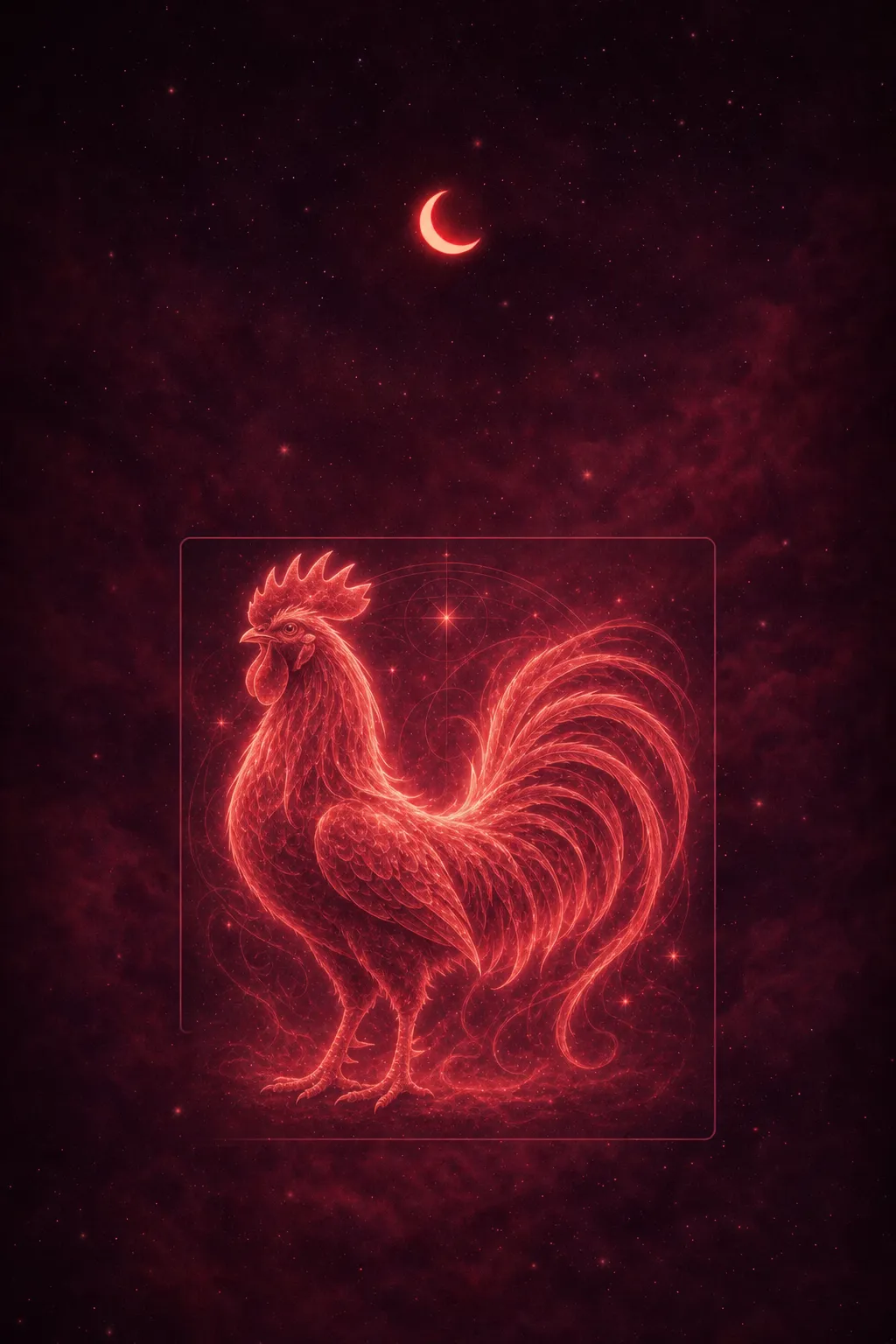

A rooster crowing in a dream symbolizes awakening, new beginnings, and timely opportunity, suggesting that your subconscious is urging you to rise to a challenge, seize a moment before it passes, or embrace a bold, confident call to action in your waking life.
In under a minute you could read what your exact dream means for you, and see a picture of it. Free.
You read what it can mean. But what did yours mean?
General meanings stop here. In the free app, tell Dream Book your exact dream and get a reading that actually makes sense for you.


Common Rooster Dream Scenarios and What They Mean
The most frequently reported scenario — a rooster crowing at dawn — is one of the psyche's clearest wake-up calls. If you hear that crow in a dream, something in your waking life is demanding attention you've been withholding: a deadline, a difficult conversation, a decision sitting on the back burner. The modern-anxiety angle is hard to ignore here; many people report this dream during periods of procrastination or major transition, as if the subconscious is sounding an alarm before circumstances force the issue. At Dream Book we explore this symbol in depth.
- Rooster attacking or chasing you: Points to a confrontation with an aggressive or domineering person — a pushy boss, a competitive peer, or even your own suppressed anger. Much like dreams of being chased, the instinct to flee rather than face the threat is the real message: something needs to be addressed, not outrun.
- A colorful rooster strutting proudly: Raises the question of confidence versus arrogance — either in you or someone around you. Status pressure and concern about public image often sit behind this image.
- Two roosters fighting: Suggests rivalry or a clash of strong-willed impulses, whether an external competition (a workplace contest, a struggle for recognition) or an internal tug-of-war between ambition and restraint — two assertive sides of yourself competing for control.
- A silent, sick, or dead rooster: Reflects lost drive, dreams touching on endings or loss of vitality, burnout, or a warning gone unheeded — diminished assertive energy that once kept you alert.
- A rooster presiding over a flock: Speaks to leadership responsibility, family dynamics, or the pressure of being the one others look to for direction and protection.
What this dream could look like
Tap an image to open it full screen
Example images. Only you can see what you write in Dream Book.
The Psychological Reading: Ego, Alertness, and the Push to Wake Up
From a psychological standpoint, the rooster operates as a symbol of the ego in its most charged state — assertive, visible, and demanding to be heard. Carl Jung associated bird imagery broadly with the rise of unconscious material into conscious awareness, and the rooster sharpens that idea: it doesn't simply surface quietly, it announces itself. When this bird appears in your dreams, the subconscious is likely flagging an imbalance between how you see yourself and how you're actually showing up. That gap — between self-image and behavior — is the psychological engine behind most rooster dreams.
But what does your version mean?
Modern anxiety adds another layer. In a culture saturated with pressure to perform and project confidence, the rooster can mirror the exhausting performance of competence: crowing loudly to convince others (and yourself) that everything is under control. If the rooster in your dream feels aggressive or out of place, consider whether your waking life has you overextending your authority, or conversely, suppressing a legitimate need to be heard. The emotional register here — pride shading into irritation, alertness curdling into confrontation — mirrors the internal friction many people feel around self-assertion, not unlike the anxiety of losing face or credibility that teeth dreams so often surface. For those who hold a Christian framework, the rooster also echoes Peter's denial, a reminder that self-knowledge requires honesty about moments when fear overrides conviction.
- Crowing rooster you can't silence: anxiety about losing control of a narrative or situation at work or at home.
- A rooster that ignores you: the psyche signaling a part of yourself — assertiveness, ambition — that feels shut down or unacknowledged, a dynamic that also underlies many chase dreams where avoidance replaces engagement.
- A silent rooster at dawn: anticipation without release — transformation is near but something is blocking the announcement of change.
General meanings end here. Read your own dream.
Describe your dream in a line or two. In seconds you get a reading of your exact dream, a picture drawn from your own words, and every symbol explained.
Free. No sign-up. Takes 10 seconds. Your dream stays private.
0%
Analyzing your dream…
Something went wrong. Please try again in a moment.
Your dreams deserve more than a dictionary
Cultural Traditions and Folk Beliefs Around the Rooster
Across Western folk tradition, the rooster has long stood at the boundary between darkness and light — a creature whose crow was believed to drive away evil spirits and announce the return of order. In medieval European culture, weather vanes were cast in the shape of roosters partly as a ward against misfortune, and the bird was understood to be a sentinel of the threshold. That protective, boundary-marking role feeds directly into the modern dream: when a rooster appears, many traditional readings treat it as a prompt to stand guard over something in your life before it slips away unnoticed.
Within American Christian folk culture, the rooster carries a pointed biblical weight — most famously as the bird that crowed at Peter's denial, making it a symbol of conscience, self-reckoning, and the cost of avoiding hard truths. That layer gives the dream symbol a particular edge for dreamers raised in that tradition: the rooster is not just a herald of the new day but a mirror asking whether you are being honest with yourself about a situation you'd rather not face — not unlike the unsettling clarity that can arrive in dreams about losing teeth.
Was yours a sign? Find out.
- Herald of change: Folk traditions widely read the crowing rooster as an announcement that a shift is coming whether you are ready or not.
- Pride and overreach: In proverbial culture, the strutting rooster is a classic caution against letting confidence tip into arrogance.
- Vigilance rewarded: Many European folk sayings treat the rooster as a model of watchfulness — the one who sees dawn first because he never stopped paying attention.
In a modern-anxiety context, these traditions translate with surprising directness. The rooster can surface during periods of high stress around control and change, borrowing an ancient image to deliver a straightforward message: something is already crowing for your attention, and ignoring it only delays the reckoning.
The Spiritual Reading: Conscience, Wakefulness, and the Moment Truth Arrives
For dreamers with a Christian frame of reference, the rooster carries one of Scripture's most quietly devastating images: the crow that broke Peter's denial. In the Gospel accounts, that sound did not condemn Peter so much as it forced him into radical self-knowledge — the bird's call marked the exact instant he could no longer avoid who he had been in that moment. If a rooster appears in your dream during a season of moral tension, avoidance, or quiet guilt, it may be functioning in exactly that biblical register: a prompt from conscience asking whether you are being honest about your own choices, loyalties, or fears — not unlike the helpless exposure that defines dreams about teeth falling out.
A bad dream isn't a bad sign.
Beyond that specific scriptural echo, the rooster's crow has long carried a broader spiritual meaning of watchfulness — the sentinel cry before something significant arrives. Many Christian traditions historically read the crowing hour as a call to prayer and alertness, a reminder that spiritual complacency carries its own cost. In a modern-anxiety context, this maps cleanly onto the experience of sensing that change is approaching but choosing not to prepare — the dream rooster as a spiritual nudge toward intentional readiness rather than passive drifting, much like the urgent forward momentum felt in dreams about being chased.
- Self-examination: The Peter narrative frames the rooster as a mirror — where in your waking life might you be in denial of something true?
- Spiritual alertness: The crow signals a threshold; something spiritually or morally significant may be closer than you want to admit.
- Conscience as compass: Rather than dread, the rooster here invites honest self-inventory — the kind that ultimately restores rather than diminishes.
Related Dream Meanings
nightmares
Being Chased Dream Meaning: Anxiety & Avoidance
5 min read
nightmares
Death Dream Meaning: Transformation, Loss & Change
5 min read
body health
Teeth Falling Out Dream: Anxiety, Loss & Vulnerability
5 min read
animals
Tarantula Dream Meaning: Fear, Control & Transformation
5 min read
animals
Wasp Dream Meaning: What It Symbolizes in Your Dreams
5 min read
animals
What Does It Mean to Dream About Feathers
5 min read
animals
Black Horse Dream Meaning: Symbolism and Interpretation
5 min read
animals
Stray Dog Dream Meaning: Abandonment, Loyalty & What Your Psyche Is Saying
5 min read
Practical Takeaways: Turning the Rooster's Wake-Up Call Into Action
When a rooster shows up in your dream, treat it less as a curiosity and more as a prompt for honest self-inventory. Before the details fade, jot down what the rooster was doing and how you felt — crowing at you signals urgency, while a silent or caged bird may point to energy you're suppressing. That emotional fingerprint is your starting data.
- Name the thing you've been avoiding. The rooster's core meaning is alertness to what you're ignoring. Write down one situation — a conversation, a decision, a commitment — you've been putting off. Give yourself a concrete deadline to address it.
- Check your assertiveness calibration. Ask whether you've been too passive (missing your moment to speak up) or too aggressive (dominating situations in ways that are alienating others). The rooster dream often flags one extreme or the other.
- Notice stress-driven control patterns. Modern anxiety frequently masquerades as hyper-vigilance. If the dream felt tense or confrontational, consider whether you're expending energy trying to control outcomes that aren't yours to manage — a pattern also common in dreams about being chased.
- Set one "dawn habit." Since the rooster marks a threshold, channel that symbolism practically: identify one small morning practice — reflection, planning, a difficult email sent early — that signals intentional forward movement rather than drift.
But what does your version mean?
The rooster rarely appears when everything is on track. Use it as reliable inner feedback: something real is calling for your attention, and the most grounded response is simply to answer it.
One dream is never the whole picture.
The free app remembers your dreams, draws them, and connects the threads over time — so the next one means even more. Free to start.
People Also Ask
A rooster crowing spiritually signals awakening, divine timing, and the call to step into your purpose. Many traditions associate its cry with the breaking of darkness and the arrival of truth. It urges you to rise, pay attention, and embrace a fresh chapter with courage and renewed awareness.
In dreams, a rooster often represents confidence, masculinity, leadership, and punctuality. It may reflect your inner drive to be heard or recognized. Seeing one can suggest you are ready to assert yourself, announce your truth, or that an important opportunity is arriving and you must not sleep through it.
Spiritually, the rooster symbolizes vigilance, resurrection, and the triumph of light over darkness. Across cultures it is a sacred guardian that heralds new beginnings. It also represents honesty, as its crow cannot be silenced, reminding us to live and speak authentically regardless of outside pressure or fear.
Yes, a crowing rooster in a dream can serve as a warning to wake up to something you have been ignoring. It may signal that time is running out, a situation demands your immediate attention, or that you risk missing a significant turning point in your waking life if you remain passive.
Curious what your dream would look like?