
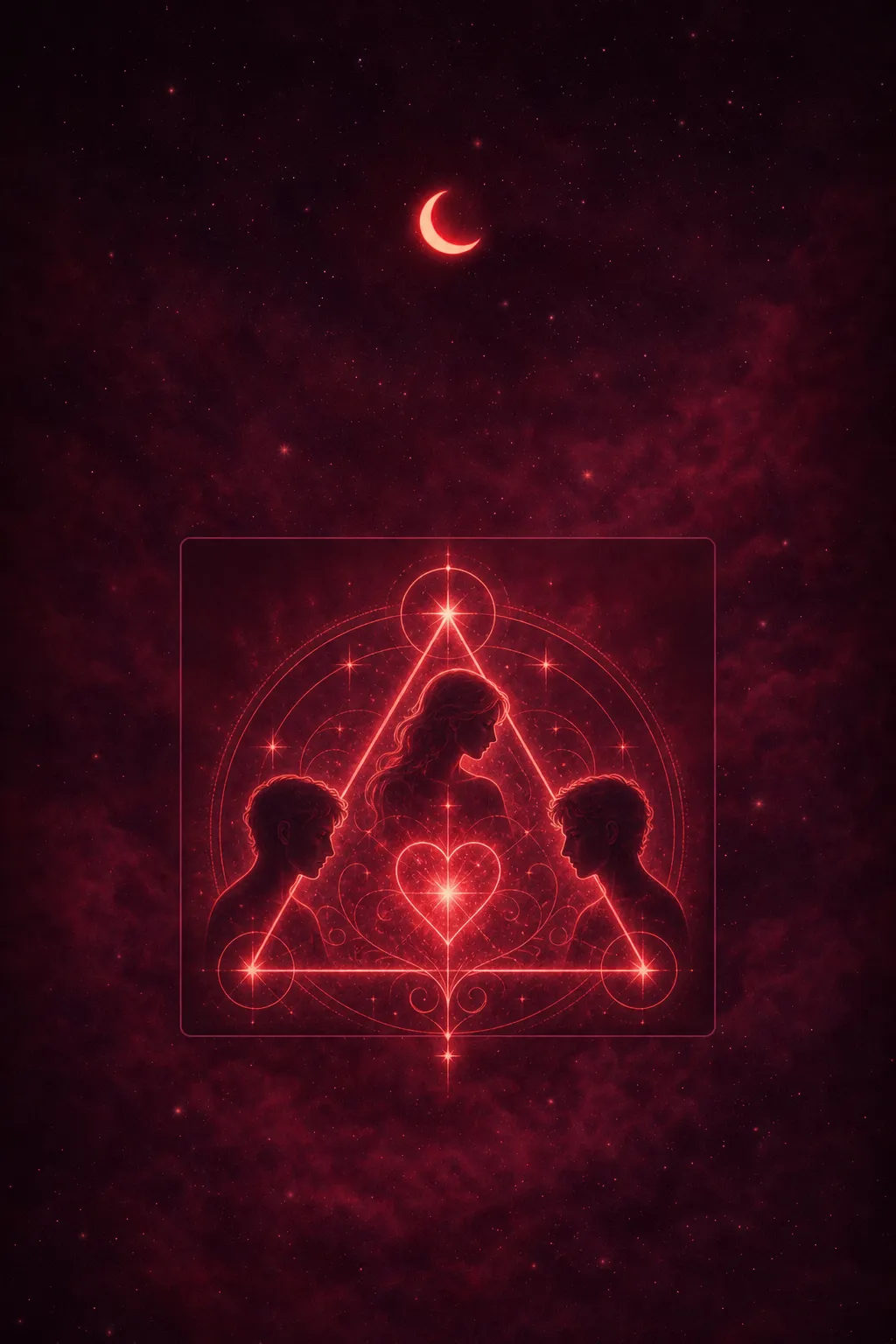

Dreaming of a love triangle often reflects inner conflict between two competing needs, values, or paths in your waking life — not necessarily a literal romantic situation. It can signal feelings of jealousy, indecision, or a fear of being replaced in a relationship. This dream usually invites you to examine where you feel torn or emotionally divided.
In under a minute you could read what your exact dream means for you, and see a picture of it. Free.
You read what it can mean. But what did yours mean?
General meanings stop here. In the free app, tell Dream Book your exact dream and get a reading that actually makes sense for you.


Common Love Triangle Dream Scenarios
You Are the One Being Chosen Between Two People
This scenario — two people competing for your affection while you watch — tends to surface when you feel undervalued or invisible in your waking life. You're not the one making the choice; you're the prize. That shift in agency matters.
It can also reflect a genuine hunger for validation. If you've been feeling unseen in a relationship or friendship, your dreaming mind stages this scene to give you what you're not getting in daylight. The two figures competing for you aren't always literal — one might represent your career, your family, your old self.
But what does your version mean?
You Are Torn Between Two Romantic Partners
This is the most emotionally raw version of the dream. You're standing between two people — one familiar, one new — and you can't move. If one of those figures is an ex-partner, the dream is almost certainly about unfinished emotional business, not a sign you should rekindle anything. The ex represents a chapter your psyche hasn't fully closed.
If both figures are real people in your current life, the dream is worth sitting with honestly. It's rarely about wanting two people simultaneously — it's more often about feeling like your current relationship is missing something the other person represents. That something is worth naming.
Your Partner Is the One Torn Between You and Someone Else
Watching your partner choose between you and a rival is one of the most distressing love triangle dreams. It mimics the feeling of being cheated on — that cold, nauseating drop in the stomach — even if your relationship is solid. This dream often has less to do with actual infidelity and more to do with insecurity: a fear that you're not enough, that someone better could come along.
It can also signal that you've noticed something subtle in your waking life — a distance, a change in behavior — that you haven't consciously acknowledged yet. The dream is your emotional radar doing its job.
The Third Person Is a Stranger
When the rival in your love triangle dream has no face or is someone you don't recognize, the symbol shifts. The stranger isn't a real threat — they're a projection. Often they represent an abstract fear: of change, of being replaced, of not being lovable. If you've been dreaming of jealousy without a clear target, this faceless rival is that feeling given a body.
Jung would call this a Shadow figure — the embodiment of everything you fear about yourself or your relationship. The stranger isn't the problem. The feeling they represent is.
What this dream could look like
Tap an image to open it full screen
Example images. Only you can see what you write in Dream Book.
Psychological Interpretation
Freud would have leaned into the obvious: desire. For him, a love triangle dream is the unconscious staging a wish — either a forbidden attraction you've suppressed, or a deeper Oedipal echo, competition for love that traces back further than you'd expect. He saw romantic dreams as the psyche's way of giving form to what waking life censors. The triangle isn't just a shape; it's a structure of longing.
Jung took a different angle entirely. He'd point to the triangle as a symbol of psychological tension between opposing forces — not two lovers, but two aspects of the self in conflict. The person you're "losing" your partner to might be your Shadow: the part of yourself you've rejected, and which now appears externalized as a rival. For Jung, the real work isn't choosing between two people — it's integrating the split within. This dream often appears during periods of individuation, when you're growing into a more complete version of yourself and the old relationship structure no longer fits.
Was yours a sign? Find out.
Calvin Hall's content analysis of over 50,000 dream reports found that romantic rivalry and interpersonal conflict are among the most frequently reported dream themes, particularly in younger adults. His cognitive theory frames the love triangle not as symbolic but as a direct mental rehearsal — the brain working through real social anxieties, playing out scenarios it hasn't resolved. If you've been avoiding a difficult conversation about your relationship, Hall would say your dreaming mind is rehearsing it for you, whether you asked it to or not.
Ernest Hartmann's emotional processing theory adds another layer. He argued that dreams function like emotional therapy — they take the raw feeling (jealousy, fear of abandonment, unresolved unrequited love) and wrap it in narrative to make it bearable. The love triangle is the story your brain builds around an emotion that doesn't yet have words. Hartmann would say: the dream isn't the problem to solve. It's the solution already in progress.
General meanings end here. Read your own dream.
0%
Analyzing your dream…
Something went wrong. Please try again in a moment.
Your dreams deserve more than a dictionary
Cultural & Spiritual Meaning
In Western psychological tradition, the love triangle dream is almost universally read as a symbol of internal conflict — the divided heart as a metaphor for a divided self. Literature and mythology are saturated with triangles: Arthur, Guinevere, Lancelot; Orpheus, Eurydice, Death itself. The triangle appears so often in storytelling because it captures something true about human desire: we rarely want just one thing cleanly.
Ibn Sirin, the 8th-century Islamic scholar whose dream interpretations remain influential across the Muslim world, interpreted romantic rivalry in dreams as a warning about fitna — discord and temptation in waking life. He read such dreams not as predictions of actual infidelity but as signals to examine one's loyalties and intentions before they became action. For Ibn Sirin, the dream was a moral mirror, not a prophecy. If you're dreaming of forbidden love, his tradition would urge reflection on where your commitments truly lie.
A bad dream isn't a bad sign.
In many East Asian traditions, dreaming of being caught between two lovers is read as a sign of imbalance — specifically, that you're giving too much of yourself to external relationships at the expense of inner harmony. Some Indigenous traditions frame the triangle differently still: three is a sacred number, and the dream might represent not conflict but synthesis — the self, the beloved, and the divine or communal dimension of love that holds them both. The question isn't who to choose, but what the third point of the triangle actually represents in your life.
Related Dream Meanings

people
Ex Partner Dream Meaning: What Your Dreams About Former Lovers Reveal
6 min read

people
Being Cheated On Dream Meaning: Insecurity & Trust
5 min read
people
Jealousy Dream Meaning: Insecurity, Fear & Hidden Desires
5 min read

people
Unrequited Love Dream Meaning: Longing & Self-Worth
5 min read

people
Forbidden Love Dream Meaning: Desire, Guilt & Longing
5 min read

people
Ex-Boyfriend Dream Meaning: Unresolved Feelings Explained
5 min read
people
Dreaming About Your Husband: Meaning and Interpretation
6 min read
people
Stranger Dream Meaning: Hidden Self & New Opportunities
5 min read
What to Do After This Dream
Start by resisting the urge to treat this dream as a literal message. If you woke up convinced your partner is hiding something, take a breath before acting on that. Love triangle dreams are almost always about internal conflict — and confronting your partner based on a dream is a fast way to create the very distance you fear.
Instead, ask yourself: what does each person in the triangle represent? Not who they are, but what quality or feeling they carry in the dream. The rival might represent freedom, excitement, or a version of your life you've set aside. Your partner might represent security, familiarity, or commitment. The triangle is your psyche's way of showing you that you want both — and asking whether that's possible.
Journaling immediately after waking helps. Write down the emotional texture of the dream — not just the plot, but how each moment felt. If this dream keeps returning, it's worth exploring with a personalized interpretation — Dream Book lets you describe your dream in detail and ask follow-up questions to understand what your subconscious is really working through, beyond what any dictionary can offer.
If the dream is connected to a real relationship tension — an ex-boyfriend who keeps appearing, a pattern of jealousy that won't quiet down — consider whether there's a conversation you've been avoiding. Dreams don't create problems. They illuminate the ones already there.
But what does your version mean?
Understanding your love triangle dream is the first step. The next is asking what it means for your life right now — that's where a personalized interpretation goes deeper than any dictionary.
One dream is never the whole picture.
The free app remembers your dreams, draws them, and connects the threads over time — so the next one means even more. Free to start.
People Also Ask
Dreaming about being in a love triangle usually signals internal conflict — a choice you're avoiding, competing desires, or fear of losing someone important. It's rarely a literal prediction about your relationship and more often a reflection of divided loyalties or unresolved feelings within yourself.
Recurring love triangle dreams involving an ex typically mean there's unfinished emotional business you haven't fully processed. Your subconscious uses the ex as a symbol for something your current life is missing or a chapter that doesn't feel closed yet — not necessarily a sign you want them back.
Not usually. These dreams are far more commonly driven by personal insecurity, fear of abandonment, or anxiety about your relationship's future than by any actual infidelity. If the dream feels urgent, it's worth examining what's making you feel insecure — not assuming the worst about your partner.
A faceless or unknown rival in a love triangle dream typically represents an abstract fear — of being replaced, of not being enough, or of change. Jungian psychology would call this a Shadow figure: not a real person, but a projection of something unresolved within yourself.
Curious what your dream would look like?