
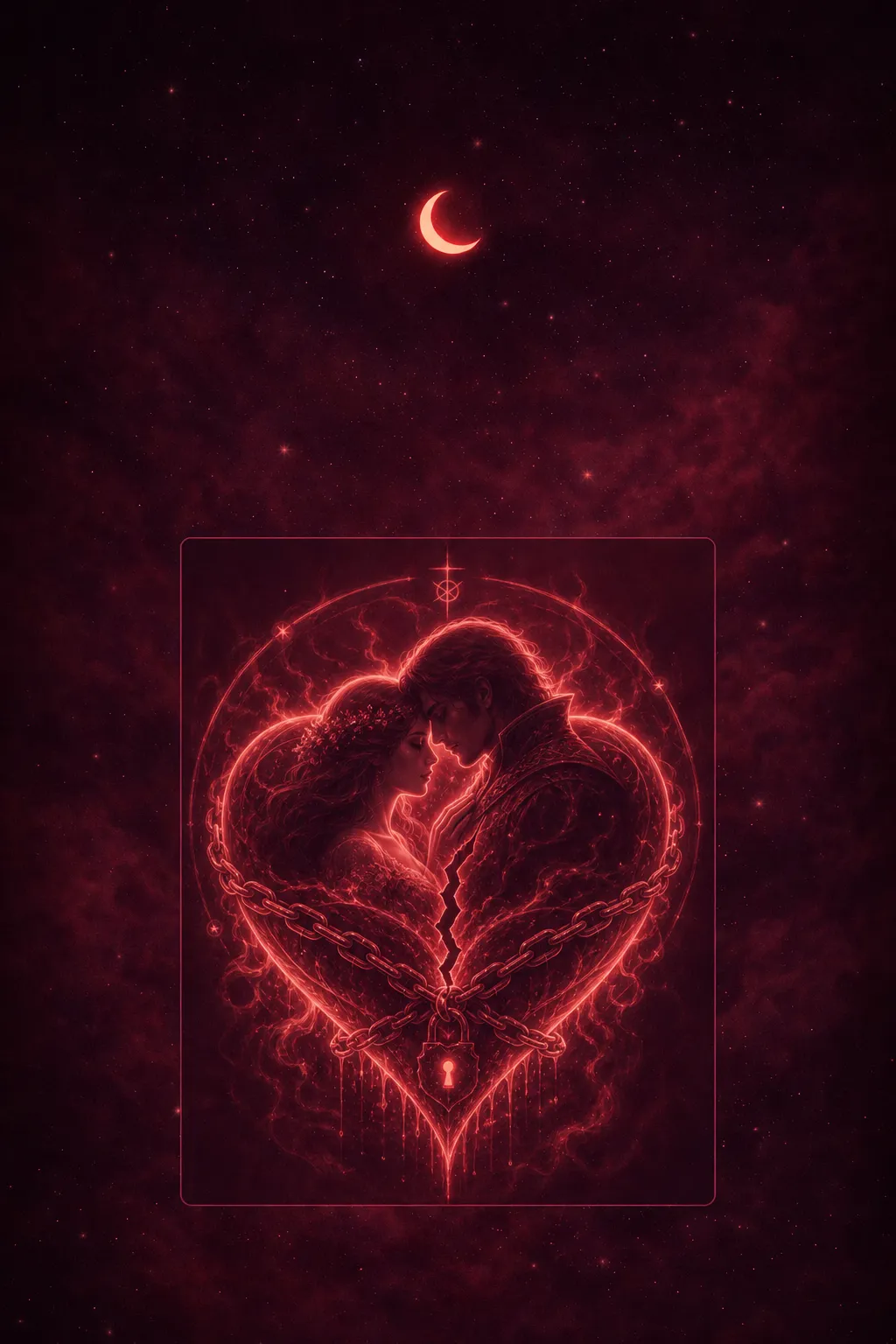

Dreaming of forbidden love usually reflects suppressed desires, unresolved emotional tension, or a longing for something your waking self feels you cannot have. It can also symbolize an internal conflict between what you want and what you believe is right. These dreams rarely predict real-life actions — they invite you to explore the deeper needs or boundaries your psyche is processing.
In under a minute you could read what your exact dream means for you, and see a picture of it. Free.
You read what it can mean. But what did yours mean?
General meanings stop here. In the free app, tell Dream Book your exact dream and get a reading that actually makes sense for you.


Common Forbidden Love Dream Scenarios
Dreaming of a Forbidden Kiss
You lean in. Or they do. The moment feels charged with everything unsaid — and then you wake up with your heart pounding. A kissing dream involving someone you "shouldn't" want is rarely just about that person. It's your unconscious granting you permission to feel something your waking mind keeps locked away.
This dream often appears during periods of emotional suppression — when you're maintaining a relationship out of obligation, or when you've told yourself that a particular desire is wrong. The forbidden kiss is the psyche's pressure valve. It doesn't mean you should act on it. It means something inside you is asking to be acknowledged.
But what does your version mean?
Falling in Love with a Stranger
Sometimes the forbidden figure has no face you recognize. You're falling in love with someone who feels entirely real in the dream, yet doesn't exist in your waking world. This is one of the more disorienting versions — because the longing lingers after you wake, attached to no one you can name.
Jung would say this stranger is an anima or animus figure — a projection of your own inner opposite, the part of yourself you haven't integrated. The "forbidden" quality here isn't about another person at all. It's about a quality, a way of being, a life you're not letting yourself live.
Forbidden Love with an Ex
Dreaming of kissing an ex or falling back into love with a former partner is one of the most searched dream experiences — and one of the most misread. Most people assume it means they want that person back. Often, it means something else entirely.
Your ex-partner in a dream frequently represents a feeling-state you associate with that relationship — freedom, passion, being truly seen — rather than the actual person. The "forbidden" layer adds guilt or grief: maybe the relationship ended badly, or you're with someone else now. What the dream is really asking is: what did that chapter give you that you're still hungry for?
A Secret Affair That Feels Real
You're hiding something. Meeting someone in secret. The dream has the texture of a double life — exhilarating and shameful at once. This scenario tends to emerge when you feel trapped in your current circumstances, whether in a relationship, a job, or a role you've outgrown.
If you've been dreaming of being cheated on in other dreams, the secret affair dream can be the flip side — your unconscious exploring both sides of a trust wound. It's worth sitting with the feeling the dream leaves behind. Is it guilt? Relief? Grief? That emotional residue is the real message.
What this dream could look like
Tap an image to open it full screen
Example images. Only you can see what you write in Dream Book.
Psychological Interpretation
Freud would have had a field day with forbidden love dreams. For him, they were almost textbook wish fulfillment — the dreaming mind enacting desires that the waking ego censors through repression. He believed the "forbidden" quality was the whole point: the dream disguises the wish just enough to slip past the internal censor, letting you experience what you've pushed underground. The more charged the taboo, the more insistently it tends to surface in sleep.
Jung took a different angle. He saw forbidden love dreams as invitations toward individuation — the lifelong process of becoming whole. The person you desire in the dream is often a Shadow figure: a carrier of qualities you've disowned, projected outward onto someone else. The desire you feel isn't just romantic. It's the pull toward integration, toward accepting parts of yourself you've exiled. If the dream leaves you feeling ashamed, that shame itself is worth examining — it usually points directly at what you've been refusing to see.
Was yours a sign? Find out.
Calvin Hall's content analysis of tens of thousands of dream reports found that love and romantic dreams overwhelmingly involve conflict — not simple wish fulfillment, but the tension between desire and consequence. His data showed that dreamers rarely get what they want cleanly; the dream stages the wanting, not the having. This aligns with what most people report: the forbidden love dream is rarely consummated without complication. Something always interrupts, or the feeling sours, or you wake just before resolution.
Ernest Hartmann's emotional processing theory offers perhaps the most useful frame. He argued that dreams exist to help us metabolize strong emotions — particularly ones we haven't been able to process consciously. A forbidden love dream, in this view, is the brain doing therapeutic work: taking the raw emotional charge of longing, guilt, or grief and weaving it into narrative so it can be felt, examined, and eventually integrated. Hobson and McCarley's activation-synthesis model adds a neurological layer — the dreaming brain is generating intense emotional signals and the cortex is building a story around them. The "forbidden" framing your mind constructs is meaningful precisely because your brain chose it from everything available.
General meanings end here. Read your own dream.
0%
Analyzing your dream…
Something went wrong. Please try again in a moment.
Your dreams deserve more than a dictionary
Cultural & Spiritual Meaning
In Western romantic tradition, forbidden love has always carried a mythic weight — Romeo and Juliet, Tristan and Isolde, the love that destroys because it cannot be contained. Dreams that echo this archetype are often read as the soul's protest against social constraint, the heart asserting something the world says it cannot have. In Jungian-influenced Western psychology, this maps onto the tension between persona (the face we show the world) and the deeper self that wants what it wants.
Ibn Sirin, the 8th-century Islamic scholar whose dream interpretations remain influential across the Muslim world, interpreted dreams of illicit or hidden love as warnings about temptation and the need for self-examination. For Ibn Sirin, such a dream was less about the desired person and more about the dreamer's inner state — a call to look honestly at where desire was pulling you away from your values. He distinguished carefully between dreams that arose from the soul (meaningful) and those arising from personal preoccupation (nafs), and forbidden love dreams, he noted, almost always fell into the latter: they reflected what you'd been thinking about, not prophecy.
A bad dream isn't a bad sign.
In many East Asian traditions, dreaming of a love that cannot be is associated with unfinished karmic business — a connection from a past life that echoes into the present. Some Indigenous traditions interpret such dreams as the spirit communicating what the waking mind refuses to voice, a message that requires a ritual response: speaking the feeling aloud, or releasing it through ceremony. Across cultures, the through-line is consistent: forbidden love in dreams is not shameful. It is information.
Related Dream Meanings

people
Kissing Dream Meaning: Intimacy, Desire & Connection
5 min read

people
Falling in Love Dream Meaning: Desire & Connection
5 min read

people
Dreaming About Kissing My Ex — What It Really Means
5 min read

people
Ex Partner Dream Meaning: What Your Dreams About Former Lovers Reveal
6 min read

people
Being Cheated On Dream Meaning: Insecurity & Trust
5 min read
people
Unrequited Love Dream Meaning: Longing & Self-Worth
5 min read
people
Dreaming About a Friend Meaning: What Your Dream Reveals
6 min read
people
Dreaming About Your Husband: Meaning and Interpretation
6 min read
What to Do After This Dream
First, don't panic — and don't immediately confess to anyone. A forbidden love dream is not a directive. It's a dispatch from a part of you that doesn't have another way to speak. Give it the same respect you'd give any important message: sit with it before you react.
Write down the feeling the dream left behind, not just the plot. Were you guilty? Euphoric? Heartbroken? That emotional signature is more revealing than who appeared in the dream. If the dream featured an unrequited love dynamic — wanting someone who didn't want you back — pay attention to where that pattern shows up in your waking life too.
Ask yourself honestly: what does the person or situation in the dream represent to you? Freedom? Passion? Being chosen? Those qualities are worth pursuing — just perhaps not in the form the dream presented them. If the dream keeps returning, that's your unconscious underlining something it considers urgent.
Dream Book lets you describe the specific details of your dream and ask follow-up questions to get a personalized interpretation — useful when a dream like this feels too charged to decode alone. Sometimes you need more than a dictionary. You need a conversation.
But what does your version mean?
Understanding your forbidden love dream is the first step. The next is asking what it means for your life right now — that's where a personalized interpretation goes deeper than any dictionary.
One dream is never the whole picture.
The free app remembers your dreams, draws them, and connects the threads over time — so the next one means even more. Free to start.
People Also Ask
It usually means your psyche is processing a desire, quality, or emotional need that you've judged as off-limits in waking life. The person in the dream often represents a feeling-state — passion, freedom, being truly seen — rather than a literal wish to pursue that individual. Sit with the emotion the dream leaves behind; that's where the real meaning lives.
Recurring dreams about an ex in a forbidden or secret context usually signal unresolved emotional business — not necessarily a desire to reunite, but an unmet need that relationship once fulfilled. Your unconscious keeps returning to it because something from that chapter hasn't been fully processed or grieved. Identifying what you associate with that person (safety, excitement, being understood) can point you toward what's missing now.
No — dreams are not instructions. They're the mind's way of processing emotion and desire, not a green light for action. Freud and Jung both emphasized that the value of such dreams lies in what they reveal about your inner life, not in any external behavior they recommend.
Across many traditions, forbidden love dreams are seen as a call for honest self-examination rather than a sign of wrongdoing. Ibn Sirin interpreted such dreams as reflecting the dreamer's own preoccupations and inner conflicts. Many spiritual frameworks view them as an invitation to understand what your soul is genuinely longing for beneath the surface desire.
Curious what your dream would look like?