
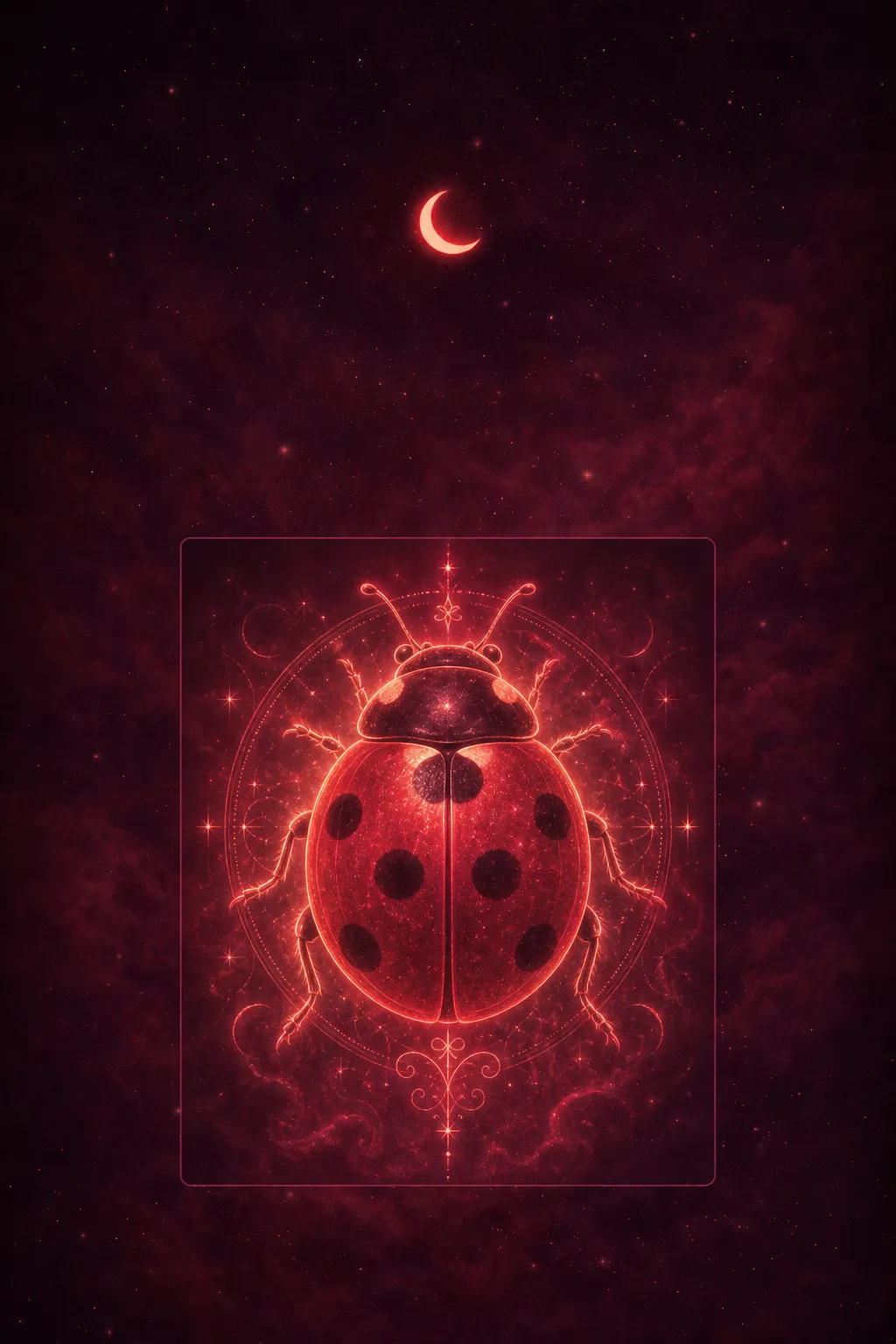

Dreaming of a ladybug often symbolizes good fortune, divine protection, and the arrival of positive change. Its bright appearance in a dream can reflect optimism, innocence, or a gentle nudge to trust the journey ahead. In many traditions, the ladybug is a sign that wishes may soon be granted.
In under a minute you could read what your exact dream means for you, and see a picture of it. Free.
A dream still on your mind? Get your personal reading.
Describe your dream in a line or two. In seconds you get a reading of your exact dream, a picture drawn from your own words, and every symbol explained.
Free. No sign-up. Takes 10 seconds. Your dream stays private.
0%
Analyzing your dream…
Something went wrong. Please try again in a moment.
Your dreams deserve more than a dictionary
Common Ladybug Dream Scenarios
A Ladybug Landing on You
When a ladybug lands on your hand, arm, or shoulder in a dream, pay attention to where it settles. That detail matters. The body part it touches often points to where the luck or healing is headed — a hand suggests your work or creativity, a shoulder suggests a burden about to lift.
This is one of the warmest dream experiences you can have. It carries an almost tactile sense of being chosen, singled out for something good. If you've been grinding through a difficult season, this dream is your subconscious registering a shift — something has changed, even if you can't see it yet in your daily life.
But what does your version mean?
A Swarm or Many Ladybugs
Dreaming of dozens or hundreds of ladybugs crawling across a surface — or rising up around you — can feel overwhelming even if the insects themselves are harmless. The emotional tone of the dream is everything here. If it felt wondrous, abundance is the message. If it felt suffocating, you may be dealing with too much of something good: too many opportunities, too many demands on your attention.
Think of it like dreaming of ants — both involve small creatures in large numbers, and both point to collective energy, community, and the cumulative power of small efforts. A swarm of ladybugs often appears when your life is about to get fuller, not emptier.
A Dead Ladybug
Finding a dead ladybug in a dream stings a little, and it's meant to. This image tends to surface when you feel that luck has run out, that a window of opportunity has closed, or that something once precious has passed its moment. It's a grief dream in miniature.
But dead things in dreams rarely mean permanent endings. Just as dreaming of a dead bird often signals the end of one phase rather than total loss, a dead ladybug usually marks a transition — something small and hopeful is finishing so something larger can begin. The feeling you wake with tells you which reading fits.
A Black Ladybug
A ladybug without its signature red — appearing all black, or with the colors reversed — is a rarer and stranger image. Black in dreams typically signals the unknown, the shadow, or something unacknowledged. A black ladybug carries the same symbolic energy as its red counterpart, but filtered through uncertainty. You sense the luck is there; you just can't quite trust it yet.
If you've been second-guessing good news, dismissing compliments, or waiting for the other shoe to drop, a black ladybug is your subconscious holding up a mirror. Compare this to the layered symbolism in butterfly dreams — transformation is present, but something is still obscuring the full picture.
What this dream could look like
Tap an image to open it full screen
Example images. Only you can see what you write in Dream Book.
Psychological Interpretation
Freud would have been less interested in the ladybug itself than in your emotional response to it. His framework centered on wish fulfillment — the idea that dreams stage what we desire but can't fully admit to wanting. A ladybug dream, in Freudian terms, might be the psyche granting you a small, safe version of the luck or love you've been suppressing hope for. The tiny scale of the symbol matters: it's not grandiose, which makes it easier for the dreaming mind to allow.
Was yours a sign? Find out.
Jung's reading goes deeper. For him, small creatures in dreams — especially ones associated with nature's cycles — often carry archetypal weight. The ladybug's red and black coloring maps onto themes of vitality (red) and the unconscious or shadow (black). Jung would see a ladybug dream as a message from the Self, the deeper organizing center of the psyche, signaling that individuation is quietly underway. Something is integrating. You are becoming more whole, even if it doesn't feel dramatic. This connects to the same territory as turtle dreams, where slow, steady inner work is the real subject.
Calvin Hall's content analysis of over 50,000 dream reports found that small animals in dreams skew strongly positive in emotional tone — they tend to appear in dreams with feelings of warmth, curiosity, and safety rather than threat. The ladybug fits this pattern precisely. Hall's work suggests that when we dream of non-threatening creatures, we're often processing feelings of competence and gentle optimism about our circumstances. Ernest Hartmann, whose work focused on dreams as emotional memory processing, would add that the ladybug's appearance likely follows a period of stress — the dreaming brain reaching for a calming, restorative image to regulate difficult feelings and help you metabolize anxiety into something softer.
Hobson and McCarley's activation-synthesis model reminds us that the brain doesn't generate dream images randomly — it pulls from emotional memory and lived experience. If you've ever felt a spark of delight seeing a ladybug in real life, that emotional trace is stored. The dreaming brain activates it precisely when it needs to synthesize a feeling of hope or protection. The image isn't arbitrary. Your brain chose it.
Every dream you log starts to connect.
Dream Book keeps your dreams in one place and reveals the threads between them over time — your private dream journal. Free to start.


Cultural & Spiritual Meaning
Across Western European traditions, the ladybug has been a symbol of divine protection for centuries. Its name in many languages traces back to the Virgin Mary — "Our Lady's bird" in English, variants in French, German, and Dutch all carry the same sacred feminine association. To dream of one was considered a direct blessing, a sign that prayers had been heard. Killing a ladybug, even in a dream, was considered an omen of bad luck to come.
In Islamic dream interpretation, Ibn Sirin — the 8th-century scholar whose work remains the most referenced classical text in this tradition — interpreted small, harmless insects in dreams as signs of minor blessings and everyday grace. A bright, living insect appearing in a dream was read as evidence of divine favor operating quietly in the dreamer's life, particularly in matters of livelihood and family. The ladybug's coloring — red associated with vitality, black with depth — would have reinforced this reading of a blessing that carries both energy and weight.
A bad dream isn't a bad sign.
In East Asian traditions, red insects are broadly associated with good fortune and joy, particularly in matters of love and partnership. Dreaming of a red creature landing gently on you carries romantic connotations in several Chinese folk traditions — it's the universe tapping you on the shoulder about a relationship. Indigenous traditions across North America hold spotted creatures as symbols of the spotted, unpredictable nature of luck itself: it doesn't arrive in straight lines. The ladybug's spots are the dream's way of saying: good things come in their own pattern, not yours.
Related Dream Meanings
animals
Ants Dream Meaning: Hard Work, Teamwork & Community
5 min read
nightmares
What Does It Mean to See a Dead Bird in a Dream
5 min read
animals
Butterflies Dream Meaning: Transformation & New Beginnings
5 min read

animals
Turtles Dream Meaning: Patience, Wisdom & Healing
5 min read
common dreams
Flowers Dream Meaning: Growth, Beauty & New Beginnings
5 min read

common dreams
Garden Dream Meaning: Growth, Peace & Inner Potential
5 min read

animals
Wolves Dream Meaning: Instincts, Loyalty & Inner Power
5 min read
animals
Birds Dream Meaning: Freedom, Spirit & Perspective
5 min read
What to Do After This Dream
Start by sitting with the emotional texture of the dream before you analyze it. Did the ladybug feel like a gift or a curiosity? Did it make you feel watched over, or did it unsettle you? The feeling is the first layer of meaning, and it's more reliable than any symbol dictionary entry, including this one.
Write down exactly what you remember — not just the ladybug, but where you were, what the light was like, whether you were alone. Ladybug dreams often arrive alongside other symbols that sharpen the meaning. If you were near flowers or in a garden, the dream leans toward growth and new beginnings. If you were indoors or in a confined space, it may be pointing to something small and hopeful trying to enter your life despite closed doors.
If this dream keeps returning, or if it arrived at a particularly charged moment in your life, it's worth exploring with a personalized interpretation. Dream Book lets you describe your dream in full and ask follow-up questions to understand what your subconscious is actually working through — not just what the symbol means in general, but what it means for you right now.
But what does your version mean?
Understanding your ladybug dream is the first step. The next is asking what it means for your life right now — that's where a personalized interpretation goes deeper than any dictionary.
One dream is never the whole picture.
The free app remembers your dreams, draws them, and connects the threads over time — so the next one means even more. Free to start.
People Also Ask
A ladybug landing on you in a dream is one of the most positive animal dream experiences — it typically signals incoming luck, a blessing arriving in your direction, or a sense of being protected. Pay attention to where on your body it lands, as that detail can point to which area of your life the good fortune is headed.
In nearly every cultural and psychological framework, yes. Ladybugs in dreams carry associations with luck, divine protection, and small joys — across Western, Islamic, and East Asian traditions alike. The exception is if the dream felt unsettling or the ladybug appeared dead, which shifts the meaning toward endings or missed opportunities.
A black ladybug — or one with reversed coloring — usually signals that luck or a positive change is present in your life, but you're having trouble trusting or seeing it clearly. It often appears when self-doubt or anxiety is filtering out good news. The energy is still positive; it's just obscured.
Dreaming of a swarm of ladybugs points to abundance, community energy, or the cumulative effect of many small positive forces in your life. If the swarm felt overwhelming rather than joyful, it may reflect too many opportunities or demands competing for your attention at once.
Curious what your dream would look like?