
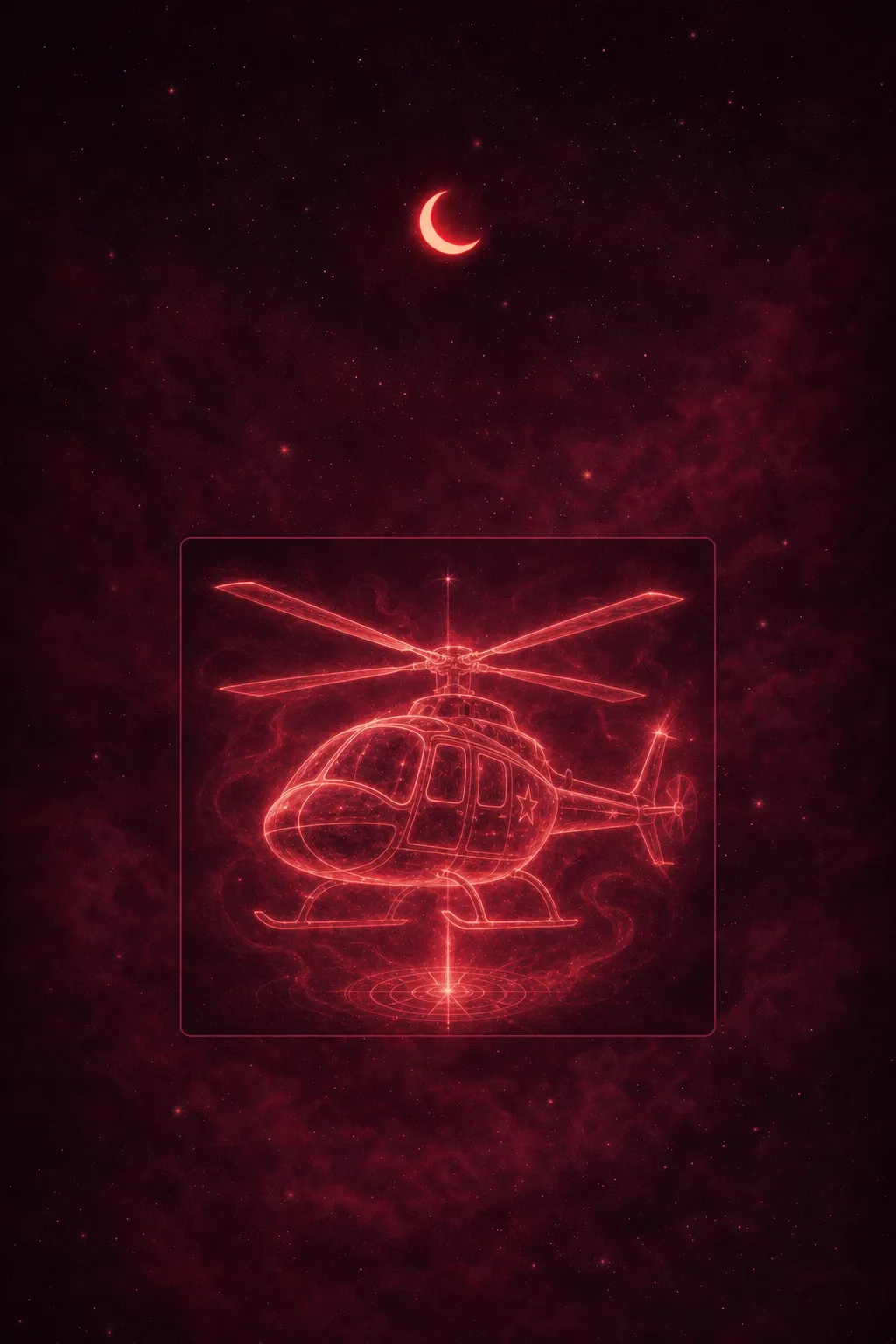

Dreaming of a helicopter often symbolizes a desire to rise above problems and gain a clearer perspective on your life. It can also reflect a need for control, a sense of urgency, or the wish to escape a stressful situation. The condition of the helicopter and how it moves in your dream usually shapes the deeper meaning.
In under a minute you could read what your exact dream means for you, and see a picture of it. Free.
You read what it can mean. But what did yours mean?
General meanings stop here. In the free app, tell Dream Book your exact dream and get a reading that actually makes sense for you.


Common Helicopter Dream Scenarios
Flying in a Helicopter
When you're the one in the cockpit — or even just a passenger — this dream speaks to ambition and the need for overview. You're not grounded in the daily grind right now; part of you wants to hover above it, assess the terrain, and decide where to land. This is the dream of someone who needs clarity more than they need speed.
There's a meaningful difference between flying freely through the air and riding in a helicopter. Free flight is about liberation. A helicopter is mechanical, deliberate, hovering — it requires skill and fuel. Your subconscious is telling you this elevation isn't effortless. It costs something.
But what does your version mean?
Helicopter Crashing
A helicopter crashing in your dream is one of the more visceral symbols of plans going sideways. You climbed high — in career, relationships, or ambitions — and something mechanical failed. The crash rarely predicts disaster; it reflects the fear of it. The dread of watching something you've carefully built come apart mid-air.
If you've been dreaming about planes crashing too, you're likely processing a broader anxiety about trajectories — your life's direction feels unstable. The helicopter crash is more personal than the plane crash, though. Helicopters carry fewer people. This failure feels intimate.
Being Rescued by a Helicopter
Rescue helicopters in dreams show up when you feel overwhelmed and secretly hoping someone — a person, an opportunity, a stroke of luck — will swoop in and lift you out. There's no shame in this. It's one of the most honest dreams the mind produces. You're exhausted, and you know it.
Pay attention to who's in the helicopter. A stranger rescuing you points to a longing for external salvation. Someone you know suggests you already sense who could help you — and you haven't asked yet. If no one comes and the helicopter leaves without you, that's your subconscious delivering a harder message: the rescue has to come from within.
A Military or Black Helicopter
Military helicopters and the infamous "black helicopter" in dreams carry a different charge entirely — surveillance, authority, threat. If one is circling overhead in your dream, you may be feeling watched, judged, or controlled by someone in your waking life. This could be a boss, a parent, or an institution that feels oppressive.
The feeling of being chased or monitored is embedded in this symbol. It's worth asking: who holds power over you right now, and does that power feel legitimate? The military helicopter doesn't just threaten — it represents authority that arrives without invitation.
What this dream could look like
Tap an image to open it full screen
Example images. Only you can see what you write in Dream Book.
Psychological Interpretation
Freud would have looked at the helicopter and seen something unmistakably phallic in its mechanics — the rotor, the thrust, the vertical ascent. But beyond that surface reading, he'd point to the wish-fulfillment at its core: the dream of rising above conflict, of escaping the messy horizontal world of human relationships into something clean and aerial. For Freud, any dream of elevation was partly a fantasy of power over those left below.
Was yours a sign? Find out.
Jung's reading cuts deeper. He saw flight symbols as expressions of the psyche's drive toward individuation — the process of becoming fully yourself. The helicopter, with its capacity to hover and observe, maps onto what Jung called the "bird's-eye view of the Self" — the part of you that can witness your own life without being consumed by it. But Jung would also warn about inflation: flying too high, losing touch with the earth, becoming disconnected from the body and the shadow. If the helicopter in your dream feels grandiose or unstable, that's the ego overreaching. The act of flying in a vehicle rather than under your own power suggests you're relying on external systems to do what only inner work can achieve.
Calvin Hall's content analysis of over 50,000 dream reports found that vehicles in dreams — cars, planes, and their equivalents — consistently appeared during periods of life transition and goal-pursuit. Helicopters, as a specific vehicle type, carry the added dimension of vertical movement, which Hall's research associates with social mobility and status concerns. Ernest Hartmann, whose work framed dreams as emotional memory processors, would read the helicopter as the mind's way of metabolizing feelings about control and vulnerability — the same way car dreams often process anxiety about life's direction. The helicopter dream, in Hartmann's framework, is the brain stitching together your fear of losing control with your hunger for perspective.
Hobson and McCarley's activation-synthesis hypothesis offers the neurological backstory: your sleeping brain fires signals through motor and spatial cortices — the same regions active when you actually navigate physical space — and the dreaming mind constructs a narrative around that activation. The helicopter becomes the brain's best story for "I am moving upward through space, rapidly, with mechanical assistance." The emotional weight you assign to that story, though, is entirely yours.
General meanings end here. Read your own dream.
0%
Analyzing your dream…
Something went wrong. Please try again in a moment.
Your dreams deserve more than a dictionary
Cultural & Spiritual Meaning
In Western dream traditions, aerial vehicles have long been associated with the soul's desire to transcend earthly limitations. The helicopter, as a modern symbol, inherits that lineage but adds a layer of human engineering — this isn't divine flight, it's controlled ascent. Western interpreters often read helicopter dreams as signs of ambition, strategic thinking, or the need to "zoom out" on a problem. It's the symbol of the person who needs the map before they can move.
Ibn Sirin, the 8th-century Islamic scholar whose dream interpretations remain foundational across the Muslim world, wrote extensively about birds and aerial movement as symbols of the soul's condition and one's standing before God. While helicopters didn't exist in his time, his framework for flying objects is instructive: ascending smoothly signifies elevation in status, spiritual rank, or good fortune; descending or crashing signals a warning to examine one's affairs before they deteriorate. Applied to the helicopter, Ibn Sirin's tradition would read a steady, controlled flight as a favorable omen — and turbulence as a call to prayer and self-examination.
A bad dream isn't a bad sign.
In many Indigenous traditions across North America, birds and flying creatures are messengers between the human world and the spirit world. A mechanical flying vessel in a dream might be interpreted as a sign that the dreamer is seeking guidance through human-made systems rather than listening to natural wisdom. The dream becomes a gentle challenge: are you using technology as a substitute for intuition? Eastern philosophical traditions, particularly in Taoist thought, similarly distinguish between effortless movement (wu wei) and forced elevation — the helicopter, requiring constant fuel and mechanical effort, might suggest you're working too hard to maintain a perspective that should come naturally.
Related Dream Meanings

common dreams
Flying Dream Meaning: Freedom, Ambition & Escape
5 min read

nightmares
Airplane Crash Dream Meaning: Loss of Control & Fear
5 min read

nightmares
Being Chased Dream Meaning: Anxiety & Avoidance
5 min read
common dreams
Flying in a Plane Dream Meaning: Freedom & Control
5 min read
common dreams
Cars Dream Meaning: Control, Direction & Life Path
5 min read

common dreams
Being Lost Dream Meaning: Confusion & Direction
5 min read

common dreams
Mountains Dream Meaning: Challenges, Goals & Growth
5 min read

common dreams
Garden Dream Meaning: Growth, Peace & Inner Potential
5 min read
What to Do After This Dream
Start by sitting with the emotional tone of the dream. Did the helicopter feel liberating or menacing? Were you in control, or was someone else flying? The feeling matters more than the image. Write it down before it fades — the specific details (who was there, what the weather was like, whether you landed safely) carry meaning that generic interpretations can't reach.
Ask yourself where in your life you're craving a higher view right now. A relationship that feels tangled? A career decision that needs distance to see clearly? The helicopter is almost always pointing at something specific. It's not a vague symbol — it arrives when you're stuck in the weeds of something and your subconscious knows you need altitude.
If this dream keeps returning, it's worth exploring with a personalized interpretation. Dream Book lets you describe your dream in detail and ask follow-up questions, so you can understand what your subconscious is actually working through — not just what helicopters "mean" in general. Dreams this specific deserve more than a one-size-fits-all answer.
But what does your version mean?
Pay attention to what you're avoiding seeing from ground level. The helicopter dream is your mind's way of saying: get above it. Look at the whole landscape. Whatever you've been too close to examine honestly — the feeling of being lost, the fear of a wrong turn — this dream is offering you the vantage point to finally see it clearly. Understanding your helicopter dream is the first step. The next is asking what it means for your life right now — that's where a personalized interpretation goes deeper than any dictionary.
One dream is never the whole picture.
The free app remembers your dreams, draws them, and connects the threads over time — so the next one means even more. Free to start.
People Also Ask
A helicopter crashing in a dream usually reflects anxiety about plans, ambitions, or a situation you've elevated yourself into — and the fear that it could fall apart. It's rarely a literal prediction; it's your mind processing the vulnerability that comes with taking risks or reaching for something higher. Ask yourself where in your waking life you're afraid of a sudden collapse.
Being rescued by a helicopter points to a deep desire for relief — someone or something swooping in to lift you out of an overwhelming situation. It often surfaces when you're exhausted and feeling like you can't find your own way out. Pay attention to who's in the helicopter: it may reveal who you're hoping will come through for you.
It depends heavily on the emotional tone of the dream. A smooth, controlled helicopter flight is generally a positive symbol — clarity, ambition, strategic perspective. A crashing, circling, or threatening helicopter signals anxiety, loss of control, or feeling surveilled. The helicopter itself is neutral; your feelings in the dream tell you which direction to interpret it.
A military helicopter typically symbolizes authority, surveillance, or a power structure that feels threatening or invasive. You may be experiencing pressure from someone in a position of control — a boss, institution, or authority figure — that feels like it's monitoring or pursuing you. It's worth examining where in your life you feel watched or restricted.
Curious what your dream would look like?