
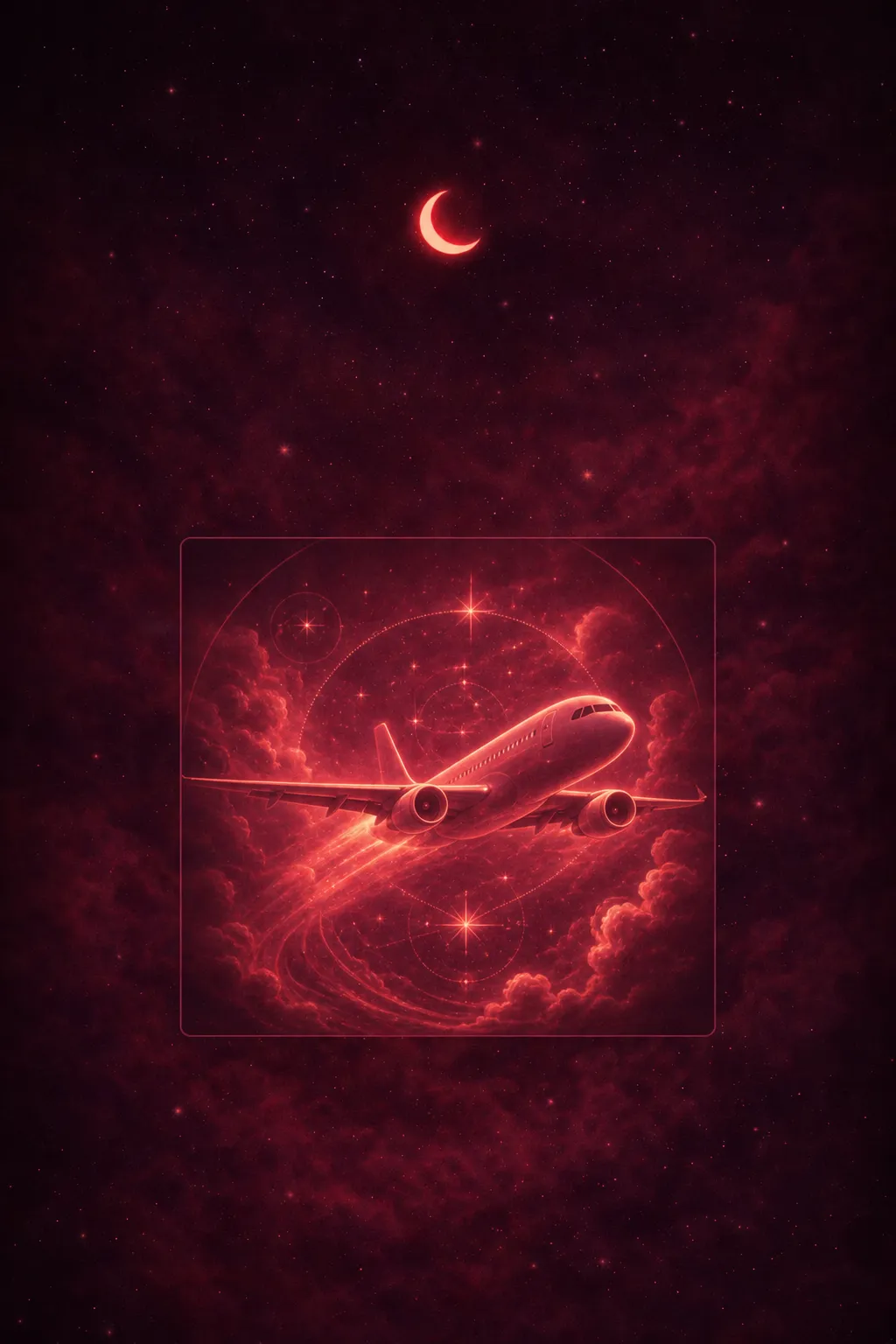

Dreaming of flying in a plane often reflects ambition, a longing for freedom, or anxiety about a major life transition. The experience of being a passenger can signal a feeling of surrendering control, while piloting the plane usually points to confidence and direction. Your emotional state during the flight is the key to unlocking what the dream means for you.
In under a minute you could read what your exact dream means for you, and see a picture of it. Free.
A dream still on your mind? Get your personal reading.
Describe your dream in a line or two. In seconds you get a reading of your exact dream, a picture drawn from your own words, and every symbol explained.
Free. No sign-up. Takes 10 seconds. Your dream stays private.
0%
Analyzing your dream…
Something went wrong. Please try again in a moment.
Your dreams deserve more than a dictionary
Common Flying In A Plane Dream Scenarios
Smooth Flight — Clear Skies, No Turbulence
You're in the cabin, the engine hums steadily, and the world below looks small and manageable. This version of the dream is one of the more reassuring ones you can have. It points to a sense of momentum — you've committed to something and it's working. The altitude represents perspective you've earned.
This dream often arrives when you've recently made a big decision and your subconscious is quietly endorsing it. Think of a job change, a move, a relationship shift. The smooth flight is your mind saying: the mechanism is holding. Trust it.
But what does your version mean?
Turbulence and Losing Control
The plane shudders. Oxygen masks drop. Your stomach lurches. This scenario is less about literal danger and more about the anxiety of being a passenger in your own life — of handing control to something or someone else and not being sure they can handle it. If you're also having falling dreams around the same time, the two are almost certainly connected.
Turbulence in a plane dream often maps directly onto real-life instability: a relationship that feels unpredictable, a work situation that keeps shifting under your feet, a health concern you're white-knuckling through. The plane hasn't crashed. But it doesn't feel safe yet either.
Missing the Flight
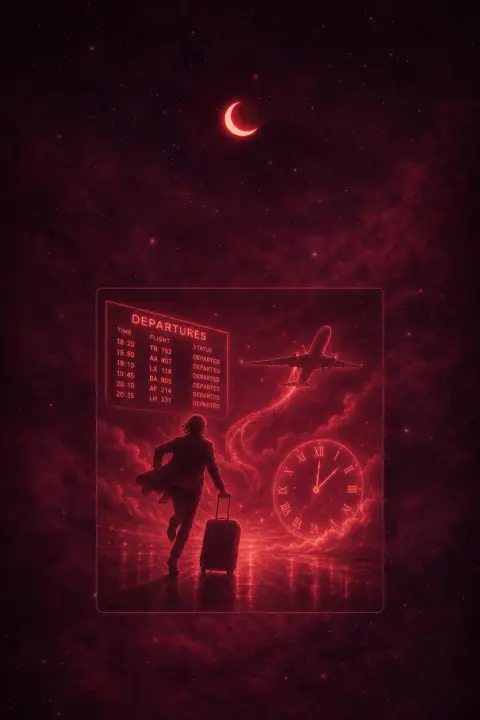
You're running through the terminal, watching the gate close, and the plane pulls back without you. Few dream scenarios carry that specific flavor of dread quite like missing a flight. It's the dream of missed opportunity, of feeling like life's momentum is moving and you're not on it.
This one tends to surface during periods of procrastination, indecision, or when you sense a window closing. Your subconscious is naming a fear you might not have said out loud yet: that you waited too long, or that you're not ready, or that someone else got there first.
Plane Crash
Watching or experiencing a plane crash in a dream is jarring, but it rarely predicts anything literal. More often it represents a catastrophic fear about a plan or ambition collapsing. You've invested in something — emotionally, financially, professionally — and part of you is running worst-case scenarios at night.
It can also signal that something you've been building is genuinely unsustainable and your deeper mind knows it before your waking mind is willing to admit it. If the crash dream keeps returning, that's worth sitting with honestly. What are you afraid of losing?
What a dream about flying in a plane could look like
Tap an image to open it full screen
Example images. Only you can see what you write in Dream Book.
Psychological Interpretation
Freud would have been fascinated by the plane specifically — not just the flying. For him, flying dreams were rooted in wish fulfillment, often tied to childhood memories of being lifted, swung, or carried. But the plane adds a layer: you're inside a machine, enclosed, hurtling forward. Freud saw enclosed spaces and forward motion as symbols of ambition and desire pressing through the constraints of social life. The plane is the civilized version of the raw wish to escape gravity entirely.
Was yours a sign? Find out.
Jung took a different angle. He saw ascent in dreams — any kind of rising above the earth — as the psyche's movement toward individuation, toward becoming more fully yourself. The plane, for Jung, would represent a collective vehicle: you're not flying alone, you're in a structure with others, which raises questions about your relationship to community, authority, and shared fate. If you're the pilot, that's one conversation. If you're a passenger, that's another. Jung would ask: who's flying this thing, and do you trust them?
Calvin Hall's content analysis of tens of thousands of dream reports found that transportation dreams — cars, trains, planes — are among the most consistent across cultures and demographics. Hall noticed that the dreamer's role in the vehicle matters enormously: drivers and pilots have fundamentally different dream profiles than passengers. Passengers, he found, more often reported themes of anxiety and dependency. That maps neatly onto the plane dream's core tension — you've surrendered control to a system larger than yourself.
Ernest Hartmann's work on dreams as emotional processing gives the turbulence scenario real explanatory power. Hartmann argued that dreams function like therapy, taking the emotional temperature of your waking life and running simulations around your most activated feelings. A bumpy flight dream isn't random noise — it's your brain rehearsing how to hold fear without being destroyed by it. Hobson and McCarley's activation-synthesis model adds another layer: the brain's motor cortex fires during REM sleep, and the sensation of movement — of being carried forward at speed — may partly explain why plane dreams feel so viscerally real. The brain constructs the narrative of a flight to make sense of its own physical activation.
Every dream you log starts to connect.
Dream Book keeps your dreams in one place and reveals the threads between them over time — your private dream journal. Free to start.


Cultural & Spiritual Meaning
In Western symbolic tradition, flight has always meant transcendence — Icarus, angels, the soul ascending. The plane democratizes that symbol, making transcendence mechanical and collective. Western dream culture tends to read plane dreams as ambition dreams: you're going somewhere, you have a destination, and the quality of the flight reflects your confidence in getting there. There's also a strong thread connecting plane dreams to feeling lost or directionless — when the destination is unclear in the dream, it often mirrors real-life uncertainty about where you're headed.
Ibn Sirin, the 8th-century Islamic scholar whose dream interpretations remain widely consulted today, wrote specifically about riding elevated conveyances as symbols of honor, status, and divine provision. A smooth journey in such a vehicle was read as a sign of blessing and forward movement in one's affairs. A crash or disruption, however, was interpreted as a warning to examine one's intentions — not as punishment, but as an invitation to realign. That distinction between warning and condemnation is worth holding onto.
A bad dream isn't a bad sign.
In many Indigenous and Eastern traditions, the sky is the domain of spirits, ancestors, and higher wisdom. To travel through it — even inside a machine — carries a sense of moving between worlds. Some East Asian dream traditions interpret plane travel as a metaphor for elevation in social standing or a significant life crossing, particularly if the dreamer arrives safely at the destination. The journey through air is never purely physical; it's always also a passage of the spirit.
Related Dream Meanings

common dreams
Falling Dream Meaning: Insecurity, Fear & Loss of Control
5 min read
common dreams
Missing a Flight Dream: Anxiety, Fear & Missed Chances
5 min read

nightmares
Airplane Crash Dream Meaning: Loss of Control & Fear
5 min read

nightmares
Plane Crash Dream Meaning: What Your Subconscious Is Telling You
5 min read

common dreams
Flying Dream Meaning: Freedom, Ambition & Escape
5 min read

common dreams
Being Lost Dream Meaning: Confusion & Direction
5 min read

common dreams
White Color Dream Meaning: Purity, Release & New Starts
6 min read

common dreams
Piano Dream Meaning: Creativity, Harmony & Inner Voice
5 min read
What to Do After This Dream
Start by asking one simple question: were you in control, or were you a passenger? That single detail does more interpretive work than almost anything else. If you were the pilot, the dream is asking about your leadership, your direction, your willingness to own where you're going. If you were sitting in row 24 with no view of the cockpit, the dream is asking about trust — in other people, in systems, in life's momentum.
Then look at the flight quality. Smooth means something different from turbulent, which means something different from crashed. Match the emotional tone of the dream to what's actually happening in your waking life right now. Chances are you already know what the plane represents — the question is whether you're willing to look at it directly.
If this dream keeps returning or shifts in intensity, it's worth exploring with a personalized interpretation. Dream Book lets you describe your dream in detail and ask follow-up questions — so instead of a generic reading, you get something that actually fits your life and what's moving through it right now.
But what does your version mean?
If the dream involved a crash or a missed flight, consider pairing this with a look at what you're most afraid of losing right now. Sometimes the most useful thing a dream does is name a fear before your conscious mind is ready to. Understanding your flying-in-a-plane dream is the first step. The next is asking what it means for your life right now — that's where a personalized interpretation goes deeper than any dictionary.
One dream is never the whole picture.
The free app remembers your dreams, draws them, and connects the threads over time — so the next one means even more. Free to start.
People Also Ask
Dreaming about flying in a plane typically points to ambition, life transitions, or feelings about control and trust. The condition of the flight — smooth or turbulent — reflects how confident or anxious you feel about a major direction your life is taking. Your role as pilot versus passenger shifts the meaning significantly.
A plane crash dream usually represents a fear that something you've invested in — a plan, a relationship, a career path — is going to fall apart. It rarely predicts literal events; more often it's your subconscious processing worst-case anxiety about something that matters deeply to you. Recurring crash dreams are worth examining for what specific ambition or commitment feels most at risk.
Missing a flight in a dream is one of the most common expressions of deadline anxiety and fear of missed opportunity. It tends to surface when you're procrastinating on something important, feeling behind in life, or sensing that a window is closing. The dream is less about the flight itself and more about what the flight represents — a chance you're afraid of losing.
It depends almost entirely on the dream's emotional tone and what happens during the flight. A smooth, calm flight is generally a positive symbol — momentum, perspective, and trust in your current direction. Turbulence, crashes, or missed flights point to anxiety, instability, or fear of failure in some area of waking life.
Curious what your dream would look like?