
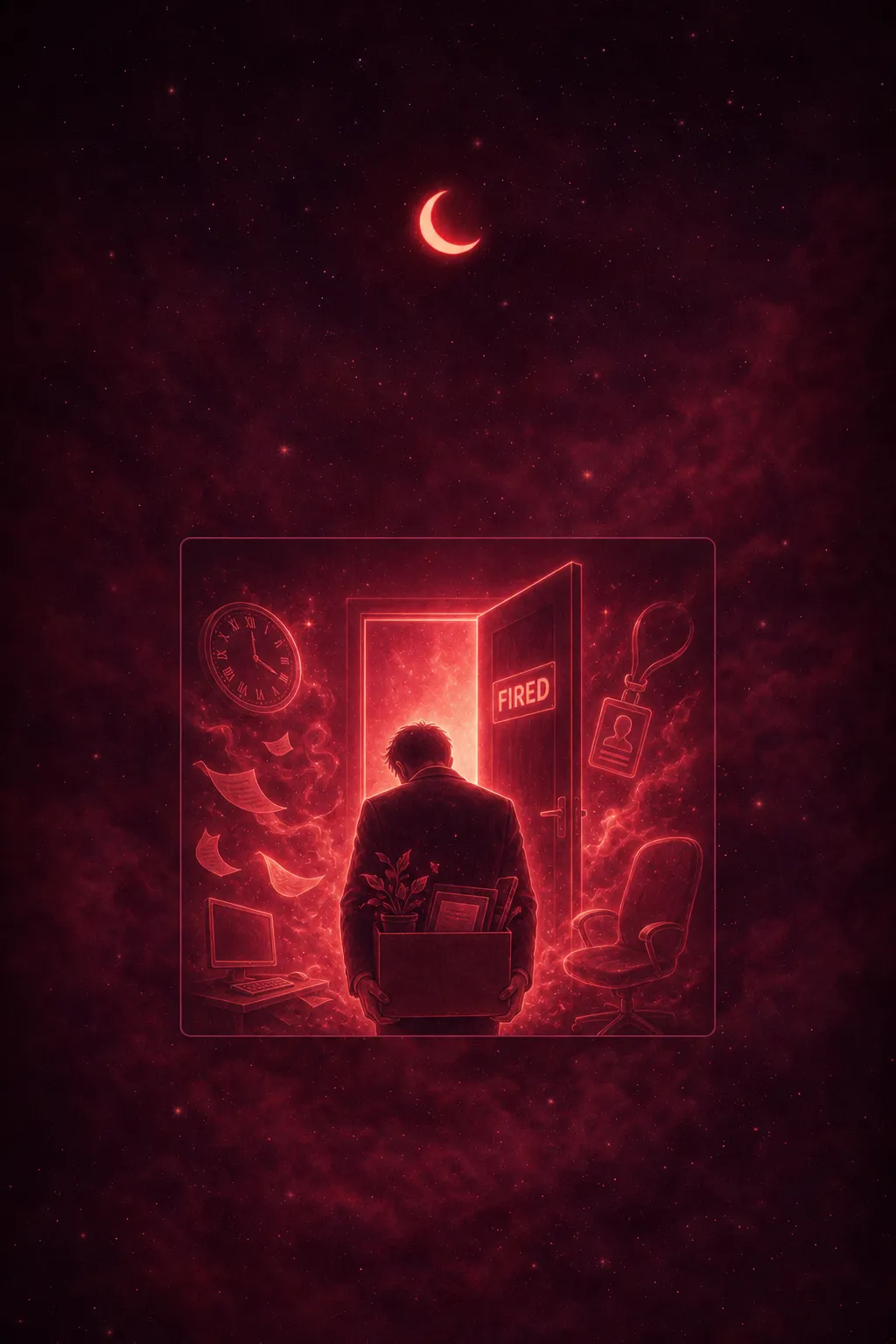

Dreaming of getting fired usually reflects anxiety about performance, fear of rejection, or a deep need for change in your waking life. It often surfaces when you feel out of control at work or question your sense of purpose and identity. Rather than a bad omen, this dream can be a signal to reassess your goals and reclaim your confidence.
In under a minute you could read what your exact dream means for you, and see a picture of it. Free.
A dream still on your mind? Get your personal reading.
Describe your dream in a line or two. In seconds you get a reading of your exact dream, a picture drawn from your own words, and every symbol explained.
Free. No sign-up. Takes 10 seconds. Your dream stays private.
0%
Analyzing your dream…
Something went wrong. Please try again in a moment.
Your dreams deserve more than a dictionary
Common Getting Fired Dream Scenarios
Being Fired by Your Boss
You're called into the office. The words land like a verdict. This version of the dream tends to appear when your relationship with authority feels shaky — not necessarily at work, but in life. A parent, a partner, anyone who holds power over your sense of worth can show up wearing your boss's face.
The feeling after the firing matters as much as the firing itself. Relief points toward a job or situation you're secretly ready to leave. Devastation points toward deep-seated fears about your value and what happens when you're no longer needed. If you've been having dreams about being late alongside this one, your subconscious is building a case about performance anxiety.
But what does your version mean?
Getting Fired and Feeling Relieved
Some people wake from this dream surprised by how good it felt. That emotional residue is important data. When the firing feels like a release, the dream is less about fear and more about a wish — the part of you that wants out of something but hasn't given yourself permission to admit it.
This is the wish-fulfillment thread that Freud spent so much of his career pulling on. The dream stages the exit you haven't made in waking life. Pay attention to what you felt free from, not just the act of being let go.
Being Fired Publicly or in Front of Colleagues
Humiliation is the engine of this variation. Being fired in front of an audience taps into the same vein as being naked in a dream — exposure, judgment, the terror of being seen as inadequate by the people whose opinions shape your identity. It often spikes during periods of comparison: when you feel like everyone else is excelling and you're barely holding on.
This scenario can also reflect real social dynamics at work. If your workplace has a culture of public criticism or you've recently witnessed someone else being humiliated, your dreaming mind may be rehearsing the threat, running the scenario to prepare you emotionally.
Being Fired from a Job You Don't Actually Have
Strange as it sounds, many people dream of being fired from a job they've never held — a fantasy career, an old job from years ago, or a completely invented workplace. This is the dream stripped of literal meaning and working purely symbolically. The "job" stands in for a role you play: parent, partner, caregiver, the responsible one.
Losing that role in the dream signals anxiety about identity. If the dream keeps recurring, it may be worth exploring alongside other being-fired dream patterns to see what role your subconscious keeps putting on the line. Sometimes it connects to job interview dreams — the two form a loop of audition and rejection your mind keeps running.
What this dream could look like
Tap an image to open it full screen
Example images. Only you can see what you write in Dream Book.
Psychological Interpretation
Freud would read the getting-fired dream as a collision between desire and dread. The workplace, in his framework, is a theater for authority — and being expelled from it replays the primal fear of rejection by the father figure, the one who grants permission and withholds it. But underneath the fear, Freud always looked for the wish. Being fired can be the unconscious staging of something you want but can't consciously claim: freedom, escape, the end of obligation.
Jung took a different angle. For him, the firing represents a confrontation with the Shadow — the part of yourself that doesn't fit the professional persona you've carefully constructed. The person who fires you in the dream often carries qualities you've disowned: ruthlessness, authority, the willingness to cut ties. The dream forces a meeting between who you perform yourself to be and what you've buried underneath. If the sensation of being chased shows up in the same dream or the same sleep cycle, Jung would say the Shadow is particularly active right now.
Was yours a sign? Find out.
Calvin Hall's content analysis of tens of thousands of dream reports found that workplace anxiety dreams — including firing scenarios — skew heavily toward feelings of failure and social rejection rather than literal job loss. His data showed that dreamers rarely dream about actual workplace events; instead, the job becomes a stage set for deeper emotional conflicts around competence and belonging. Hall's work suggests that if you're dreaming about being fired, the question to ask isn't "am I about to lose my job?" but "where in my life do I feel I'm not measuring up?"
Ernest Hartmann's research on dreams as emotional memory processors adds another layer. He argued that the brain uses sleep to work through emotionally charged experiences by connecting them to older, similar feelings — what he called "contextualizing" emotion. A stressful week at work doesn't just create a work dream; it reactivates every previous time you've felt judged or discarded. The getting-fired dream, in Hartmann's model, is your mind doing the emotional filing — linking present stress to past wounds so you can metabolize both. This is also why the dream can feel disproportionately devastating even when your job is fine.
Every dream you log starts to connect.
Dream Book keeps your dreams in one place and reveals the threads between them over time — your private dream journal. Free to start.


Cultural & Spiritual Meaning
In Western psychological tradition, job loss dreams are almost always read as anxiety symbols — mirrors of imposter syndrome, burnout, or transition. But in many Eastern traditions, particularly in Chinese dream interpretation, losing a position in a dream can carry the opposite meaning: a sign of impending change that clears the way for something better. The loss is a threshold, not a verdict.
Ibn Sirin, the 8th-century Islamic scholar whose dream interpretations remain influential across the Muslim world, wrote that dreaming of being dismissed from a position of work or responsibility often signals a warning to examine one's conduct — not necessarily a prediction of literal job loss, but a call to assess whether you are fulfilling your duties with integrity. For Ibn Sirin, the emotional tone of the dream was crucial: if the dismissal came with shame, it pointed to a need for self-correction; if it came with peace, it could signal divine relief from a burden that was never truly yours to carry.
A bad dream isn't a bad sign.
In Indigenous frameworks that treat dreams as messages from the spirit world or the collective, being removed from a role can signal that you've outgrown a particular path and that the community — or something larger — is nudging you toward your true purpose. The firing isn't punishment; it's redirection. This resonates with the Jungian concept of individuation — the lifelong process of becoming more fully yourself, which sometimes requires losing the roles that kept you small.
Related Dream Meanings
common dreams
Being Late Dream Meaning: Anxiety, Fear & Missed Chances
5 min read

common dreams
Naked Dream Meaning: Vulnerability & Exposure
5 min read
common dreams
Being Fired Dream Meaning: Insecurity & Fear of Failure
5 min read
common dreams
What Does It Mean to Dream About a Job Interview
5 min read

nightmares
Being Chased Dream Meaning: Anxiety & Avoidance
5 min read

common dreams
What Does It Mean to Dream About Getting Fired? Dream Interpretation
5 min read

common dreams
School Dream Meaning: Anxiety, Nostalgia & Growth
5 min read

common dreams
Ocean Dream Meaning: Emotions, Change & the Subconscious
5 min read
What to Do After This Dream
First, sit with the emotion the dream left behind. Not the story — the feeling. Was it dread, relief, shame, or something quieter? That residue is the message. Write it down before it fades, because the emotional texture of a dream is more revealing than the plot.
Next, ask yourself where in your waking life you feel evaluated, inadequate, or at risk of being cast out. It may not be work at all. It could be a friendship that feels conditional, a relationship where you're performing rather than connecting, or a creative project where your inner critic has taken on the boss's voice.
If this dream keeps returning, it's worth going deeper than a dictionary entry can take you. Dream Book lets you describe your dream in detail and ask follow-up questions to understand what your subconscious is actually working through — because the specifics of your version of this dream matter enormously.
And if the dream is tied to real workplace stress, consider it a signal worth acting on. Not a prophecy — but an invitation to have the conversation you've been avoiding, set the boundary you've been deferring, or finally admit what you want your work life to actually look like. Sometimes the getting-fired dream is the most honest career counselor you have.
But what does your version mean?
Understanding your getting-fired dream is the first step. The next is asking what it means for your life right now — that's where a personalized interpretation goes deeper than any dictionary.
One dream is never the whole picture.
The free app remembers your dreams, draws them, and connects the threads over time — so the next one means even more. Free to start.
People Also Ask
Dreaming about getting fired usually reflects anxiety about performance, fear of failure, or a sense that your position — at work or in a relationship — feels unstable. It rarely predicts actual job loss; more often it surfaces feelings of inadequacy or a hidden desire to leave a situation that no longer fits.
Recurring fired dreams typically point to an unresolved emotional conflict around worth, authority, or belonging. Ernest Hartmann's research suggests the brain replays emotionally charged scenarios during sleep to process them — if the dream keeps returning, the underlying feeling hasn't been fully addressed in waking life.
Not necessarily. In many cultural traditions, including some Islamic interpretations rooted in Ibn Sirin's work, being dismissed in a dream can signal a coming change or a call to reassess your path — not a prediction of disaster. The emotional tone of the dream is the most important clue to its meaning.
Relief after a dream firing is a significant signal — it suggests part of you wants out of something you haven't consciously admitted. Freud saw this as wish fulfillment: the dream stages the exit your waking self hasn't been willing to make. Ask yourself what you felt free from, not just what you lost.
Curious what your dream would look like?