
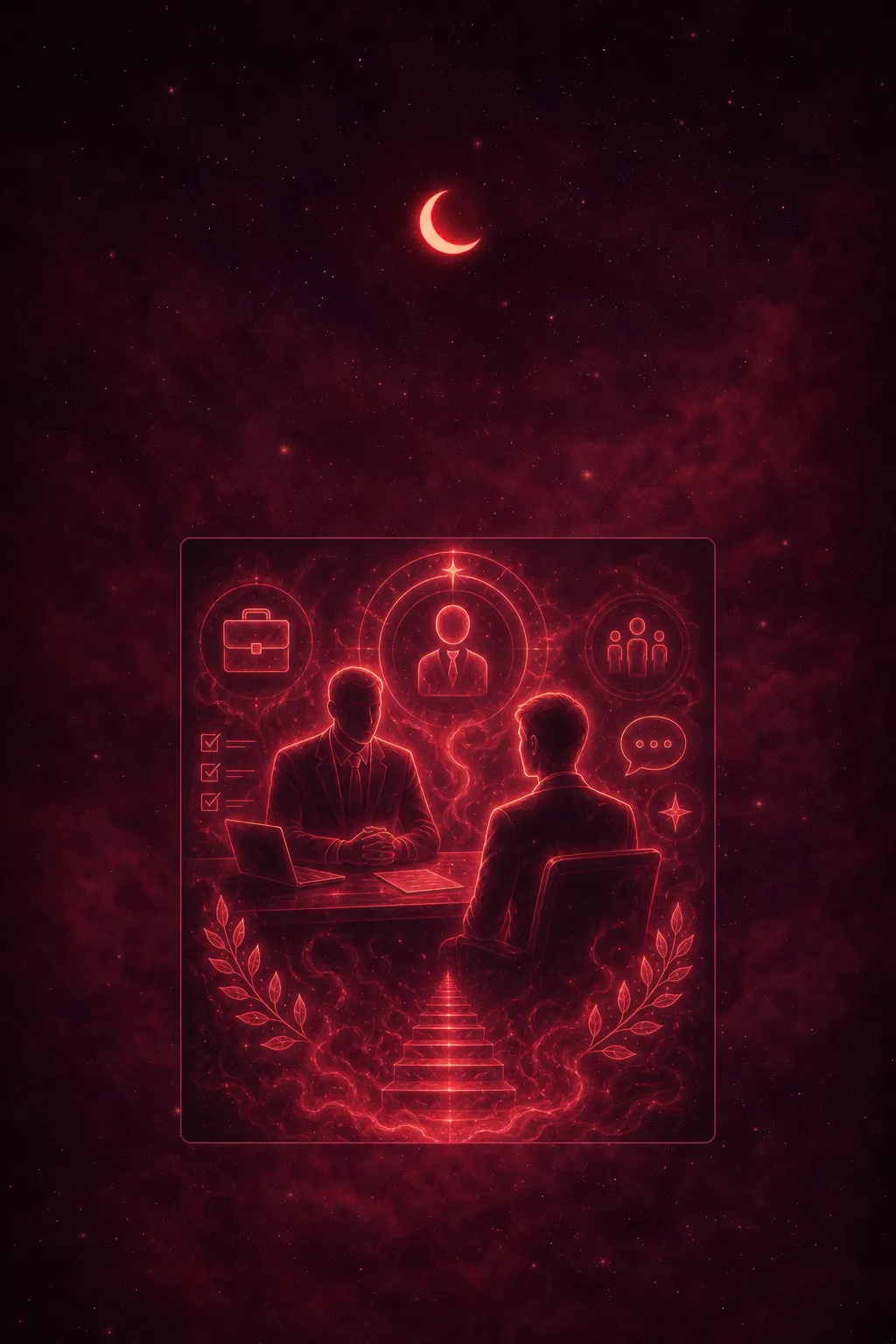

Dreaming about a job interview typically reflects your real-life anxieties about being judged, evaluated, or tested, symbolizing a desire to prove your worth, fear of failure, or readiness to embrace a new opportunity, challenge, or significant change in your waking life.
In under a minute you could read what your exact dream means for you, and see a picture of it. Free.
You read what it can mean. But what did yours mean?
General meanings stop here. In the free app, tell Dream Book your exact dream and get a reading that actually makes sense for you.


A dream still on your mind? Get your personal reading.
Describe your dream in a line or two. In seconds you get a reading of your exact dream, a picture drawn from your own words, and every symbol explained.
Free. No sign-up. Takes 10 seconds. Your dream stays private.
0%
Analyzing your dream…
Something went wrong. Please try again in a moment.
Your dreams deserve more than a dictionary
Common Job Interview Dream Scenarios and What They Mean
Because the job interview dream is really a canvas for evaluation anxiety, the specific details shift its meaning considerably. The most frequently reported variants tend to cluster around loss of control — a core thread of modern stress — and what they reveal about how you privately measure your own readiness. At Dream Book we explore this symbol in depth.
- Arriving unprepared or having no answers: The mind is staging a fear of exposure. You feel caught off-guard by real-life demands and sense your competence could crumble under scrutiny at any moment.
- Running late or unable to find the room: Time-pressure stress from waking life bleeds directly into the dream. The obstacle-filled corridor or the clock ticking past your slot signals anxiety about missed opportunity and a felt loss of control over outcomes.
- Mind going blank or being unable to speak: Performance paralysis in its purest dream form — your voice or confidence feels suppressed exactly when it matters most.
- Dressed wrong, underdressed, or exposed: Vulnerability and shame about how others perceive your flaws or unpreparedness; a close cousin of the classic "naked in public" dream.
- A hostile or dismissive interviewer: Often a projection of your own harsh inner critic, or an authority figure from waking life whose judgment feels unfair.
- The interview goes brilliantly or you get the offer: A genuinely encouraging sign — growing confidence and a readiness to embrace change or a new identity.
- Not knowing what the job even is: Ambiguity about life direction; you feel tested without knowing the criteria, reflecting uncertainty about who you are becoming.
- Being rejected outright: Fear of not belonging — though some dreamers report relief, as if finally facing the feared outcome releases its power.
- The same interview repeating: An unresolved waking situation that feels stuck, looping until the underlying pressure is addressed.
But what does your version mean?
Across all these variants, the central question the dream presses is one of self-knowledge: do you believe, privately, that you are enough? Tracking which scenario recurs — and how you feel when you wake — offers a cleaner read on where your confidence and sense of control genuinely stand right now.
What this dream could look like
Tap an image to open it full screen
Example images. Only you can see what you write in Dream Book.
Psychological Meaning of the Job Interview Dream
At its psychological core, dreaming of a job interview is your subconscious staging an internal audit. The interviewer figure — whether a stern stranger or a faceless authority — typically represents the critical inner voice that measures your readiness against some standard you fear you cannot meet. Mainstream psychology frames this as evaluation anxiety bleeding into sleep: the mind rehearses high-stakes judgment because waking life has left the outcome unresolved, and the brain treats uncertainty as a threat worth processing overnight.
The emotional axis running through these dreams stretches between anxiety and confidence, scrutiny and acceptance. When the dream tips toward dread — forgetting your résumé, blanking on answers, arriving late — it often signals impostor feelings: a quiet suspicion that you do not fully deserve the role or opportunity you are pursuing. From a broadly Jungian perspective, that interviewer can also embody your own ego-ideal, the version of yourself you feel perpetually short of becoming. Christian-influenced readings add a layer here, interpreting the judgment scene as a reflection of a deeper longing for worthiness and grace — being accepted not merely on performance but on who you are.
Modern life amplifies all of this. In an era of constant self-optimization, the dream taps into anxieties around control and change that extend well beyond career moves. Key psychological signals to notice include:
- Anticipatory rehearsal — your mind pre-playing a real upcoming event to reduce uncertainty
- Self-worth check — an honest reckoning with whether you feel adequate in a current role or relationship
- Transition marker — the dream surfaces at identity crossroads, not only career ones
- Control hunger — the desire to script an outcome that waking life refuses to guarantee
General meanings end here. Read your own dream.
Describe your dream in a line or two. In seconds you get a reading of your exact dream, a picture drawn from your own words, and every symbol explained.
Free. No sign-up. Takes 10 seconds. Your dream stays private.
0%
Analyzing your dream…
Something went wrong. Please try again in a moment.
Your dreams deserve more than a dictionary
Every dream you log starts to connect.
Dream Book keeps your dreams in one place and reveals the threads between them over time — your private dream journal. Free to start.
Cultural and Traditional Readings of the Job Interview Dream
Across Western folk tradition, dreams of being tested or judged by an authority figure have long been interpreted as omens of transition — a threshold moment where one chapter closes and another demands proof of worthiness. In broadly Christian cultural memory, such imagery echoes the idea of a reckoning: standing before a higher power and being found adequate or wanting. While few modern dreamers frame it in explicitly theological terms, that undercurrent of moral and personal accountability still colors how many people in the US instinctively feel when they wake from an interview dream unsettled — as though something larger than a job was on the line.
Was yours a sign? Find out.
Contemporary culture has layered its own anxieties onto this archetype. In an era defined by economic uncertainty, rapid career pivots, and the constant pressure to brand and perform the self, the job interview has become one of the most recognizable symbols of high-stakes judgment in everyday life. Folk wisdom around such dreams tends to be pragmatic: many people treat a vivid interview dream as a nudge from the subconscious to prepare more thoroughly, reassess where they stand professionally, or simply acknowledge stress they have been pushing aside.
- Threshold symbol: culturally understood as marking a passage between identities or life stages
- Control anxiety: reflects a widespread modern fear of being at the mercy of forces — economic, social — beyond personal influence
- Self-inventory signal: folk interpretation often treats the dream as a prompt to honestly audit skills and ambitions before a real decision point arrives
Spiritual Meaning of the Job Interview Dream
From a spiritual standpoint, a job interview dream can be read as the soul confronting the question of calling and worthiness before something greater than any human employer. In a broadly Christian frame, scripture frequently portrays God as one who searches the heart — Jeremiah 17:10 speaks of the Lord testing minds and rewarding according to conduct — and a dream of being examined may surface that same underlying awareness: that your motives, gifts, and readiness are being weighed at a deeper level than a résumé can capture. This is less about divine judgment as threat and more about an invitation to honest self-examination.
Modern anxiety amplifies this spiritual dimension. When daily life feels relentlessly performance-driven, the dream may be pointing toward a spiritual imbalance — an over-reliance on external validation at the expense of inner grounding. Many faith traditions teach that true vocation is discerned inwardly, through prayer, quiet, or reflection, rather than won through impressing others. The dream, in this light, becomes a prompt to reconnect with your own sense of purpose rather than chase approval.
A bad dream isn't a bad sign.
- Calling vs. performance: The dream may ask whether you are pursuing what genuinely aligns with your values or simply seeking status.
- Surrender of control: Spiritual traditions widely frame releasing outcome-anxiety as an act of faith — trusting that adequate preparation, combined with humility, is enough.
- Inner worthiness: A recurring interview dream can signal a need to ground your sense of value in something more stable than external success.
Related Dream Meanings

animals
Snakes Dream Meaning: Fear, Change & Hidden Threats
5 min read

body health
Teeth Falling Out Dream: Anxiety, Loss & Vulnerability
5 min read

common dreams
Falling Dream Meaning: Insecurity, Fear & Loss of Control
5 min read

common dreams
Holy Water Dream Meaning: Purification & Spiritual Renewal
5 min read

common dreams
Karma Dream Meaning: Guilt, Justice & Consequences
5 min read

common dreams
What Does It Mean to Dream About Time Travel
5 min read

common dreams
What Does It Mean to Dream About Levitating
5 min read

common dreams
Joy Dream Meaning: Fulfillment, Hope & Inner Peace
5 min read
What to Do After a Job Interview Dream
Because this dream so reliably surfaces evaluation anxiety and self-worth questions, the most useful first step is simply to name what is pressing on you in waking life. Ask yourself: where do you currently feel scrutinized, measured, or at risk of being found inadequate? The answer is not always a literal job search — it may be a new relationship, a creative project, a health situation, or any role where you fear falling short. Identifying the real-life pressure point converts vague overnight dread into something you can actually address.
From there, channel the dream's energy into concrete preparation and self-regulation rather than rumination. A few grounded steps worth taking:
- Audit your readiness honestly. Write down what you feel unqualified for and what evidence — real, not imagined — supports or contradicts that feeling. Impostor feelings shrink when exposed to facts.
- Separate what you can control from what you cannot. Preparation, practice, and attitude are within reach; the outcome is not. Focus your effort on the former.
- Rehearse in low-stakes settings. If anticipatory anxiety is high, deliberate practice (mock interviews, talking through decisions with a trusted friend) can quiet a mind that is already rehearsing scenarios involuntarily.
- Build a calming pre-sleep routine. Recurring evaluation dreams often intensify during high-stress periods; reducing ambient stress before bed can reduce their frequency without suppressing the useful message they carry.
Treat the dream less as a warning and more as useful feedback: your mind is telling you it cares deeply about a particular outcome. That care, properly directed, becomes motivation rather than anxiety.
But what does your version mean?
One dream is never the whole picture.
The free app remembers your dreams, draws them, and connects the threads over time — so the next one means even more. Free to start.
People Also Ask
Dreaming about being hired typically signals confidence, readiness for change, or anticipation of a new opportunity in waking life. It often reflects your desire for recognition and validation. Psychologically, it suggests you feel prepared to step into a new role or that positive results from your current efforts are on the horizon.
Recurring job interview dreams usually point to ongoing feelings of being evaluated or judged in daily life. They can surface during performance reviews, relationship pressures, or personal challenges. Your subconscious uses the interview setting as a familiar framework to process anxiety about proving your worth or meeting expectations others have placed on you.
Dreams felt as divine warnings tend to be unusually vivid, emotionally intense, and difficult to forget upon waking. Spiritual traditions suggest praying or meditating on the dream's core message and checking whether it aligns with moral guidance you already trust. If a job interview dream feels urgent and prophetic, treat it as a prompt to reflect seriously on a pending life decision.
Both pregnancy and job interview dreams share a common theme: new beginnings and anxiety about readiness. If you experience both, your subconscious is likely processing a major transition — a career shift, creative project, or personal growth milestone. The combination suggests you sense something significant is developing and you are questioning whether you are truly prepared for it.
A job interview dream often mirrors your inner ambitions and self-assessment. It reveals how confident you truly feel about your skills and future goals. If the interview goes well in the dream, you likely hold strong self-belief. If it goes poorly, your subconscious may be urging you to build more preparation and self-assurance.
Curious what your dream would look like?