
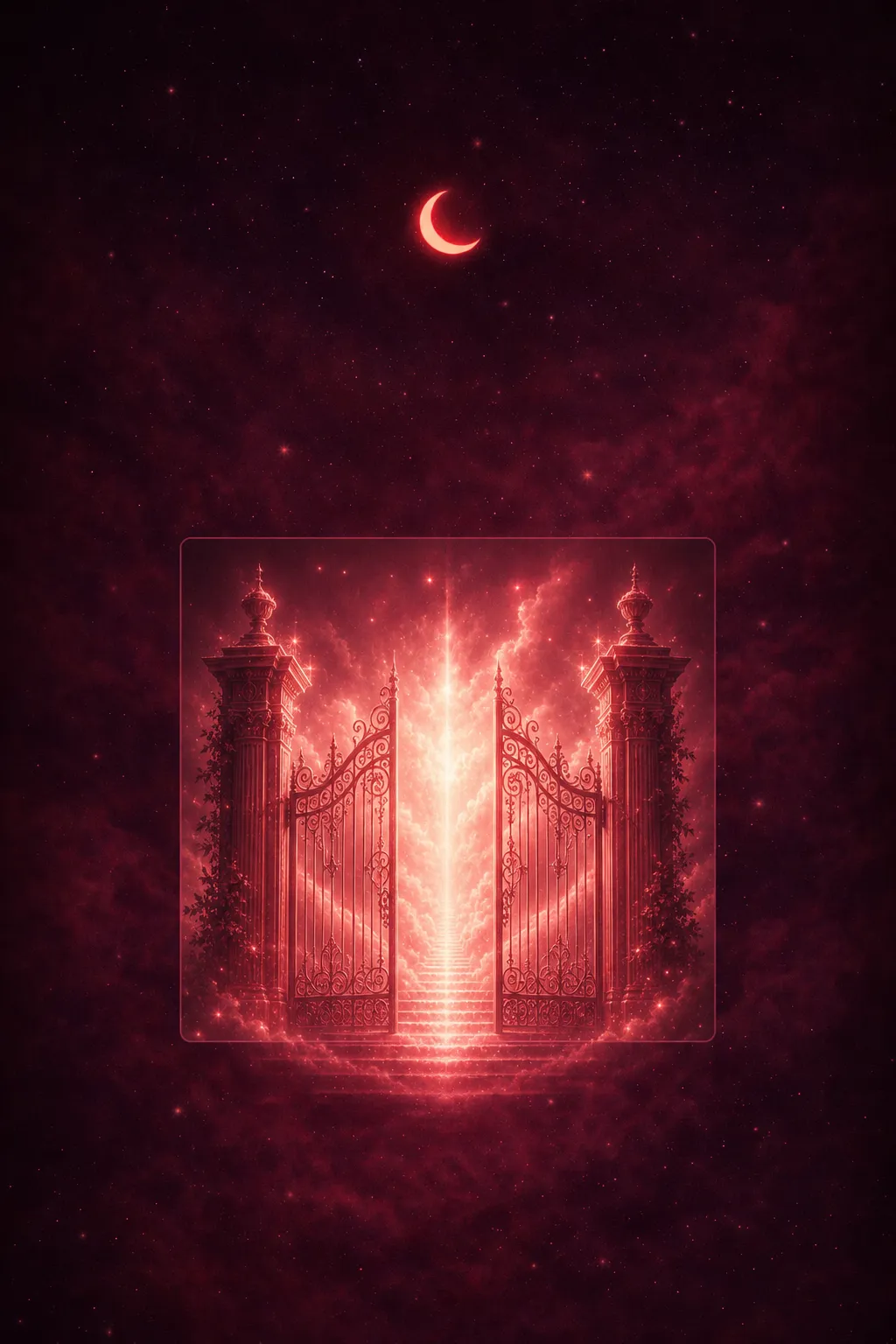

Dreaming of the gates of heaven often reflects a powerful inner transition — a sense that something in your life is ending or beginning in a profound way. It may speak to feelings of worthiness, spiritual longing, or a deep need for peace and acceptance. The emotion you felt at those gates is usually the key to your personal interpretation.
In under a minute you could read what your exact dream means for you, and see a picture of it. Free.
If they came to you in that dream, you already know it felt like more than a dream.
This page can't tell you what the visit meant for you. The free app gives you the warm, spiritual reading of your own dream — gently, in plain words.


A dream still on your mind? Get your personal reading.
Describe your dream in a line or two. In seconds you get a reading of your exact dream, a picture drawn from your own words, and every symbol explained.
Free. No sign-up. Takes 10 seconds. Your dream stays private.
0%
Analyzing your dream…
Something went wrong. Please try again in a moment.
Your dreams deserve more than a dictionary
Common Gates of Heaven Dream Scenarios
Standing at the Gates But Unable to Enter
You're there. The gates are in front of you — luminous, enormous, ancient — and yet something holds you back. Maybe they won't open. Maybe a figure turns you away. Maybe your feet simply refuse to move.
This is one of the most emotionally charged variations of this dream, and it almost always arrives during a period of transition or self-doubt. You're reaching for something — a new chapter, a relationship, a version of yourself — and some part of you isn't sure you deserve it. The gates become a mirror for your own sense of worthiness.
If you've been dreaming of running but being unable to move, this dream belongs to the same emotional family. The obstacle isn't out there. It's inside.
Was yours a sign? Find out.
Passing Through the Gates Peacefully
In this version, you walk through without resistance. There's warmth on the other side, or light, or the faces of people you've loved. You feel no fear — only a deep, inexplicable calm that lingers long after you wake.
Dreams like this often follow grief, illness, or the death of someone close. They're not premonitions. They're the mind doing what Ernest Hartmann described as emotional memory processing — using the vivid theater of sleep to metabolize feelings too large for waking hours to hold.
If you've recently lost someone, this dream may connect to what many call a visitation dream — the sense that the boundary between here and somewhere else has briefly thinned.
Watching Someone Else Enter the Gates
You're standing outside, watching another person — sometimes a stranger, sometimes someone you recognize — pass through the gates of heaven while you remain behind. There's no cruelty in it. You simply aren't the one going through.
This scenario often surfaces when you're processing a loss you haven't fully grieved. Watching a loved one enter can be the psyche's way of granting them peace — and granting yourself permission to let go. If the figure is someone who has died, this dream may echo the archetype of talking to the dead, a symbolic conversation your waking mind couldn't finish.
Sometimes the figure is someone you don't recognize at all. In that case, Jung would point to the stranger as an aspect of your own psyche — a part of yourself you're releasing, or a version of who you used to be that you're finally letting pass on.
The Gates Appearing in an Unexpected Place
Not all gates of heaven appear in clouds or white light. Sometimes they materialize at the end of a corridor, behind a door in an old house, or at the edge of a dark forest. The setting feels wrong — but the gates themselves feel unmistakably significant.
This displacement is worth paying attention to. The unconscious is telling you that transcendence isn't waiting in some distant afterlife — it's embedded in your ordinary life, hidden inside the rooms and corridors you already walk through. Something sacred is closer than you think.
What this dream could look like
Tap an image to open it full screen
Example images. Only you can see what you write in Dream Book.
Psychological Interpretation
Freud would have been suspicious of this dream — not dismissive, but probing. For him, dreams of heaven and transcendence often masked something more earthly: a wish to escape responsibility, to be absolved, or to return to the unconditional love of early childhood. The gates, in Freudian terms, represent a threshold between the self you present to the world and the desires you've pushed underground. Wanting to pass through is wanting to be fully known and still accepted.
Jung took a different angle entirely. He saw the gates of heaven as an archetypal image rooted in the collective unconscious — a symbol that appears across every culture because it speaks to something universal in the human psyche. For Jung, this dream often signals a moment of individuation: the self moving toward wholeness, integrating the parts of the personality that have been ignored or suppressed. The gates aren't an exit. They're a threshold into a more complete version of yourself. If your dreams have also featured angels or radiant light, Jung would read the entire constellation as your psyche reaching for integration.
But what does your version mean?
Calvin Hall, who spent decades analyzing over 50,000 dream reports, found that dreams with religious or transcendent imagery were far more common during periods of major life change — transitions in career, relationship, or identity. His cognitive theory frames the gates of heaven not as mystical messages but as the mind's own conceptual language: you think in images, and when you're standing at a crossroads in life, your dreaming brain reaches for the most powerful threshold image it has. It's worth noting that if you've been dreaming about crossroads or locked doors, Hall's framework would group these together as the same underlying cognitive event.
Hobson and McCarley's activation-synthesis hypothesis offers the most grounded counterpoint: during REM sleep, the brain fires signals somewhat randomly, and the cortex weaves those signals into a narrative. But here's what's interesting — even within that framework, the specific imagery your brain reaches for is shaped by your emotional preoccupations. The gates appear because something in your waking life has primed you to think about endings, beginnings, and what lies beyond what you can currently see. The neuroscience and the symbolism aren't in conflict. They're describing the same phenomenon from different angles.
General meanings end here. Read your own dream.
Describe your dream in a line or two. In seconds you get a reading of your exact dream, a picture drawn from your own words, and every symbol explained.
Free. No sign-up. Takes 10 seconds. Your dream stays private.
0%
Analyzing your dream…
Something went wrong. Please try again in a moment.
Your dreams deserve more than a dictionary
Every dream you log starts to connect.
Dream Book keeps your dreams in one place and reveals the threads between them over time — your private dream journal. Free to start.
Cultural & Spiritual Meaning
In Western Christian tradition, the gates of heaven are almost inseparable from the figure of Saint Peter — the keeper of the threshold, the one who decides who enters. To dream of these gates is to dream of divine judgment, but also divine mercy. Medieval dream interpreters believed such visions were genuine communications from God, moments when the soul briefly touched the eternal. The image carries centuries of longing: the hope that there is somewhere beyond suffering, and that you will be welcomed there.
Ibn Sirin, the 8th-century Islamic scholar whose dream interpretations remain influential across the Muslim world, wrote that dreaming of entering paradise or its gates was among the most auspicious visions a person could receive. He interpreted it as a sign of righteousness, of prayers being answered, or of good things approaching in the dreamer's waking life. If the dreamer was prevented from entering, Ibn Sirin read this as a call to self-examination — not condemnation, but an invitation to realign one's actions with one's values. His interpretations were always grounded in the dreamer's personal circumstances, a reminder that context transforms meaning.
A bad dream isn't a bad sign.
In many Indigenous traditions across the Americas and Africa, the boundary between the living and the dead is not a gate but a river, a forest edge, or a mountain pass — but the function is identical. To approach that boundary in a dream is to receive wisdom from the ancestors, to be reminded that the living and the dead remain in conversation. Eastern philosophies, particularly in Tibetan Buddhism, see such dream experiences as opportunities for the consciousness to practice the transition it will one day make — a rehearsal, not a warning. Across all of these traditions, the gates of heaven in a dream are never simply about death. They're about what you believe is waiting on the other side of your greatest fears.
Related Dream Meanings
nightmares
Running But Can't Move: Meaning and Interpretation
5 min read
nightmares
What Does It Mean When a Dead Person Visits You in a Dream
6 min read
nightmares
Talking to Dead: Meaning and Interpretation
6 min read
common dreams
Old House Dream Meaning: Past, Nostalgia & Unresolved Issues
5 min read
people
Angel Dream Meaning: Guidance, Protection & Insight
5 min read
common dreams
Crossroads Dream Meaning: Decision, Conflict & Choice
6 min read
nightmares
Dying Dream Meaning: Transformation, Fear & Change
5 min read
nightmares
Afterlife Dream Meaning: Closure, Loss & the Unknown
5 min read
What to Do After This Dream
The first thing to do is sit with the feeling, not just the image. Did you feel peace? Longing? Shame? Fear? The emotion is more diagnostic than the symbol. A dream of gates that fills you with warmth is a fundamentally different experience than one that leaves you with a sense of rejection — even if the visual content looks identical.
Write down everything you remember before the logic of the waking day dissolves it. Not just what you saw, but what you felt in your body. Were you reaching toward the gates or retreating from them? Was there someone with you? These details are the real content of the dream.
Ask yourself what threshold you're standing at in your waking life. The gates of heaven are rarely about literal death — they're about transformation. Something is ending, or you want it to. Something is beginning, or you're afraid it won't. The dream is asking you to look directly at that edge instead of away from it. If you've also been dreaming of dying or the afterlife, the pattern is worth exploring together rather than in isolation.
If this dream returns — especially if it carries strong emotion or feels more real than ordinary dreams — it's worth exploring with something more than a dictionary definition. Dream Book lets you describe your dream in full and ask follow-up questions to understand what your subconscious is actually working through, not just what gates of heaven "mean" in general.
Was yours a sign? Find out.
Understanding your gates-of-heaven dream is the first step. The next is asking what it means for your life right now — that's where a personalized interpretation goes deeper than any dictionary.
Keep the ones that matter close.
The free app saves your most meaningful dreams and reads the signs across them — so a visit or a sign is never lost. Free to start.
People Also Ask
Dreaming of the gates of heaven typically signals a major threshold in your waking life — an ending, a beginning, or a deep question about your own worthiness and direction. It's rarely about literal death. More often, it reflects transformation, spiritual longing, or the need to let something go.
No — despite the common fear, dreaming of heaven or its gates is not a premonition of death. Psychologists like Ernest Hartmann understand these dreams as emotional processing, especially common during grief or major life transitions. They're the mind reaching for its most powerful imagery to work through big feelings.
Being denied entry often reflects feelings of unworthiness, guilt, or the sense that you haven't yet become the person you want to be. Ibn Sirin interpreted this as a call to self-reflection rather than a judgment. It's an invitation to examine what you believe you need to change or accept about yourself.
Recurring dreams about heaven or the afterlife usually point to an unresolved emotional theme — grief, fear of change, spiritual searching, or a life transition you haven't fully processed. When the same dream returns, your subconscious is signaling that something still needs your attention.
Curious what your dream would look like?