
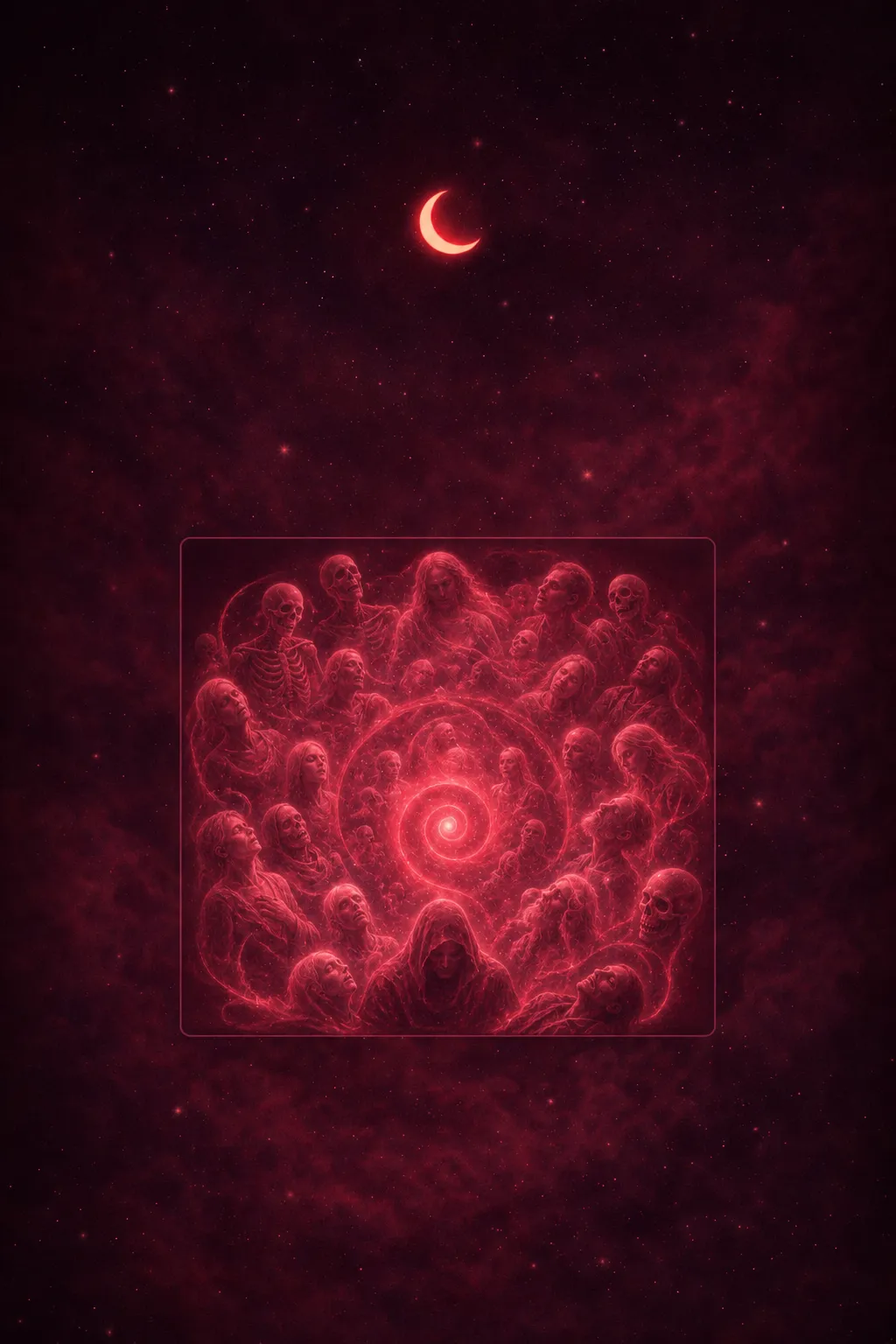

Dreaming everyone is dead typically reflects deep feelings of isolation, fear of abandonment, or anxiety about major life changes, as your subconscious uses death imagery to symbolize endings, emotional disconnection, or a profound shift in your relationships and the world around you.
In under a minute you could read what your exact dream means for you, and see a picture of it. Free.
If they came to you in that dream, you already know it felt like more than a dream.
This page can't tell you what the visit meant for you. The free app gives you the warm, spiritual reading of your own dream — gently, in plain words.


A dream still on your mind? Get your personal reading.
Describe your dream in a line or two. In seconds you get a reading of your exact dream, a picture drawn from your own words, and every symbol explained.
Free. No sign-up. Takes 10 seconds. Your dream stays private.
0%
Analyzing your dream…
Something went wrong. Please try again in a moment.
Your dreams deserve more than a dictionary
Common Dream Scenarios and What They Mean
The specific shape of this dream shifts its meaning considerably. The most frequently reported version — waking up as the sole survivor in a world of corpses — tends to reflect profound emotional isolation rather than literal fear of death. It often surfaces during periods of burnout or depression, when a person feels invisible or disconnected from everyone around them. A closely related scenario, in which every family member is dead, zeroes in on security anxiety: the psyche is wrestling with fears about losing its support structure, or with the pressure of being the one who holds everything together.
- Watching everyone die but feeling powerless to stop it — points to helplessness and guilt, often tied to a real-life situation where you feel responsible for others but unable to protect them.
- A citywide or apocalyptic mass death — frequently linked to generalized anxiety and end-of-world dread fed by relentless news cycles; the dream is externalizing a loss-of-control feeling about the wider world.
- Everyone is dead, yet you feel calm or even relieved — this unsettling variant usually signals an urgent need for boundaries or relief from overwhelming obligations, not hidden aggression.
- Interacting with or trying to revive the dead — suggests unfinished emotional business or unprocessed grief, a wish to reconnect with something or someone that has changed or ended; dreams about death and what it represents often carry this same undercurrent of longing for restoration.
- The dead suddenly wake up — reflects ambivalence about a change, or hope that a loss might still be reversed.
Was yours a sign? Find out.
Across all these variants, the common thread is the psyche using extreme imagery to communicate something it cannot say quietly: that control feels lost, that emotional reserves are running low, or that a significant ending demands acknowledgment.
What this dream could look like
Tap an image to open it full screen
Example images. Only you can see what you write in Dream Book.
Psychological Reading: Loss, Control, and the Transforming Self
From a psychological standpoint, dreaming that everyone around you is dead rarely signals anything prophetic — it is the subconscious using extreme imagery to communicate an internal state that feels equally extreme. Mainstream dream psychology frames mass-death imagery as an amplified grief signal: the mind projects unresolved fear of abandonment or anticipatory mourning outward onto every person in your social world, turning a private emotional wound into a landscape-wide loss. If you have been quietly carrying unprocessed bereavement — or dreading the departure of someone important — the psyche may have no subtler way to surface that weight than by emptying the world entirely. This pattern shares emotional territory with classic anxiety dreams such as dreams of teeth falling out, where the subconscious translates inner dread into vivid physical or social catastrophe.
Modern-anxiety framing adds another layer. Under chronic stress, the brain can generate what researchers sometimes call a "relief fantasy" — the world emptied of demands, obligations, and noise — while simultaneously coding that same emptiness as terror. Both responses can appear in a single dream, leaving you shaken by something you almost wanted. This tension is worth sitting with honestly. Recurrent dreams of this kind, especially when paired with low mood and a sense of disconnection in waking life, can serve as a quiet but serious signal that isolation or depression deserves attention. A dream shaped like an apocalyptic collapse of your social world may be the psyche's loudest available alarm bell.
But what does your version mean?
- Grief and anticipatory loss: fear of abandonment projected across the entire relational field
- Overwhelm and control: the emptied world as both longed-for silence and dreaded helplessness
- Survivor dynamics: being the last one standing can reflect feeling fundamentally different, guilty, or burdened by continuation
- Ego transformation: in a Jungian reading, the death of everyone represents the old self — its relationships, roles, and identity — clearing space for genuine change
- Life-transition processing: a move, breakup, or career shift can register internally as everyone being gone
General meanings end here. Read your own dream.
Describe your dream in a line or two. In seconds you get a reading of your exact dream, a picture drawn from your own words, and every symbol explained.
Free. No sign-up. Takes 10 seconds. Your dream stays private.
0%
Analyzing your dream…
Something went wrong. Please try again in a moment.
Your dreams deserve more than a dictionary
Every dream you log starts to connect.
Dream Book keeps your dreams in one place and reveals the threads between them over time — your private dream journal. Free to start.
Cultural and Traditional Perspectives on Mass-Death Dreams
Across Western folk tradition, dreaming of widespread death has long carried an ominous reputation — a warning sign, an ill omen, or a signal that major change was bearing down on the dreamer's community. Older European superstition treated such visions as portents requiring prayer or ritual protection, and a broadly Christian reading still lingers in some corners of American culture: mass death in dreams can evoke apocalyptic imagery drawn from Revelation, framing the dream as a spiritual wake-up call about mortality, accountability, or the fragility of the world people take for granted. That biblical undertone rarely dominates modern interpretation, but it does add a layer of unease that purely secular readings miss.
Contemporary Anglo-American culture, however, has largely shifted away from omen-based thinking toward a self-help, psychologically oriented framework. Most people today instinctively reach for questions like "What is this telling me about myself?" rather than "Is this a bad sign?" That shift matters, because it reframes the dream as data about internal life rather than external fate — a perspective that fits neatly with modern anxieties around control and overwhelm. Pandemic memory, relentless news cycles, and the habit of doomscrolling have genuinely embedded mass-death imagery into the cultural imagination, making it far more available as dream material than it was a generation ago. Interestingly, that same dread of losing control also surfaces in subtler dreams about death, where a single loss stands in for the same fears that mass-death imagery expresses on a grander scale.
- Folk omen tradition: historically read as a warning of community-wide disruption or personal loss.
- Christian cultural lens: may evoke themes of end-times or spiritual reckoning, prompting reflection on priorities.
- Modern anxiety framing: pandemic trauma and news overload now routinely seed this imagery without any prophetic meaning attached.
- Self-help orientation: mainstream Anglo culture treats the dream as a mirror for internal stress, not a literal forecast.
Spiritual Meaning: Endings, Warning, and the Hope of Restoration
Within a US Christian framework, mass-death imagery in dreams can land as a sharp spiritual prompt — a nudge to examine whether you have been taking the people and relationships in your life for granted. Rather than reading the vision as a dark omen, many pastors and Christian counselors point toward scriptures of restoration: Ezekiel's valley of dry bones (Ezekiel 37:1–14) pictures a field of death transformed into living community, suggesting that even the most desolate inner landscape carries the seed of renewal. Paul's reminder in 1 Corinthians 15 that death is not the final word, and the promise in Revelation 21:4 that grief itself will one day be undone, offer a theological frame that softens the dread without dismissing it.
A bad dream isn't a bad sign.
From a broader spiritual perspective, the dream fits a recurring archetype: the apocalyptic clearing that precedes a new chapter. Many contemplative traditions treat imagery of widespread ending as a symbolic death of an old self or life-phase — the psyche's way of dramatizing that something must be released before growth is possible. In an era shaped by chronic stress and the feeling that events are spinning beyond personal control, this kind of dream may function as a spiritual wake-up call: an invitation to reconnect with what genuinely matters before exhaustion quietly strips it away.
- Ezekiel 37 lens: desolation in the dream does not mean permanent loss — restoration is the arc.
- Endings-as-rebirth: consider what old identity or relationship pattern may be ready to be laid down.
- Gratitude prompt: the emotional shock of the dream can be redirected into intentional appreciation for living relationships.
Related Dream Meanings
nightmares
Apocalypse Dream Meaning: Fear, Change & Inner Turmoil
5 min read
nightmares
Death Dream Meaning: Transformation, Loss & Change
5 min read
body health
Teeth Falling Out Dream: Anxiety, Loss & Vulnerability
5 min read
nightmares
Dying Dream Meaning: Transformation, Fear & Change
5 min read
common dreams
Falling Dream Meaning: Insecurity, Fear & Loss of Control
5 min read
nightmares
Being Chased by a Snake: Meaning and Interpretation
6 min read
nightmares
Being Attacked Dream Meaning: Fear & Hidden Anxiety
5 min read
nightmares
Hell Dream Meaning: Fear, Guilt & Unresolved Issues
5 min read
Practical Takeaways: What to Do After This Dream
Because this dream almost always signals internal overload rather than anything prophetic, the most useful first step is a simple stress audit. Ask yourself honestly: where in your life do you feel most out of control right now — work deadlines, a strained relationship, a major life transition? Naming the source of that pressure out loud (or in a journal) can strip the dream of its emotional charge and point you toward a concrete next step.
Was yours a sign? Find out.
- Check your isolation levels. If you have been canceling plans, withdrawing from friends, or feeling like "no one really gets it," treat that as a signal worth acting on — reach out to one person this week, not to process the dream, but simply to reconnect.
- Reframe endings as information. If a relationship, job, or chapter of your life is quietly closing, this dream may be your psyche pushing you to acknowledge it. Journaling about what feels "over" — similar to processing dreams about dying — can help you move from helplessness to intentional choice.
- Regulate before you interpret. Anxiety amplifies nightmare intensity. A consistent sleep routine, reduced screen time before bed, and basic breathwork are unglamorous but genuinely effective ways to lower the frequency of high-distress imagery — much like the somatic dread that accompanies falling dreams.
- Seek professional support if the theme recurs. A pattern of mass-death dreams alongside persistent low mood or anxiety is worth raising with a therapist — not because the dream predicts anything, but because recurring distress imagery is useful clinical information.
Keep the ones that matter close.
The free app saves your most meaningful dreams and reads the signs across them — so a visit or a sign is never lost. Free to start.
People Also Ask
The Bible doesn't directly address dreaming of the dead, but scripture suggests such dreams may carry symbolic meaning. In Genesis and Daniel, God used dreams to communicate warnings and guidance. Many believers interpret dreams of the dead as prompts for reflection, prayer, or spiritual awareness rather than literal messages from the deceased.
Dreaming of death is generally not a bad omen. Most dream interpreters view it as a symbol of transformation, endings, and new beginnings. It often reflects major life changes, letting go of old habits, or personal growth. Rather than fearing such dreams, consider what aspects of your life may be shifting or closing.
Dreams featuring recurring themes, vivid emotions, or powerful symbols like death, falling, or being chased often carry important psychological messages. If a dream leaves you deeply unsettled or repeats frequently, it likely reflects unresolved stress, fear, or emotional conflict your waking mind hasn't yet processed. These deserve genuine reflection and attention.
Dreaming that everyone is dead often signals feelings of isolation, emotional exhaustion, or fear of abandonment. It can reflect anxiety about losing loved ones, grief, or a sense that your social world is changing dramatically. Psychologically, it may also connect to recurring themes seen in dreams about fire or water, representing a desire to escape overwhelming responsibilities or a need for deep personal renewal.
Curious what your dream would look like?