
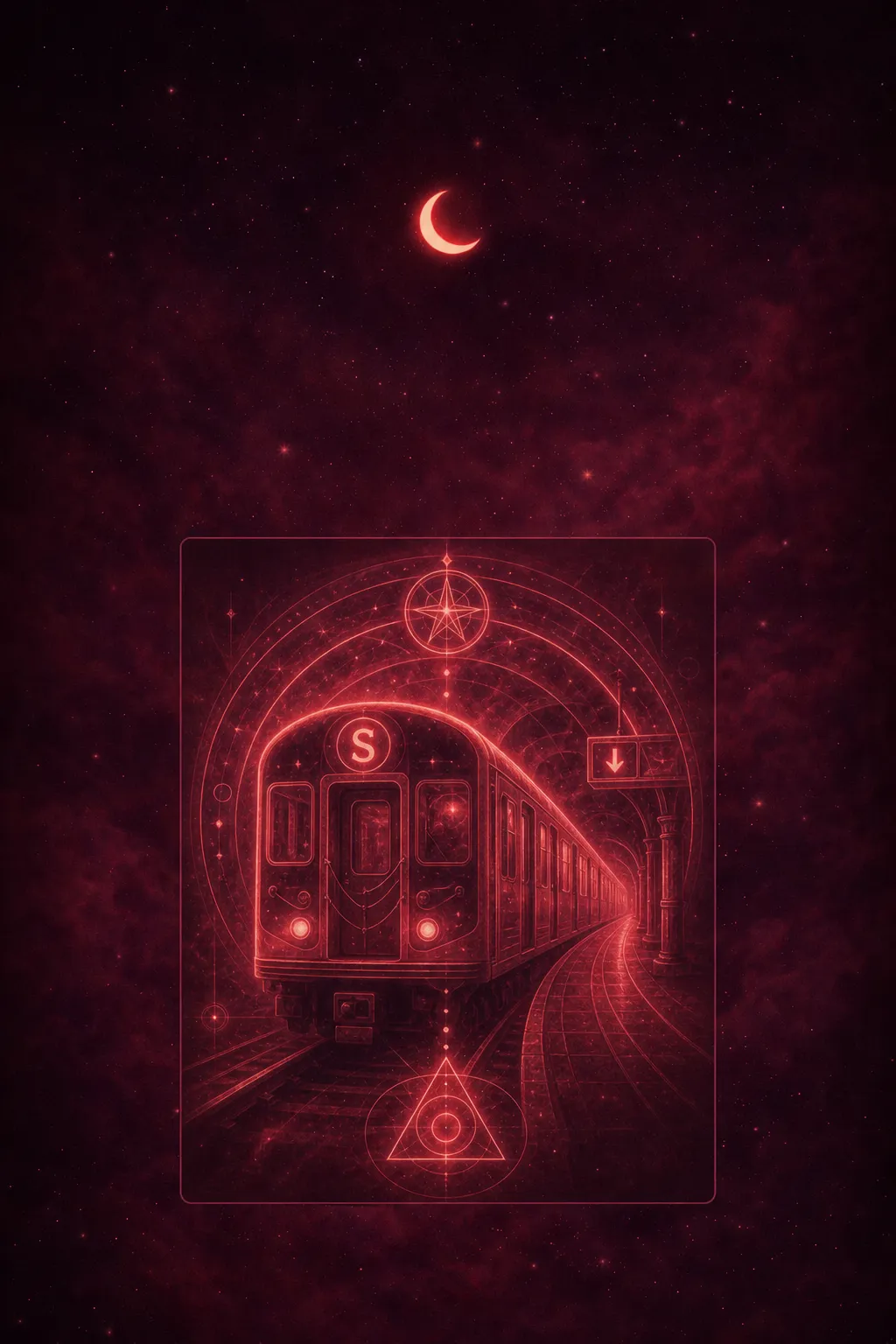

Dreaming of a subway often reflects your sense of direction, the pace of your life, or feelings of being on a predetermined path. Underground transit can symbolize hidden emotions or unconscious drives moving you forward. Missing a subway or feeling lost in a station may point to anxiety about missed opportunities or lack of control.
In under a minute you could read what your exact dream means for you, and see a picture of it. Free.
You read what it can mean. But what did yours mean?
General meanings stop here. In the free app, tell Dream Book your exact dream and get a reading that actually makes sense for you.


Common Subway Dream Scenarios
Missing the Subway or Being Left Behind
You're on the platform. The doors slide shut. The train pulls away without you. This is one of the most viscerally frustrating dream experiences — and it almost always connects to a fear of missed opportunity or falling behind. Something in your waking life has a deadline, a window, a moment that feels like it's closing.
This scenario often surfaces during major life transitions: a job change, a relationship at a crossroads, a creative project you keep postponing. Your subconscious is holding up a mirror. If you also find yourself running late in other dreams, the pattern is worth paying attention to — your mind is trying to tell you something about urgency and readiness.
But what does your version mean?
Lost in the Subway or Wrong Train
You board confidently, then realize nothing looks familiar. The station names don't make sense. You've taken the wrong line entirely. Dreams of being lost in the subway tunnel tap into a deep anxiety about direction — not just physically, but in terms of life path and identity.
This dream tends to appear when you're at a crossroads you haven't consciously acknowledged yet. Maybe you've been following a route that made sense once but no longer fits. The underground setting matters: subways run beneath the visible world, which suggests the confusion you're feeling is happening at a level below your daily awareness.
Crowded or Claustrophobic Subway Car
The car is packed. You can't move. The walls feel close. Claustrophobia in a subway dream points to social pressure, overwhelm, or the feeling that other people's demands are consuming your space. You're being carried somewhere by a crowd, not by your own choice.
There's often a loss-of-autonomy quality here that mirrors how car dreams where the brakes fail operate — you're in a vehicle, technically moving forward, but not in control. Pay attention to who else is in the car with you. Familiar faces suggest specific relationships are contributing to the pressure.
Subway Flooding or Crashing
Water rushing into the tunnels. The train derailing in the dark. These are high-intensity subway dreams that amplify the symbol to its extreme. Flooding in an underground space — where water has nowhere to go — speaks to emotions that have been suppressed for too long and are now threatening to overwhelm you. If you've been dreaming of dark water in other contexts, this dream is part of the same emotional current.
A subway crash carries a different weight: sudden, violent disruption to a path you thought was fixed. Something you trusted to carry you forward has failed. This can reflect a real-world breakdown — in plans, in relationships, in health — that you're beginning to process.
What this dream could look like
Tap an image to open it full screen
Example images. Only you can see what you write in Dream Book.
Psychological Interpretation
Freud would have found the subway irresistible. Tunnels, for him, were among the most transparent dream symbols — enclosed passages representing the unconscious itself, or the body, or both. The subway as a whole fits neatly into his wish-fulfillment framework: the dream of smooth, effortless transit reflects the desire for life to simply work, to carry us forward without resistance. When the train breaks down or you miss it, that's the repressed anxiety breaking through the fantasy.
Jung read underground spaces differently. For him, descending beneath the surface — whether into a basement, a cave, or a subway tunnel — was a movement toward the unconscious, toward the Shadow. The subway dream, in Jungian terms, is an invitation to look at what's running beneath your conscious life: the motivations, fears, and unlived possibilities you've pushed underground. If the dream feels threatening, it's often because the Shadow material is close to surfacing. Jung's concept of individuation — the lifelong process of integrating all parts of the self — suggests that these underground journeys in dreams are part of how we grow.
Was yours a sign? Find out.
Calvin Hall's decades of content analysis across tens of thousands of dream reports found that transportation dreams are among the most common, and that they almost always correlate with the dreamer's sense of agency and progress in waking life. Hall noticed that people experiencing major life transitions — career changes, relationship shifts, relocations — dreamed of vehicles and transit systems at significantly higher rates. The subway, with its fixed tracks and predetermined stops, maps particularly well onto feelings of being locked into a path you didn't fully choose. If you've also been dreaming of trains or buses, Hall's data suggests you're working through a sustained question about where your life is headed.
Ernest Hartmann's emotional processing theory adds another layer. Hartmann argued that dreams function as a kind of overnight therapy — the sleeping brain takes the emotional residue of the day and weaves it into imagery that helps us metabolize it. The subway, then, isn't just a symbol of direction; it's the brain's chosen container for processing anxiety about transition. Hobson and McCarley's activation-synthesis hypothesis would frame it more mechanically: the brain's motor systems fire during REM sleep, generating sensations of movement, and the narrative mind stitches a subway ride around those signals. But even within that framework, the specific emotional tone — the dread of missing the train, the relief of arriving — comes from you.
General meanings end here. Read your own dream.
0%
Analyzing your dream…
Something went wrong. Please try again in a moment.
Your dreams deserve more than a dictionary
Cultural & Spiritual Meaning
In Western symbolic tradition, the underground has long carried associations with the unconscious, the underworld, and the hidden self. The subway fits squarely into that lineage. Moving through tunnels beneath a city is, symbolically, moving through the parts of life that don't show up on the surface — the infrastructure of your existence, the systems that keep things running without anyone seeing them.
Ibn Sirin, the 8th-century Islamic dream scholar whose interpretations remain influential across the Muslim world, wrote extensively about journeys as dream symbols. For Ibn Sirin, a journey that proceeds smoothly signals blessing and forward movement in one's affairs, while a journey interrupted — by obstacles, wrong turns, or vehicles that fail — warns of difficulties ahead that require patience and recalibration. Applied to the subway dream, a smooth ride would carry a quietly optimistic meaning, while getting lost or stranded would prompt the dreamer to examine where in their life they've lost their way and what spiritual or practical correction might be needed.
A bad dream isn't a bad sign.
In East Asian interpretive traditions, underground spaces are often associated with the ancestral realm and with hidden knowledge. A dream of descending into a subway could be read as a moment of contact with deeper wisdom — not something to fear, but something to listen to. The train's destination, in this reading, matters as much as the journey itself: where are you going, and is it where you truly want to arrive?
Related Dream Meanings
common dreams
Being Late Dream Meaning: Anxiety, Fear & Missed Chances
5 min read

common dreams
Being Lost Dream Meaning: Confusion & Direction
5 min read

common dreams
Cars Dream Meaning: Control, Direction & Life Path
5 min read

common dreams
Dreaming of Dark Water Meaning: What Your Dream Reveals
6 min read
common dreams
Train Dream Meaning: Life Path, Goals & Direction
5 min read
common dreams
Bus Dream Meaning: Life Path, Control & Belonging
5 min read

common dreams
Elevator: Meaning and Interpretation
6 min read

common dreams
What Does It Mean to Dream About Airplanes
5 min read
What to Do After This Dream
Start by sitting with the emotional texture of the dream before you analyze it. Were you anxious, calm, resigned, exhilarated? The feeling is the first data point. A terrifying subway crash and a peaceful underground ride are very different messages even though they share the same symbol.
Ask yourself honestly: in your waking life, do you feel like you're on the right track? Not metaphorically — really sit with it. Are you moving toward something you chose, or something that was chosen for you? The subway's fixed rails are a useful image here. You can ride the system efficiently, or you can start asking whether you boarded the right line in the first place.
If the dream featured an elevator or other vertical movement alongside the subway, pay attention to the direction — up and down carry their own meanings layered beneath the horizontal transit. And if the dream keeps returning, that repetition is your subconscious insisting on being heard.
Journaling immediately after waking captures details that dissolve within minutes — the station names, the faces, the specific moment things went wrong. If this dream keeps returning, it's worth exploring with a personalized interpretation — Dream Book lets you describe your dream in your own words and ask follow-up questions to understand what your subconscious is actually working through.
But what does your version mean?
Understanding your subway dream is the first step. The next is asking what it means for your life right now — that's where a personalized interpretation goes deeper than any dictionary.
One dream is never the whole picture.
The free app remembers your dreams, draws them, and connects the threads over time — so the next one means even more. Free to start.
People Also Ask
Missing the subway in a dream usually points to a fear of missed opportunity or falling behind on something important in your waking life. It often appears during periods of transition — a deadline, a decision, or a window you're afraid is closing. Your subconscious is flagging urgency around something you may not have fully faced yet.
Getting lost in a subway dream reflects confusion about your direction or life path, often at a level deeper than conscious awareness. The underground setting amplifies this — it suggests the disorientation is happening beneath the surface, in goals or values you haven't examined lately. It's a prompt to ask whether the route you're on is still the one you actually want.
Not necessarily. A smooth, purposeful subway ride can signal that you're moving efficiently toward your goals and trusting the process. The emotional tone of the dream matters most — anxiety and dread point to unresolved pressure, while calm or curiosity suggest you're navigating transition with more confidence than you might realize.
A flooded subway combines two powerful symbols — the underground and water — to suggest emotions that have been suppressed and are now threatening to overwhelm you. It typically appears when you've been pushing feelings down for a long time and they're starting to break through. This dream is less a warning and more an invitation to address what you've been avoiding.
Curious what your dream would look like?