
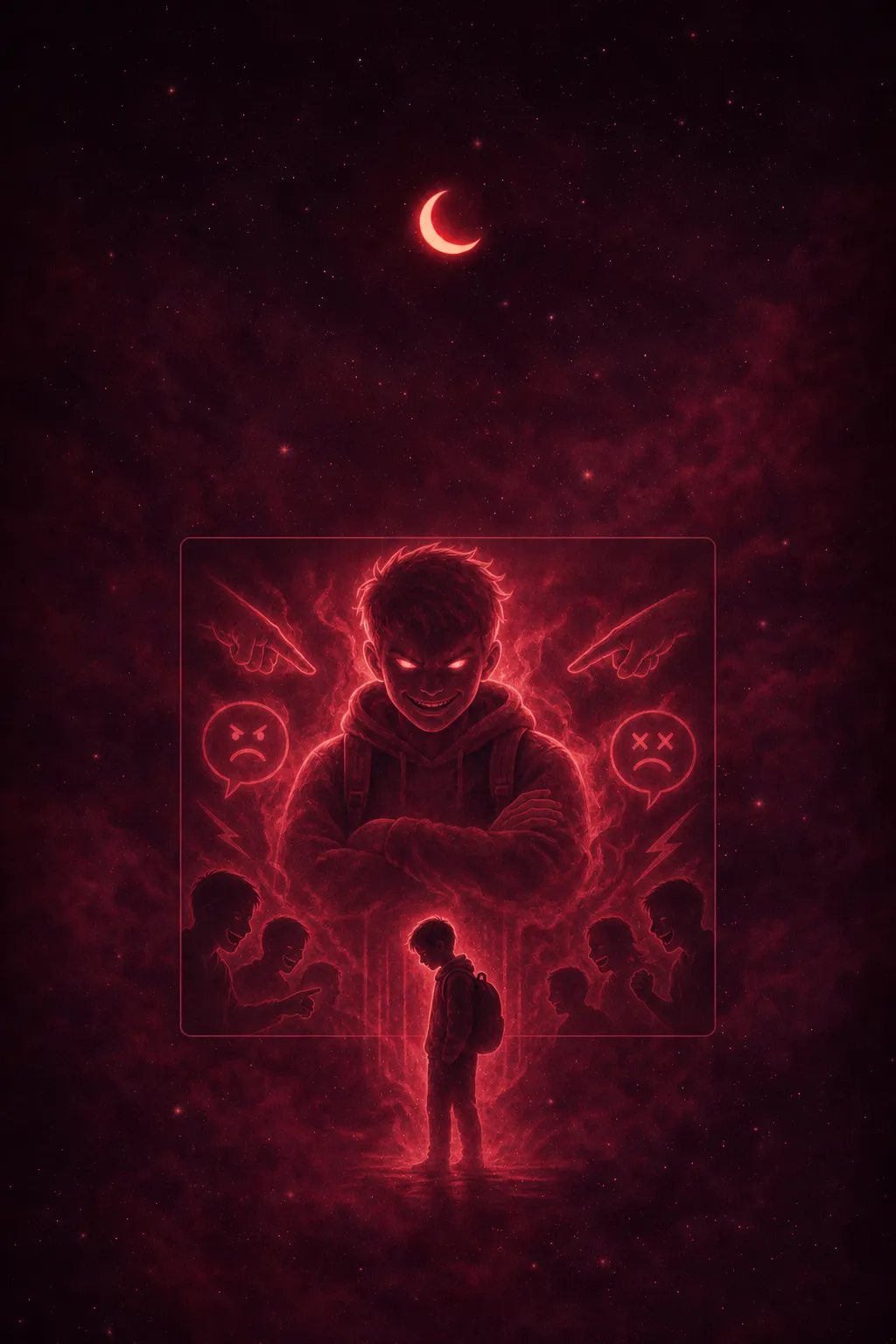

Dreaming of a school bully usually reflects unresolved feelings of powerlessness, lingering anxiety from past experiences, or a current situation where you feel intimidated or controlled. The bully often represents an inner critic, a domineering person in your waking life, or old wounds that still need healing. Paying attention to how you respond in the dream can offer insight into your confidence and emotional resilience.
In under a minute you could read what your exact dream means for you, and see a picture of it. Free.
You read what it can mean. But what did yours mean?
General meanings stop here. In the free app, tell Dream Book your exact dream and get a reading that actually makes sense for you.


Common School Bully Dream Scenarios
Being Chased or Cornered by the Bully
When the bully is chasing you through school corridors, your dream is staging a confrontation you've been avoiding. The chase is never really about escape — it's about the thing you're running from. Usually that thing is a feeling: humiliation, inadequacy, the fear that someone sees through you.
Notice where you run. If you find a door that won't open or a room with no exit, your subconscious is telling you the avoidance strategy has run its course. The pressure behind you is pressure you're putting on yourself.
But what does your version mean?
Standing Up to the Bully
This is the dream people wake up from feeling unexpectedly good. You finally say the thing. You hold your ground. The bully backs down — or doesn't, but it doesn't matter, because you didn't collapse. This scenario marks a psychological shift, a moment where something in you is ready to stop accommodating what diminishes you.
If you've been dreaming this after being attacked or threatened in earlier dreams, pay attention. The progression is meaningful. Something is integrating.
The Bully from Your Actual Past
Sometimes the face is specific. Someone you haven't thought about in twenty years shows up with perfect clarity, and you're back in that hallway, that classroom, that cafeteria. This kind of dream tends to appear when a current situation is triggering the same emotional signature as the original wound — the same helplessness, the same social exposure.
It's worth exploring alongside dreams of being back in school, which often carry the same freight: the sense that you're being evaluated, found lacking, or trapped in a role you outgrew. The past isn't haunting you randomly. Something in the present called it up.
Becoming the Bully
This one lands harder. You're the one doing the intimidating, the mocking, the cornering — and you wake up unsettled. Before you spiral, know this: dreaming of high school dynamics where you play the aggressor is often about power you feel you lack, not power you're abusing. The psyche sometimes tries on the opposite role to understand it.
But it can also be a genuine signal. Are you being harder on someone — a colleague, a partner, yourself — than is fair? The dream might be asking you to look at that honestly.
What this dream could look like
Tap an image to open it full screen
Example images. Only you can see what you write in Dream Book.
Psychological Interpretation
Freud would have seen the school bully as a figure of authority distorted by the unconscious — a projection of the superego turned punishing and external. In his framework, the bully represents everything we've been told we're not allowed to be or want, now wearing a human face and threatening us with exposure. The school setting matters too: for Freud, returning to school in dreams is almost always about judgment, performance anxiety, and the fear of being found out.
Was yours a sign? Find out.
Jung took it somewhere deeper. The bully, in Jungian terms, is a Shadow figure — the part of the psyche that carries everything we've rejected or buried. When the bully appears, Jung would say you're being confronted with your own disowned power, your own capacity for aggression or dominance that you've never let yourself acknowledge. The path isn't to defeat the bully but to integrate what they represent. Ignoring the Shadow doesn't make it smaller; it makes it louder. This connects to why chase dreams so often feature figures that feel threatening but never quite catch you — the unconscious is pursuing integration, not destruction.
Calvin Hall's content analysis of over 50,000 dream reports found that aggression is one of the most consistent dream themes across cultures and demographics. Specifically, Hall noted that dreamers are far more likely to be the victim of aggression than the perpetrator — a pattern that maps directly onto the school bully dynamic. His research suggests these dreams aren't random emotional noise; they're consistent expressions of how we experience social threat and power imbalance in waking life.
Ernest Hartmann's emotional processing theory adds another layer. Hartmann argued that dreams function like a kind of overnight therapy — they take the emotional core of what's troubling us and connect it to older, related memories, building a web of meaning. A difficult meeting with your manager on Tuesday might pull up a memory of being humiliated in front of your class at age eleven, not because they're identical, but because they share the same emotional signature. The bully dream is your mind doing that stitching work, trying to process the current wound through the lens of the original one.
General meanings end here. Read your own dream.
Describe your dream in a line or two. In seconds you get a reading of your exact dream, a picture drawn from your own words, and every symbol explained.
Free. No sign-up. Takes 10 seconds. Your dream stays private.
0%
Analyzing your dream…
Something went wrong. Please try again in a moment.
Your dreams deserve more than a dictionary
Cultural & Spiritual Meaning
In Western psychological tradition, the school bully dream sits squarely in the territory of the wounded inner child — a concept that's become almost cultural shorthand. The dream is read as evidence that some formative experience of powerlessness hasn't been fully metabolized, and the subconscious keeps returning to it the way a tongue returns to a sore tooth. Western therapeutic approaches often use these dreams as entry points into early attachment wounds and self-worth narratives.
Ibn Sirin, the 8th-century Islamic scholar whose dream interpretations remain foundational across much of the Muslim world, wrote that dreaming of being oppressed or overpowered by another person is a sign to examine where you have surrendered your will unnecessarily — and a call to seek justice through patience rather than confrontation. He interpreted such dreams not as omens of ongoing harm, but as reminders that endurance and dignity are forms of strength. The oppressor in the dream, in his reading, often symbolizes a test of character rather than a literal enemy.
A bad dream isn't a bad sign.
In many Indigenous and Eastern traditions, dreams of conflict with another person are understood as messages about relational imbalance — not just between you and another individual, but between you and the community, or between different aspects of the self. The bully figure in these frameworks is often seen as a teacher in disguise: harsh, yes, but pointing toward something that needs to be reclaimed. The discomfort of the dream is the lesson, not the punishment.
Related Dream Meanings

nightmares
Being Chased Dream Meaning: Anxiety & Avoidance
5 min read

nightmares
Being Attacked Dream Meaning: Fear & Hidden Anxiety
5 min read

common dreams
Back in School Dream Meaning: Nostalgia, Anxiety & Growth
5 min read

common dreams
High School Dream Meaning: Insecurity, Nostalgia & Growth
5 min read

people
Ex-Girlfriend Dream Meaning: Unresolved Feelings & Desires
5 min read

people
Seeing Jesus Dream Meaning: Hope, Guidance & Faith
5 min read

people
Dreaming About Your Father: Meaning and Interpretation
5 min read

people
Jesus Dream Meaning: Guidance, Hope & Transformation
5 min read
What to Do After This Dream
First, don't dismiss it as "just stress." The school bully dream has specificity — a setting, a face, a feeling — and that specificity is information. Sit with the emotional residue for a few minutes before you get up. What did you feel in the dream? Shame? Rage? Helplessness? That feeling is the real message, and it's pointing somewhere in your waking life.
Ask yourself: where do I feel like this right now? Not in 1997, but this week. Is there a relationship, a workplace dynamic, a family pattern that's activating the same response? The bully in the dream is almost always a costume worn by something current.
If the dream keeps returning — especially if it's escalating or shifting in tone — it's worth going deeper than a dictionary entry can take you. Dream Book lets you describe exactly what happened in your dream and ask follow-up questions to understand what your subconscious is actually working through, not just what school bullies "mean" in general.
But what does your version mean?
And if the dream surfaces something real — a memory of actual harm, a wound that still has weight — consider whether it's time to talk to someone about it. Some things deserve more than a night's processing. Understanding your school bully dream is the first step. The next is asking what it means for your life right now — that's where a personalized interpretation goes deeper than any dictionary.
One dream is never the whole picture.
The free app remembers your dreams, draws them, and connects the threads over time — so the next one means even more. Free to start.
People Also Ask
Dreaming about a specific bully from your past usually signals that a current situation is triggering the same emotional response as the original experience — feelings of powerlessness, shame, or social threat. The dream is less about that person and more about what they represented: a moment when you felt unable to defend yourself. Something in your present life is echoing that feeling.
Recurring bully dreams often point to an unresolved pattern — either an old wound that hasn't been fully processed, or a current dynamic that keeps reactivating it. Ernest Hartmann's research suggests the dream mind connects emotionally similar experiences across time, so a difficult relationship or workplace situation can keep pulling up the original school memory. The repetition is the subconscious asking you to pay attention.
Dreaming that you're the bully is often about displaced power rather than actual aggression — it can reflect feelings of powerlessness that your mind is processing by trying on the opposite role. It can also be a prompt to examine whether you're being harder on someone (or yourself) than is warranted. Either way, the dream is worth taking seriously rather than brushing aside.
Yes — Calvin Hall's large-scale content analysis found that aggression and victimization are among the most common dream themes, strongly correlated with waking-life stress and social anxiety. The school setting amplifies this because it's one of the earliest environments where we experienced evaluation and social hierarchy. If these dreams are frequent, they're likely reflecting ongoing tension in your waking life.
Curious what your dream would look like?