
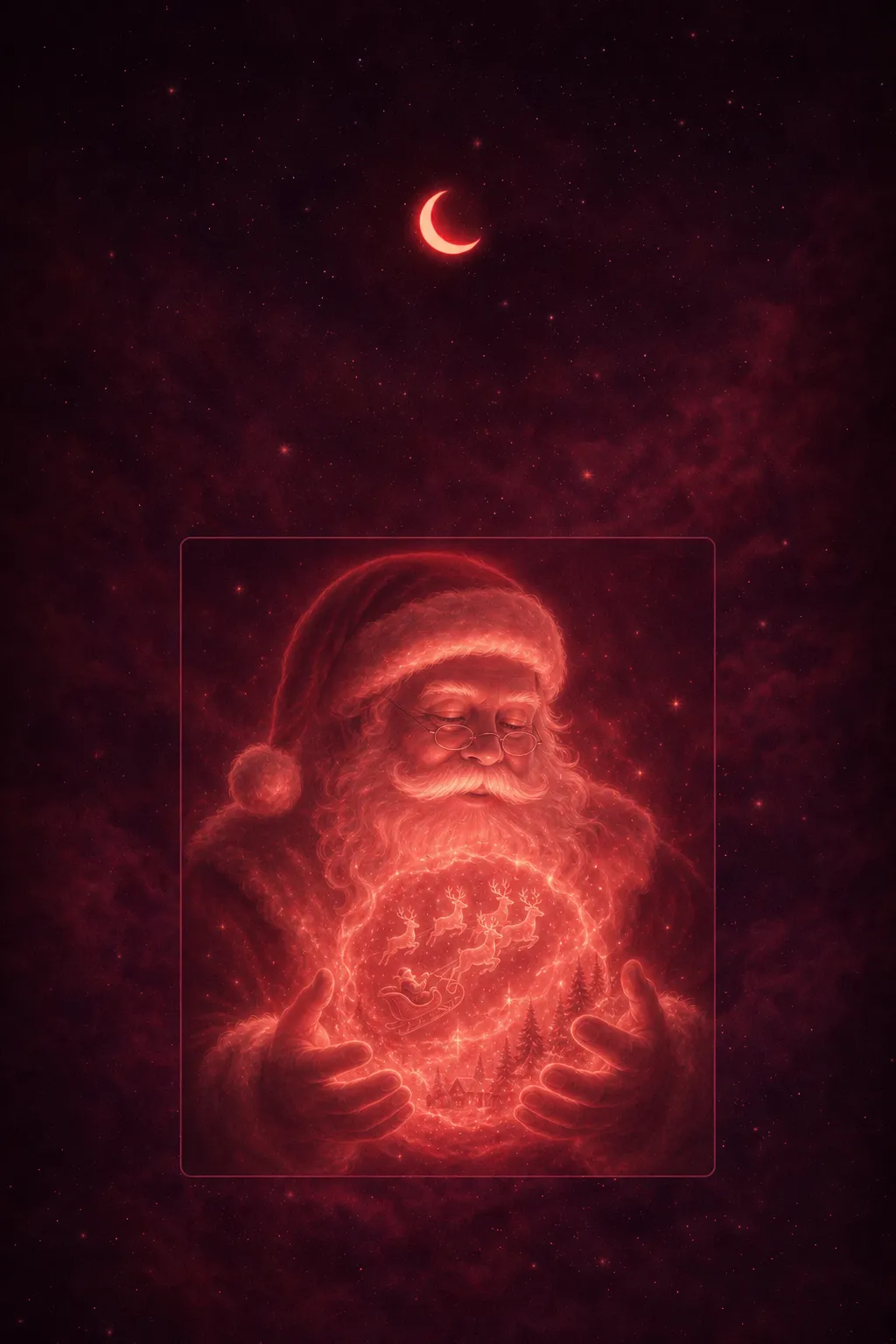

Dreaming of Santa Claus meaning centers on themes of generosity, reward, and childlike wonder, as this symbol often reflects your longing for unconditional love, your hopes for good fortune, or a subconscious reminder to embrace gratitude, trust in abundance, and reconnect with the joy and innocence you may have lost in adult life.
In under a minute you could read what your exact dream means for you, and see a picture of it. Free.
You read what it can mean. But what did yours mean?
General meanings stop here. In the free app, tell Dream Book your exact dream and get a reading that actually makes sense for you.


A dream still on your mind? Get your personal reading.
Describe your dream in a line or two. In seconds you get a reading of your exact dream, a picture drawn from your own words, and every symbol explained.
Free. No sign-up. Takes 10 seconds. Your dream stays private.
0%
Analyzing your dream…
Something went wrong. Please try again in a moment.
Your dreams deserve more than a dictionary
Common Santa Claus dream scenarios and what they mean
The way Santa appears in your dream — and how you feel about him — shifts the meaning considerably. Here are the most telling variants.
Dreaming of receiving a gift from Santa
This is the warmest scenario, and it speaks directly to felt worthiness. If the gift delights you, your mind may be signaling that you genuinely believe your efforts deserve recognition. If the gift disappoints, pay attention — the dream may be surfacing a quiet fear that no external reward will ever quite match how hard you have been working.
But what does your version mean?
Dreaming of Santa who seems eerie, fake, or threatening
A sinister or hollow-seeming Santa points to distrust — of authority figures, of cheerful promises, or of someone in your life whose "generosity" feels performative. The dream strips the mask off, asking whether you are accepting help that comes with strings attached.
Dreaming that you become Santa yourself
Wearing the red suit suggests you have taken on the provider or caretaker role for those around you. This can feel meaningful, but the shadow side is real: burnout, quiet resentment, and an identity so bound to giving that your own needs go unspoken. Consider whether the role was chosen or simply handed to you.
Dreaming of discovering Santa isn't real
Unmasking Santa in a dream often mirrors a waking-life disillusionment — a relationship, institution, or belief that once felt safe is now harder to trust. Like dreams set in a childhood home, this scenario tends to surface during transitions that force you to leave a comforting story behind.
Dreaming of waiting for Santa who may not arrive
Anticipation without arrival is a classic anxiety dream. You are dependent on an outcome you cannot control, and the dream reflects exactly that loss of agency — whether tied to a job decision, a relationship, or recognition you have been hoping someone else will finally offer.
Was yours a sign? Find out.
Dreaming that Santa says you are on the naughty list
This scenario hands your inner critic a megaphone. Being judged unworthy by the ultimate gift-giver maps onto shame, guilt about recent choices, or a nagging sense that you have fallen short of your own moral standards — not necessarily anyone else's.
What this dream could look like
Tap an image to open it full screen
Example images. Only you can see what you write in Dream Book.
What Your Psyche Is Really Saying About Santa
From a psychological standpoint, Santa Claus functions as a powerful projection screen — one your subconscious uses to work through questions of worthiness, reward, and who is ultimately in charge of your well-being. The "naughty or nice" ledger is essentially your internalized critic made visible: a dream in which Santa passes you over or frowns at his list often reflects an inner evaluator that is measuring you against standards you may not even consciously endorse. This dynamic is especially common during high-demand seasons when the pressure to perform — to be generous enough, present enough, cheerful enough — can quietly erode self-esteem.
Jung would recognize Santa as a variant of the Wise Old Man archetype: the benevolent authority who sees everything and still chooses to give. Dreaming of him warmly can signal a genuine wish to be seen and cared for — a wish that, for many adults, goes unspoken. There is also a regression pull here: the dream may be drawing you back toward the uncomplicated safety of a childhood home, using nostalgia as a coping strategy against adult stress and uncertainty.
- Passivity vs. agency: Because Santa's gifts arrive without personal effort, he can symbolize a tension between waiting to be rescued and taking ownership of your own life.
- Disillusionment: A dream in which Santa is exposed as fake or menacing may reflect grief over lost innocence — or a healthy push toward confronting reality rather than relying on magical thinking.
- Obligation pressure: Dreaming of being Santa yourself often points to feeling over-responsible for others' happiness, a common anxiety during emotionally loaded times of year.
General meanings end here. Read your own dream.
Describe your dream in a line or two. In seconds you get a reading of your exact dream, a picture drawn from your own words, and every symbol explained.
Free. No sign-up. Takes 10 seconds. Your dream stays private.
0%
Analyzing your dream…
Something went wrong. Please try again in a moment.
Your dreams deserve more than a dictionary
Every dream you log starts to connect.
Dream Book keeps your dreams in one place and reveals the threads between them over time — your private dream journal. Free to start.
Santa Claus in Cultural Tradition and Folk Belief
The Santa Claus most people dream about is a surprisingly recent invention. The familiar red-suited figure is largely a 19th- and 20th-century Anglo-American construction, shaped by advertising, literature, and popular media rather than deep folklore. When he appears in your dreams, you are often engaging less with an ancient archetype and more with a symbol of consumer-season pressure — the weight of holidays, spending, and obligation that modern life layers onto what is supposed to be a celebratory time of year. Dreams set in a Christmas atmosphere frequently surface around the winter holidays precisely because that period concentrates so many competing demands: family expectations, budgets stretched thin, and the silent social contract of gift-giving.
A bad dream isn't a bad sign.
The "naughty or nice" list carries a distinctly cultural undertone worth noting separately from its psychological dimension. In mainstream Anglo-American tradition, this motif functions as a kind of folk surveillance — a yearly audit of behavior with real stakes attached. Dreaming of being evaluated by Santa, or anxiously wondering where you stand on his list, can reflect a broader cultural anxiety about performance and control: the sense that rewards are conditional and that some unseen authority is always keeping score.
- Gift economy pressure: Cultural norms around reciprocity mean dreams may surface stress about whether you have given enough — or received less than you feel you deserve.
- US Christian framing: In households where Christmas carries religious weight, Santa can appear as a secular stand-in for divine provision or judgment, blending folk tradition with spiritual expectation.
- Consumer-season overload: The commercialized holiday calendar can make Santa a symbol of obligation rather than delight — a cue worth reflecting on if he appears exhausted or distant in your dream.
The Spiritual Meaning of Dreaming About Santa Claus
Santa Claus has a quieter spiritual ancestry than most dreamers realize. The figure traces back to St. Nicholas of Myra, a fourth-century Christian bishop celebrated for anonymous, generous giving — an echo of the biblical principle that it is "more blessed to give than to receive" (Acts 20:35). When Santa appears in your dream, that lineage can surface as a gentle spiritual nudge: are you giving freely in your waking life, or are you waiting to receive recognition before you feel moved to be generous? The dream may be inviting you to examine where true blessing originates — James 1:17 describes every good gift as coming from above, which reframes Santa less as a cosmic judge and more as a symbol pointing beyond himself.
A smaller but sincere strand of Christian thought treats the Santa figure with mild caution, seeing him as a cultural stand-in that can crowd out deeper reflection on grace and provision. If the dream leaves you feeling empty or vaguely deceived — perhaps linked to a Christmas setting that feels hollow — it may be prompting honest self-inquiry: what authority or source are you really trusting to validate your worth and meet your needs? That question sits at the intersection of modern anxiety and faith, since both traditions ultimately challenge the idea that an outside judge holds the final verdict on whether you are enough.
- Gift-giving impulse: the dream may signal a spiritual call to act generously without waiting for acknowledgment.
- Source of blessing: reflect on whether you are looking to a human authority — or an idealized figure — to supply what only inner conviction or faith can provide.
- Gratitude audit: Santa dreams near the holiday season can be a prompt to take stock of genuine thankfulness rather than transactional expectation.
Related Dream Meanings
common dreams
Dreaming About Childhood Home Meaning - Dream Interpretation
5 min read
common dreams
Christmas: Meaning and Interpretation
5 min read
people
God Speaking Dream Meaning: Guidance, Purpose & Truth
5 min read
people
What Does It Mean to Dream About a Wedding Going Wrong
5 min read

people
Arguing Dream Meaning: Conflict, Tension & Inner Stress
5 min read
people
Teacher Dream Meaning: Guidance, Authority & Growth
5 min read
people
Dreaming About Coworker Meaning - Dream Interpretation Guide
6 min read

people
Buddha Dream Meaning: Peace, Wisdom & Inner Guidance
5 min read
Practical Takeaways: What to Do After a Santa Claus Dream
Rather than simply cataloguing what the dream means, use it as a prompt for honest self-reflection. Because Santa is so closely tied to judgment — the naughty-or-nice accounting — waking up from this kind of dream is a good moment to ask whether you are holding yourself to standards that are genuinely yours or ones you absorbed from authority figures long ago. If the dream left you anxious or overlooked, that emotional residue is worth sitting with: it often points to unmet needs around recognition that you can begin to address consciously, whether by asking for feedback at work, naming a need in a relationship, or simply acknowledging your own efforts without waiting for external approval.
But what does your version mean?
- Journal the feeling, not just the plot. Write down whether you felt worthy, nervous, overlooked, or delighted — the emotion carries more diagnostic weight than the story details.
- Check your giving and receiving balance. Santa dreams often surface when generosity feels one-sided. Notice whether you are consistently over-giving or struggling to accept help.
- Revisit expectations around the holidays. If the dream coincides with the Christmas season, it may be flagging unresolved pressure around the holidays — financial stress, family obligation, or the gap between the ideal and the real.
- Identify who holds authority in your waking life. If Santa felt judgmental, ask yourself whose approval you are quietly working to secure — and whether that pursuit is costing you.
One dream is never the whole picture.
The free app remembers your dreams, draws them, and connects the threads over time — so the next one means even more. Free to start.
People Also Ask
Spiritually, Santa Claus represents generosity, divine abundance, and the fulfillment of heartfelt wishes. Dreaming of him may signal that blessings are coming your way or that you need to open your heart to giving. He can also symbolize a higher power watching over you with unconditional care and goodwill.
Warning dreams from a higher power tend to feel vivid, urgent, and emotionally intense — different from ordinary dreams. Recurring imagery, a strong sense of dread, or a clear symbolic message you remember upon waking are key signs. Reflecting quietly and noting patterns across multiple dreams can help you discern genuine spiritual guidance.
Precognitive dreams — those that seemingly predict future events — are widely considered the rarest. Shared or mutual dreams, where two people report identical imagery, are also extraordinarily uncommon. Most sleep researchers acknowledge these experiences are real for the dreamer, even if their exact cause remains a fascinating and debated mystery.
A saint appearing in a dream is often interpreted as a powerful message of protection, moral guidance, or spiritual encouragement. It may indicate you are at a crossroads requiring wisdom and virtue. Many traditions view such visitations as genuine blessings, urging you to trust your higher values and seek a deeper sense of purpose.
Curious what your dream would look like?