
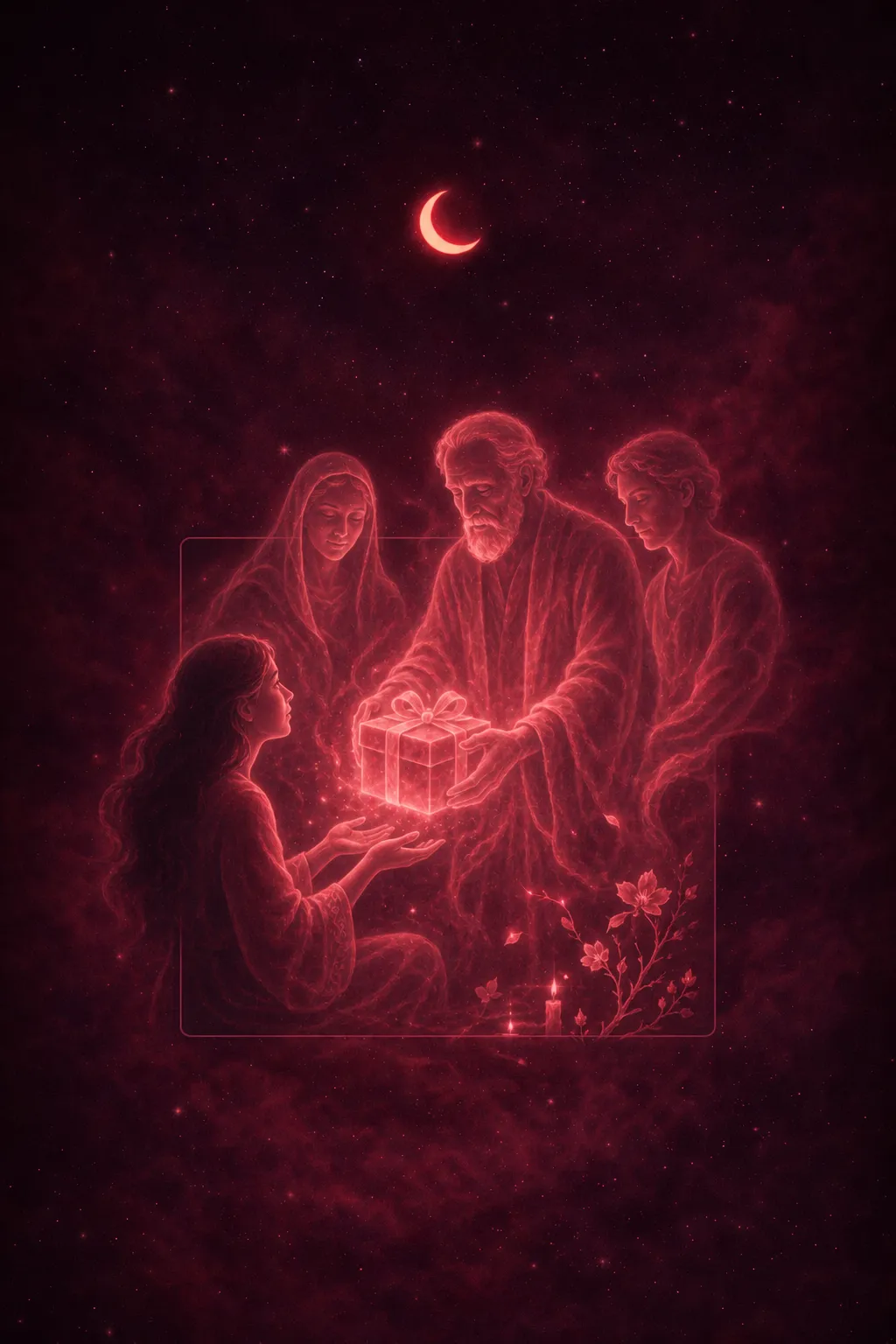

Dreaming of a dead person giving you a gift typically signals grief processing, continuing emotional bonds with the deceased, and an unconscious desire for closure or legacy — the gift symbolizes what that person meant to you and what part of them you are still carrying forward in your waking life.
In under a minute you could read what your exact dream means for you, and see a picture of it. Free.
A dream still on your mind? Get your personal reading.
Describe your dream in a line or two. In seconds you get a reading of your exact dream, a picture drawn from your own words, and every symbol explained.
Free. No sign-up. Takes 10 seconds. Your dream stays private.
0%
Analyzing your dream…
Something went wrong. Please try again in a moment.
Your dreams deserve more than a dictionary
Common Scenarios and What They Mean
A Deceased Parent or Grandparent Hands You Something
This is the scenario most people search after. When a parent or grandparent appears and offers you a gift — whether it's a physical object, a wrapped package, or something passed silently from hand to hand — the dream is drawing on what psychologists call a continuing bond. Your psyche hasn't severed the relationship; it's still in dialogue with who that person was to you. The gift most often represents a blessing, a permission slip, or a piece of their legacy that you feel you've inherited — not financially, but emotionally. These dreams tend to surface around milestones: a wedding, a new baby, a career change, or a significant birthday. If your parent appears healthy, calm, and at peace, that detail carries weight. It usually reflects a shift toward acceptance in your own grieving.
Was yours a sign? Find out.
The Gift Is Money, Jewelry, or Something Valuable
Receiving money or valuables from someone who has died can stir up complicated feelings on waking. The dream often maps onto real inheritance anxiety — worries about estate matters, about benefiting from a death, or about whether you honored the person properly. Emotionally, valuables gifted by the dead can represent the worth and esteem they gave you in life. If guilt edges in — if the dream feels slightly wrong — that's worth noticing. It may point to something unsaid or a relationship that ended without resolution. See also our deeper look at visitation dreams, which share this theme of the deceased bearing something meaningful.
An Object You Can't Quite Identify
Sometimes the gift is vague — a small box, a folded cloth, an object that dissolves before you can examine it. This ambiguity is itself informative. Your psyche is still sorting out what the loss actually means, what has changed in you, and what you need. Ask yourself: what did the giver represent to me — strength, safety, creativity, a particular way of seeing the world? The blurry gift may stand for that quality, something you're in the process of reclaiming as your own.
Refusing or Unable to Accept the Gift
If you drop the gift, push it away, or wake up before you can take it, pay attention. This pattern often reflects unresolved grief or lingering guilt. There may be things you never said, an apology you never gave or received, or a farewell that never happened. The refusal isn't supernatural; it's the psyche flagging that something still needs to be processed before you can feel complete.
But what does your version mean?
The Gift Comes with Words or a Warning
Occasionally the dead speak when they hand something over — a phrase, a warning, or a name. This is your own inner voice using a trusted, authoritative figure to deliver counsel you need to hear. Read the message as self-generated wisdom rather than literal contact. If it resonates with a real decision you're facing, that's the point: your dreaming mind dressed up your own instinct in a voice you trust.
The Giver Feels Frightening or the Gift Feels Wrong
When the dream carries dread — the deceased seems angry, the gift feels threatening, or something is simply off — the unease is about the relationship, not about any supernatural force. Difficult or ambivalent bonds don't resolve cleanly at death. The dream is surfacing unfinished emotional work, and that's exactly what dreams are designed to do. For a broader look at difficult dreams about the dead, the same principle applies: the discomfort is an invitation, not a threat.
What a dream about receiving gifts from the dead could look like
Tap an image to open it full screen
Example images. Only you can see what you write in Dream Book.
The Psychology Behind the Dream
Contemporary grief psychology has largely moved away from the idea that you must "let go" of the dead. Continuing-bonds theory, developed by researchers like Klass, Silverman, and Nickman, argues that maintaining an inner relationship with someone who has died is not only normal — it's healthy. A dream in which the deceased hands you something is a textbook expression of this: the bond continues, and the gift is its symbol.
Beyond grief theory, the gift-from-the-dead dream performs several psychological functions:
- Integration: Receiving something signals a move from raw grief toward acceptance — not forgetting, but incorporating the loss into your ongoing life.
- Self-resource projection: Qualities you associated with the deceased — resilience, humor, a particular kind of love — are being symbolically returned to you. The dream is reminding you that those qualities didn't vanish; they live in you now.
- Guilt processing: A gift can carry ambivalence. If the relationship was complicated, the dream may be working through what you feel you owe, or what was never settled.
- Stabilization during change: These dreams cluster around life transitions. When your identity is in flux — a move, a marriage, a birth, an illness — the familiar figure of the deceased provides a kind of psychic anchor.
A bad dream isn't a bad sign.
At Dream Book, we consistently find that people who dream this way are not in psychological trouble; they are doing the hard, necessary labor of mourning. If you'd like to explore what talking to the dead in dreams means in a similar framework, the psychological reading is closely related.
Every dream you log starts to connect.
Dream Book keeps your dreams in one place and reveals the threads between them over time — your private dream journal. Free to start.


Cultural Context
Across cultures that share an Anglo-heritage worldview, dreams of the dead bringing gifts have historically occupied a middle ground between comfort and caution. In early modern English and American folk tradition, such dreams were taken seriously as possible messages but rarely acted upon literally — they were more often retold as reassuring than prophetic. The Romantic period elevated the idea of the dead communicating through dreams as a form of ongoing love, a theme still visible in popular culture from Victorian mourning practices to contemporary grief memoirs. Today, the dominant mainstream reading in English-speaking countries is psychological: the dream reflects the dreamer's inner world, not a transmission from beyond. Yet the emotional weight of the experience — the vividness, the sense that it was somehow real — keeps the spiritual interpretation alive and personally meaningful for many.
Spiritual Readings
For those who hold a Christian faith framework, a dream of receiving a gift from the departed can carry a gentle biblical resonance. The book of James (1:17) describes every good and perfect gift as coming from above, and some dreamers find comfort in reading such a dream as a sense of God's grace channeled through a beloved figure — a reminder that love doesn't end. It's worth noting that mainstream Christian theology does not endorse literal communication with the dead; the comfort, if it comes, is understood as God's compassion expressed through the imagery the dreamer's heart needs most.
A broader folk-spiritual reading — common across many denominations and non-religious spiritual frameworks — treats this type of dream as a visitation: a moment when the veil between worlds feels thin, and the deceased offers reassurance that they are at peace. This reading is held gently by most who embrace it. It isn't a literal claim about what happens after death; it's a felt experience of comfort that many find genuinely healing during grief. Whether you interpret the dream psychologically, spiritually, or both, the emotional meaning is consistent: you are loved, and that love persists. You might also find resonance in the related experience of dreaming of hugging someone who has died, where the comfort theme runs equally deep.
Related Dream Meanings
nightmares
Deceased Visiting Dream: Closure, Guidance & Grief
5 min read
nightmares
Dead Person Dream Meaning: Closure & Unresolved Loss
5 min read
nightmares
Talking to Dead: Meaning and Interpretation
6 min read
nightmares
Hugging a Dead Person: Meaning & Interpretation
5 min read
nightmares
Skeleton Dream Meaning: What It Reveals About Your Inner Self
5 min read
nightmares
What Does It Mean to Dream About Being Stalked
5 min read
nightmares
Dreaming About Serial Killer: Meaning and Interpretation
6 min read
nightmares
Being Chased by a Snake Dream: Anxiety & Hidden Fear
5 min read
What to Do With This Dream
You don't need to decode every detail to benefit from this dream. A few grounding practices help:
- Write it down immediately. Note the object, the setting, the emotional quality on waking. The feeling — warm, peaceful, unsettled, guilty — is often more informative than the symbol itself.
- Ask what the giver represented to you. Strength? Safety? Approval? That quality is likely what the dream is surfacing in yourself.
- Notice the timing. Are you facing a major life change? An anniversary of the loss? The dream may be your psyche's way of gathering support for what's ahead.
- Honor the relationship. If guilt or unfinished business surfaced, consider a small act of acknowledgment — writing a letter, visiting a place that mattered, or simply speaking aloud what you never said. Dreams can prompt real emotional work.
- Don't force a single interpretation. The psychological and spiritual readings aren't mutually exclusive. You can find scientific grounding in continuing-bonds theory and still hold the dream as a private moment of grace.
Was yours a sign? Find out.
If the dreams are frequent, distressing, or accompanied by persistent grief that interferes with daily life, speaking with a grief counselor or therapist — someone trained in bereavement — is a wise and caring step for yourself.
Keep the ones that matter close.
The free app saves your most meaningful dreams and reads the signs across them — so a visit or a sign is never lost. Free to start.
People Also Ask
Dreaming of a dead person giving you a gift reflects your ongoing emotional bond with them, your grief process, and what their presence meant to you. The gift symbolizes legacy, love, or qualities you're reclaiming. It's a normal part of mourning, not a supernatural event, and is generally considered a healthy grief response.
Spiritually, receiving a gift in a dream — especially from the deceased — is widely interpreted as a message of comfort, blessing, or ongoing love. In a Christian framework, it can evoke divine grace. More broadly, many see it as a felt 'visitation' offering reassurance that the person who died is at peace and still connected to you.
Signs that a dream of a dead person may carry deeper significance include: the deceased appearing healthy and calm, the emotional tone feeling unusually vivid or peaceful, a clear message or gesture, and a strong sense of presence on waking. These markers are often associated with grief processing or what some call a visitation dream.
The Bible presents dreams as a channel through which God communicates (Numbers 12:6, Job 33:14-15). James 1:17 describes every good and perfect gift as coming from God. Some Christian dreamers interpret a gift received in a dream as a symbol of divine grace or comfort, though mainstream theology doesn't endorse literal communication with the dead.
Curious what your dream would look like?