
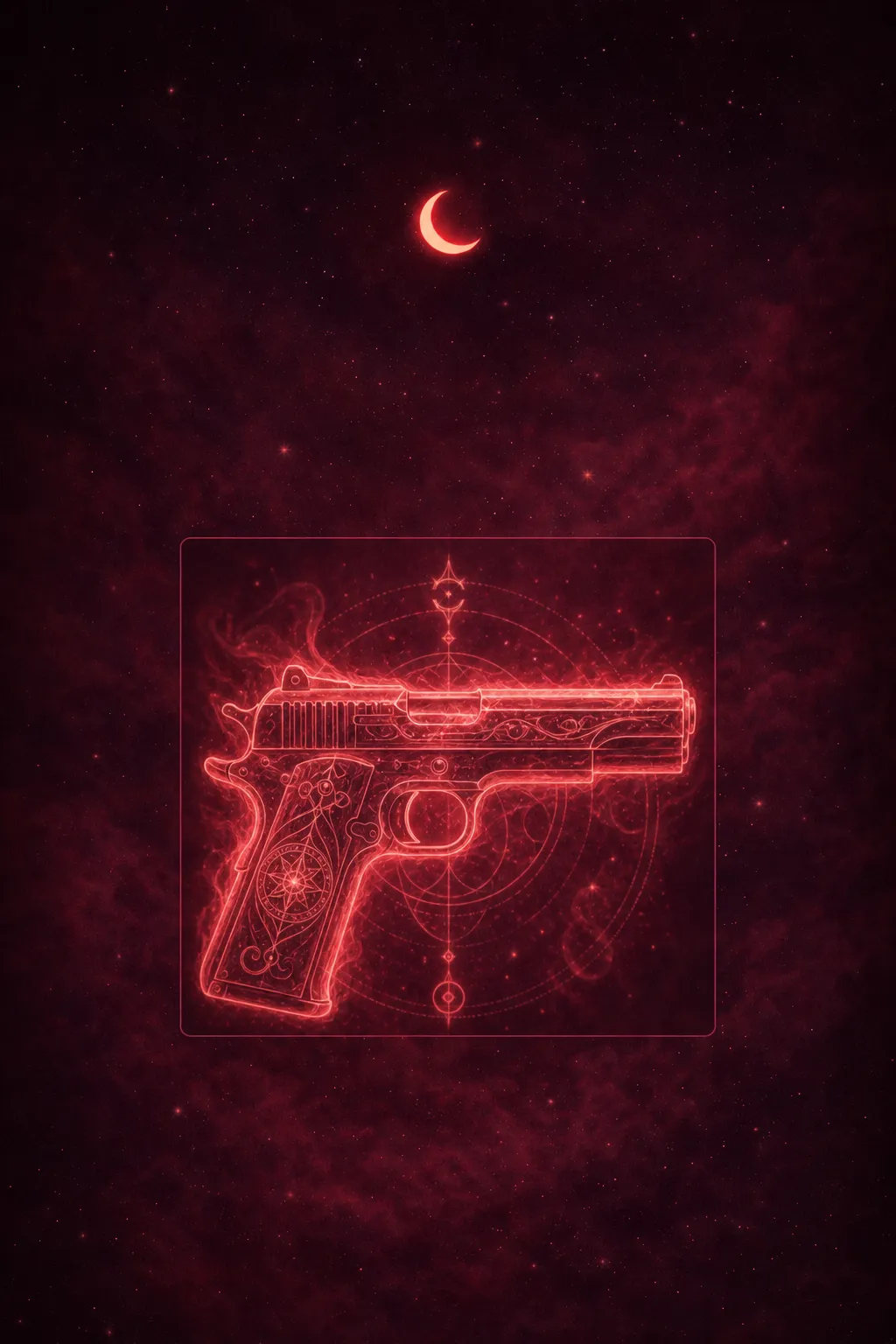

Dreaming about guns meaning centers on power, control, and aggression, as guns in dreams typically symbolize your desire to assert dominance, protect yourself from threats, or confront deep-seated fears, and the context—whether you're firing, being shot at, or simply holding a weapon—reveals the specific emotional conflict your subconscious mind is urging you to address.
In under a minute you could read what your exact dream means for you, and see a picture of it. Free.
A dream still on your mind? Get your personal reading.
Describe your dream in a line or two. In seconds you get a reading of your exact dream, a picture drawn from your own words, and every symbol explained.
Free. No sign-up. Takes 10 seconds. Your dream stays private.
0%
Analyzing your dream…
Something went wrong. Please try again in a moment.
Your dreams deserve more than a dictionary
Common Gun Dream Scenarios and What They Mean
The scenario unfolding around the gun shapes its meaning as much as the weapon itself. The most reported variant — having a gun pointed at you — typically mirrors a waking situation where you feel cornered: an overbearing boss, a suffocating relationship, or a deadline that allows no escape. Your mind is staging the pressure visually, forcing you to acknowledge how little agency you feel. By contrast, holding, aiming, or firing a gun flips the dynamic toward agency and assertion. This can reflect healthy boundary-setting or, more uncomfortably, suppressed anger you haven't consciously acknowledged — the dream is nudging you to own that tension rather than project it outward.
- Gun jams or won't fire: A classic anxiety dream. You need to act decisively but feel blocked — by self-doubt, exhaustion, or circumstances outside your control. It often surfaces during high-stakes periods at work or in relationships.
- Being shot or wounded: Points to feeling emotionally blindsided — a harsh criticism, a betrayal, or a sudden loss that has left a real psychological mark, much like a blood-and-wound image signals hurt that cuts deep.
- Shooting another person: Rarely literal; usually signals intense, unresolved anger toward someone or a desperate wish to end a draining situation — followed sometimes by guilt on waking.
- Hearing gunshots without seeing a source: Reflects ambient dread — hypervigilance driven by news overload, unspoken household tension, or a vague sense that something is about to go wrong.
- Finding, carrying, or buying a gun: Suggests you are quietly preparing yourself — gathering confidence or readiness — though hidden anger may also be fueling that impulse.
- A loved one holding a gun: Often highlights relational conflict or worry about that person's volatility, rather than any literal threat.
- A toy or broken gun: An encouraging sign — a fear or bully in your life may carry far less real power than it appears, and your psyche is beginning to recognize that.
A bad dream isn't a bad sign.
Across all these variants, the core question is the same: who holds the power, and do you feel it is rightfully yours? Tracking that answer honestly is where the dream's self-knowledge begins.
What a dream about a gun could look like
Tap an image to open it full screen
Example images. Only you can see what you write in Dream Book.
The Psychological Reading: Control, Aggression, and the Pressured Self
At its psychological core, a gun in a dream is rarely about violence itself — it is about the concentration of force and who commands it. Mainstream psychology frames this around the fight-or-flight system: when waking life delivers chronic stress, unresolved conflict, or a decision that feels irreversible, the sleeping mind reaches for dramatic imagery to match that internal pressure. Who holds the gun is the first question worth sitting with. Holding it yourself often signals a suppressed need for self-assertion or boundaries you have been reluctant to enforce. Facing one suggests you feel exposed, outmaneuvered, or unable to control an outcome — a dynamic closely related to the helplessness that falling dreams express.
Depth psychology has long noted that displaced aggression — anger you do not consciously claim — frequently surfaces through weapon imagery. Rather than labeling this alarming, it is more useful to treat it as information: what relationship or situation is generating rage or resentment you have not yet acknowledged? A Christian psychological perspective might frame this as a call to honest self-examination, recognizing that unowned feelings do not disappear but find expression elsewhere, including in dreams.
- Loss of control: a gun that misfires or jams often mirrors anxiety about being ineffective or losing influence over circumstances.
- Boundary needs: arming yourself in a dream may reflect a healthy recognition that you need to protect your time, energy, or emotional space.
- Point of no return: pulling — or refusing to pull — the trigger can symbolize a high-stakes decision the waking mind is rehearsing.
- Media saturation: in an era of constant news cycles, gun imagery can also represent generalized cultural dread rather than any specific personal conflict.
Every dream you log starts to connect.
Dream Book keeps your dreams in one place and reveals the threads between them over time — your private dream journal. Free to start.


Cultural and Traditional Meanings of Guns in Dreams
In the American cultural imagination, guns carry layered symbolic weight that no other object quite matches — simultaneously a tool of self-reliance, a constitutional symbol, a source of fear, and a marker of moral debate. That real-world charge bleeds directly into the dream state. A lifelong hunter or veteran may experience a gun in a dream as neutral or even reassuring, while someone whose main exposure to firearms is through news coverage of shootings may wake from the same image with dread. Folk belief in many Western traditions has long associated weapons in dreams with incoming conflict or the need to prepare a defense — echoing the practical frontier ethos that shaped much of Anglo-American culture.
But what does your version mean?
From a broadly Christian perspective, the weapon often surfaces as a prompt for moral inventory: are you the aggressor, or the one under threat? Scripture's recurring tension between justice and mercy can map onto who holds the gun and why, nudging the dreamer toward self-examination rather than simple fear. This sits comfortably alongside modern-anxiety readings — in an era of round-the-clock news cycles saturated with reports of violence, the gun can appear as the mind's shorthand for all the threat and instability it has absorbed, even when no personal confrontation exists. Dreams involving firearms sometimes share emotional ground with war dreams, in that both tend to reflect a psyche under sustained pressure rather than a literal prediction of danger.
- Holding the gun with confidence: Folk tradition reads this as latent authority or readiness to assert boundaries.
- An unfamiliar or broken gun: Widely interpreted as a warning that your defenses or resources may be unreliable when tested.
- A gun handed to you by someone else: Culturally suggests inherited responsibility — or pressure placed on you by another person's expectations.
The Spiritual Reading: Warfare, Power, and Disarming the Inner Conflict
Within a US Christian framework, a gun appearing in a dream can signal what many believers call spiritual warfare — an awareness that unseen battles are being fought around and within you. Ephesians 6 calls the faithful to put on the full armor of God, and a dream gun may surface as a vivid, contemporary stand-in for that same imagery: something threatening is pressing close, and the dreamer is being prompted to seek protection through prayer rather than personal force. Psalm 91's promise of refuge speaks directly to the anxiety underneath such dreams — the sense that danger is real but not beyond a higher power's reach. Meanwhile, Christ's words in Matthew 26:52, that those who live by the sword perish by it, offer a gentle corrective: dreams in which you wield the gun with confidence may be inviting reflection on whether aggression or coercion has crept into your waking conduct.
Was yours a sign? Find out.
From a broader spiritual perspective, the gun functions as a symbol of misdirected power — energy that could build, protect, or heal being aimed destructively instead. Many spiritual traditions frame such dreams as a call to guard your inner life: where is your attention pointed, and what are you "firing" at others through sharp words, resentment, or unresolved internal conflict? The invitation is to disarm — not to become passive, but to convert reactive force into conscious, intentional action. Whether you read this through scripture or a more general sense of spiritual awareness, the core message is consistent: the dream is less a threat and more a mirror, asking you to examine what kind of power you are carrying and whether it is truly aligned with your values.
Related Dream Meanings
body health
Blood Dream Meaning: Loss, Vitality & Transformation
5 min read
common dreams
Falling Dream Meaning: Insecurity, Fear & Loss of Control
5 min read
nightmares
War Dream Meaning: Inner Conflict, Fear & Resolution
5 min read
nightmares
What Does It Mean to Be in a Coma in a Dream
5 min read
nightmares
Dreaming of a Coffin Meaning: What Your Dream Reveals
5 min read
nightmares
Brakes Not Working: Meaning and Interpretation
5 min read
nightmares
What Does It Mean to Dream About Being Cursed
5 min read
nightmares
What Does Broken Glass Mean in a Dream? Interpretation and Symbolism
5 min read
What You Can Actually Do With a Gun Dream
The most useful first step is a quick context audit: ask yourself where in waking life you feel either cornered or dangerously in charge. Chronic deadline pressure, a relationship stuck in silent standoff, or a decision you keep deferring can all generate this kind of dream. Jotting down one or two sentences about the dream immediately on waking — who held the gun, whether it fired, how you felt — gives you raw material to work with rather than a vague sense of unease you carry through the day.
From there, match what you notice to a concrete action:
- If you felt powerless or threatened: identify the real-world situation triggering that feeling and name one boundary you have been avoiding setting.
- If you held the gun: consider whether you are carrying suppressed frustration — displaced anger that needs a healthier outlet, such as exercise, honest conversation, or structured journaling.
- If the gun misfired or jammed: look at areas where you feel chronically ineffective and ask whether your expectations, or your strategy, need adjusting.
- If the dream felt like a recurring anxiety spiral rather than a one-off image, treat it as a signal that stress levels have crossed a threshold worth addressing — sleep hygiene, a counselor, or even a pattern of conflict-themed dreams worth tracking over time.
A bad dream isn't a bad sign.
The practical goal is not to decode a hidden prophecy but to use the image as a mirror. A gun dream tends to surface when something in waking life demands a decisive response you have not yet made — treat it as a prompt, not a verdict.
If it keeps coming back, the app helps you understand the pattern.
Log each recurring dream and the free app shows you what's underneath — calmly, over time. Free to start.
People Also Ask
Spiritually, a gun represents personal power, authority, and the ability to defend yourself. It can signal a need to assert boundaries or a warning about aggression in your life. Some traditions see it as a symbol of transformation — the capacity to destroy old patterns and make room for new growth.
A gun in a dream commonly symbolizes control, conflict, fear, or suppressed anger. It may reflect a situation where you feel threatened or, conversely, where you hold power over others. The context matters greatly — firing a gun, being shot at, or simply holding one each carries a distinct emotional meaning.
The Bible does not mention guns directly, but biblical dream interpretation links weapons to conflict, divine judgment, and spiritual warfare. Proverbs 25:18 compares a false witness to a weapon. A gun in a dream may therefore represent spiritual battles, deception, or the need to stand firm in your convictions and faith.
Recurring gun dreams usually point to unresolved tension, ongoing stress, or a persistent sense of vulnerability in waking life. Your mind may be processing feelings of powerlessness or anger you have not fully acknowledged. Reflecting on current conflicts or fears — and addressing them directly — often reduces how frequently this symbol appears.
Curious what your dream would look like?