
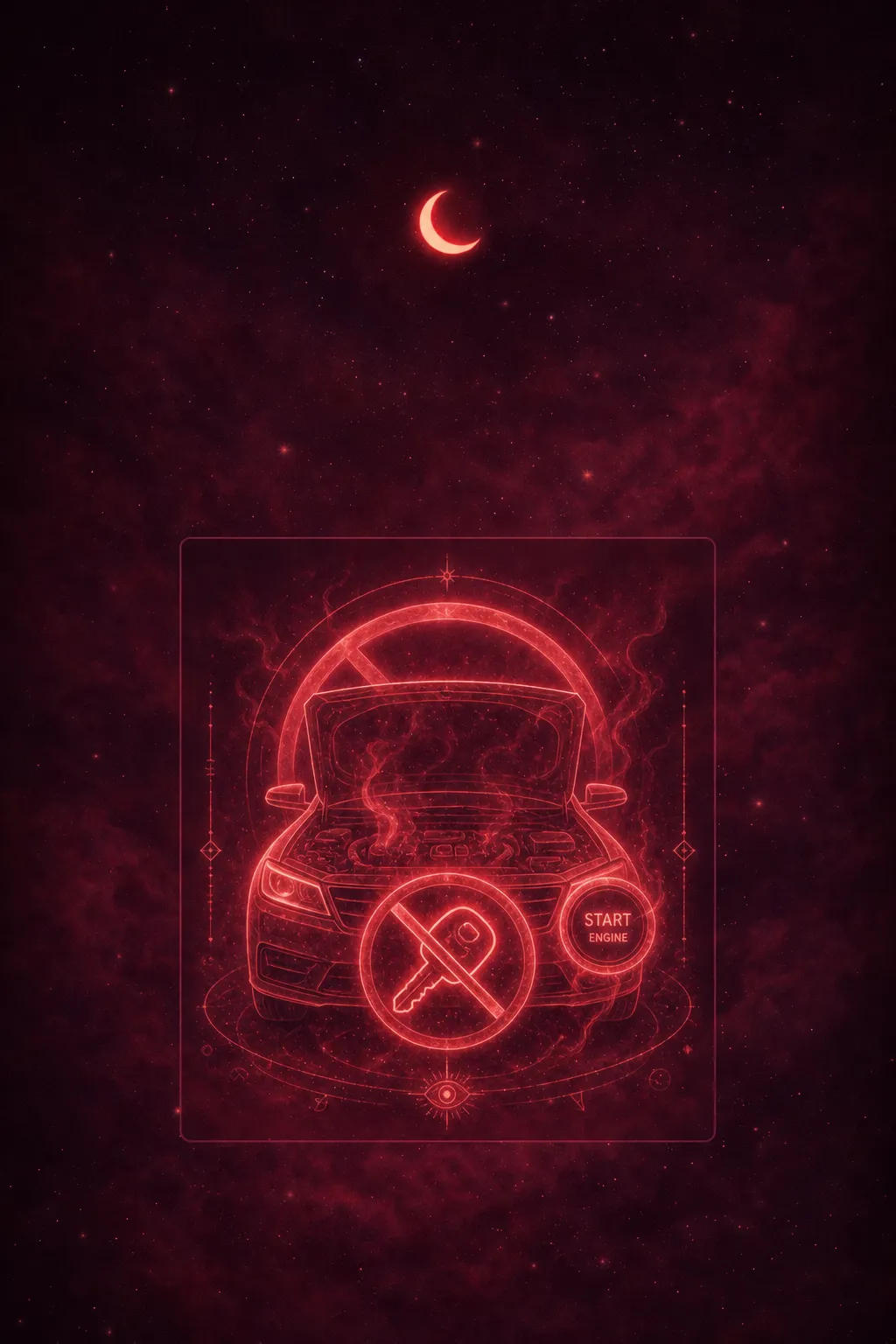

A car won't start dream meaning points to feeling blocked, powerless, or unable to move forward in a key area of your waking life, often reflecting self-doubt, fear of failure, or external obstacles that are draining your motivation and leaving you frustrated by circumstances beyond your control.
In under a minute you could read what your exact dream means for you, and see a picture of it. Free.
A dream still on your mind? Get your personal reading.
Describe your dream in a line or two. In seconds you get a reading of your exact dream, a picture drawn from your own words, and every symbol explained.
Free. No sign-up. Takes 10 seconds. Your dream stays private.
Add who was there and how you felt, and the reading will be about your dream.
0%
Analyzing your dream…
Something went wrong. Please try again in a moment.
Your dreams deserve more than a dictionary
Common Dream Scenarios and What They Mean
Because the car-not-starting dream belongs to a whole family of modern-anxiety dreams, the specific way the car fails tends to mirror the specific way you feel blocked in waking life. Pay attention to the detail — it usually points straight to the source of the pressure.
Dreaming of turning the key but the engine won't catch
You are putting in the effort, but nothing moves. This variant most often surfaces during burnout: your internal reserves are genuinely low, and the dream is signaling that pushing harder won't help without first recharging.
But what does your version mean?
Dreaming that you need to be somewhere and the car refuses to start
The most urgent-feeling version. It maps to fear of failing an obligation — a deadline, an appointment, a role you feel responsible for. Control is slipping in a situation where the stakes feel high.
Dreaming of missing keys or having the wrong key
You lack the means, credentials, or authority to begin. A common dream during career transitions or when starting something new feels premature.
Dreaming that the engine starts then dies repeatedly
False starts and stop-go progress. This pattern can reflect self-sabotage, wavering commitment, or circumstances that keep undermining momentum just as it builds.
Dreaming it isn't your car or you're a passenger trying to start it
Agency has shifted elsewhere. Progress depends on someone else, and that dependence is creating its own anxiety.
Was yours a sign? Find out.
Dreaming of a strange fault — smoke or an unknown malfunction
A vaguer signal that something internal is off — emotionally, physically, or structurally — without you yet being able to name it clearly. Across all variants, the underlying thread is the same: a gap between intention and momentum. Identifying which scenario recurs most often can help you locate where your sense of control feels most fragile right now.
What this dream could look like
Tap an image to open it full screen
Open a frame to see the details
Example images. Only you can see what you write in Dream Book.
Psychological Meaning: Agency, Control, and Inner Depletion
In mainstream psychological terms, the car functions as a vivid stand-in for personal agency — your ego's instrument for navigating life on your own terms. When it refuses to start, the dream is staging a conflict your waking mind may be reluctant to face: the gap between where you want to be and the energy or resolve you can actually summon. Psychologists recognize this as a classic anxiety-dream pattern, one that tends to spike during high-stakes transitions — a career crossroads, a stalling relationship, a deadline that keeps looming larger. The subconscious, unable to solve the problem directly, rehearses the helplessness instead.
From a self-knowledge standpoint, the dream is worth taking seriously as internal feedback. The engine, symbolically, is your motivational core. A dead engine may reflect genuine burnout — a signal that you have been running on fumes and pushing through rather than addressing exhaustion. Decision paralysis reads here too: sometimes the car won't start simply because part of you is not yet certain where you actually want to go. A loose Christian reading would frame this as a call to pause and seek clarity before acting, trusting that forced effort rarely substitutes for genuine direction.
- Frustration and self-doubt: often surface when real-life goals feel blocked by circumstances outside your control.
- Urgency without traction: mirrors modern performance anxiety — the pressure to constantly move forward, even when rest is what's needed.
- Helplessness: may point to an area of life where you feel dependent on others' decisions or external validation to proceed.
Every dream you log starts to connect.
Dream Book keeps your dreams in one place and reveals the threads between them over time — your private dream journal. Free to start.


Cultural and Traditional Readings
In Anglo-American folk belief, vehicles have long carried the weight of personal destiny — the open road is a deeply embedded cultural symbol of freedom, self-determination, and the pursuit of a better life. When that road is blocked before the journey even begins, traditional dream lore reads it as a warning sign from the unconscious: the timing is wrong, the preparation is lacking, or unseen forces are working against forward movement. Older American folk traditions, shaped partly by Protestant ideals of industry and self-reliance, treated such dreams as nudges toward self-examination — a prompt to audit where your effort and your faith were actually invested.
Within US Christian-influenced culture, a car that refuses to start can resonate with the biblical theme of seasons and appointed times — the sense that striving alone is not always enough, and that some doors simply will not open until the right moment arrives. Some believers interpret a vivid, recurring version of this dream as a divine warning from God, a quiet spiritual signal to stop and discern before pressing forward. This reading sits comfortably alongside the modern-anxiety framing rather than replacing it: contemporary dreamers tend to interpret the stalled engine as a mirror of burnout or loss of control, while still sensing, on a quieter level, that the obstacle may be calling them to pause rather than push harder.
A bad dream isn't a bad sign.
- Self-reliance culture: The dream challenges the deeply held belief that willpower alone drives outcomes, exposing its limits.
- Timing and readiness: Folk and faith traditions both suggest the block may signal a need to reassess whether the goal — not just the effort — is truly ready.
- Control anxiety: In a culture that prizes busyness and momentum, a car that won't start is an especially charged image of helplessness.
Spiritual Meaning: Divine Timing and the Wisdom of the Pause
From a spiritual standpoint, a car that refuses to start is less a sign of failure and more an invitation to stop and listen. Within a US Christian frame, the dream fits a well-worn biblical pattern: delay as divine redirection rather than denial. Isaiah 40:31 promises renewed strength to those who wait on the Lord, and Habakkuk 2:3 reminds the reader that a vision has its appointed time — "though it linger, wait for it." Dreaming of stalled plans, then, may reflect an inner prompting that the timing is not yet right, that rushing forward would carry real cost, and that surrendering the illusion of total control is itself a form of faithfulness.
Beyond formal religious frameworks, many spiritual traditions treat this kind of dream as an intuitive checkpoint — a signal from a deeper layer of awareness urging you to reconsider your direction before committing further energy to a path that may need reassessing. In an age of relentless productivity pressure, that quiet internal "not yet" can be genuinely countercultural.
- Delay as preparation: The pause may be clearing space for something more aligned to arrive.
- Releasing control: Spiritually, the stalled engine can symbolize the limits of willpower alone — an invitation to trust a process larger than yourself.
- Discernment over urgency: The dream may be asking whether the destination you are pressing toward still reflects your authentic values and purpose.
Related Dream Meanings
common dreams
Being Late Dream Meaning: Anxiety, Fear & Missed Chances
5 min read
animals
Dreaming of Snakes: Fear, Betrayal and Transformation
5 min read

body health
Teeth Falling Out Dream: Anxiety, Loss & Vulnerability
5 min read

common dreams
Dreaming of a Mountain: Climbing Goals or Fear of Collapse
5 min read
common dreams
Garden Dream Meaning: Growth, Peace & Inner Potential
5 min read

common dreams
Space Dream Meaning: Freedom, Aspiration & the Unknown
5 min read

common dreams
Underwater Dream Meaning: Emotions & Self-Exploration
5 min read
common dreams
Sun Dream Meaning: Vitality, Clarity & Purpose
5 min read
Practical Takeaways: Turning the Dream into Action
When this dream shows up repeatedly, treat it as a low-grade alarm worth taking seriously rather than brushing off. Before the feeling fades in the morning, jot down one honest answer to this question: What in my waking life feels ready to move but keeps stalling? Naming the specific area — a job search, a difficult conversation, a creative project — breaks the vague anxiety the dream trades in and hands you something concrete to work with.
- Audit your energy, not just your schedule. Stalled momentum is often a fuel problem. If you are running on poor sleep, chronic stress, or decision overload, no amount of willpower will turn the engine over. Address depletion first.
- Identify what is actually in your control. List the obstacles blocking forward motion and mark each one: within your control, partly within your control, or completely outside it. Direct your effort only toward the first two columns.
- Break the ignition cycle. If you have been trying the same approach repeatedly and getting nowhere, the dream may be flagging that the strategy — not the destination — needs to change. Seek outside input, lower the barrier to entry, or set a smaller first step.
- Set a decision deadline. Prolonged indecision feeds exactly the helplessness the dream reflects. Give yourself a defined window to act, even imperfectly.
But what does your version mean?
The dream is not predicting failure — it is reflecting a present-tense mismatch between your drive and your current capacity or circumstances. Treat it as useful data, not a verdict.
One dream is never the whole picture.
The free app remembers your dreams, draws them, and connects the threads over time — so the next one means even more. Free to start.
People Also Ask
Spiritually, a car represents your personal drive, life direction, and sense of control over your journey. It reflects how you are navigating your path in waking life. The condition of the car often mirrors your inner energy, willpower, and readiness to pursue your goals or move forward through challenges.
Fully lucid dreams in which the dreamer consciously controls every detail are considered among the rarest experiences. Even rarer are shared or mutual dreams, where two people report dreaming the same scenario independently. Most people never experience either in a lifetime, making them fascinating and widely discussed in dream research and personal accounts.
Dreaming about car problems typically signals feelings of frustration, powerlessness, or being stuck in some area of life. It may point to obstacles blocking your progress, fears about failing to meet responsibilities, or a lack of confidence. These dreams encourage you to examine what might be draining your motivation or holding you back.
A car that won't start in a dream often reflects a sense of helplessness or inability to begin something important. It may indicate low self-confidence, fear of failure, or emotional exhaustion. This dream is a nudge to identify what is blocking your momentum and to address those internal or external barriers before moving forward.
Dreams believed to be warnings from God typically feel unusually vivid, emotionally intense, and deeply memorable long after waking. They often repeat or carry a strong sense of urgency and moral weight. If the dream aligns with scripture, prayer, or a persistent gut feeling urging righteous action, many faith traditions consider it worth taking seriously.
Curious what your dream would look like?