
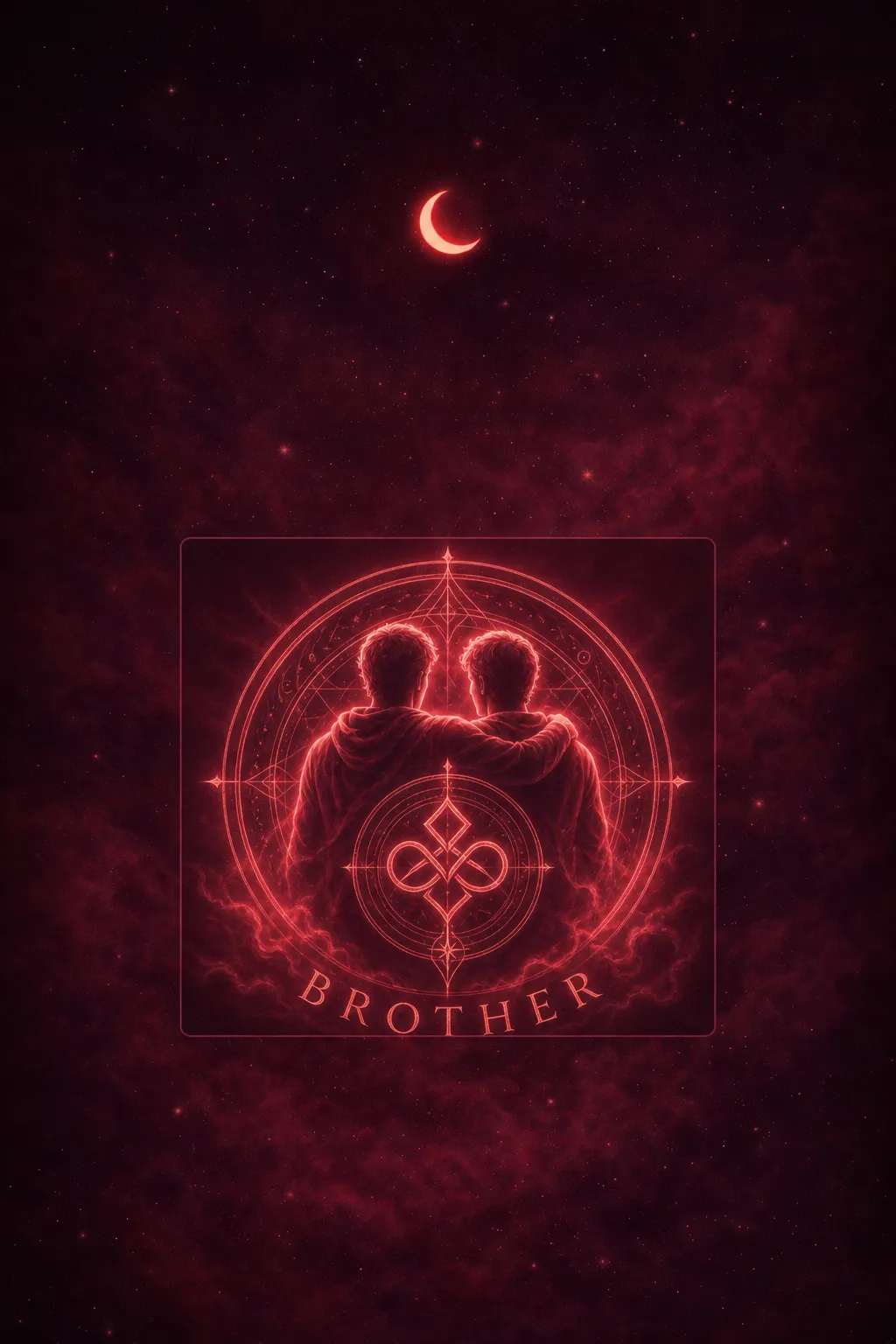

Dreaming of a brother often reflects themes of rivalry, protection, and shared identity. It can point to unresolved tension or a deep need for support in your waking life. Your brother in a dream may also symbolize a part of yourself — your own assertiveness, ambition, or competitive drive.
In under a minute you could read what your exact dream means for you, and see a picture of it. Free.
A dream still on your mind? Get your personal reading.
Describe your dream in a line or two. In seconds you get a reading of your exact dream, a picture drawn from your own words, and every symbol explained.
Free. No sign-up. Takes 10 seconds. Your dream stays private.
0%
Analyzing your dream…
Something went wrong. Please try again in a moment.
Your dreams deserve more than a dictionary
Common Brother Dream Scenarios
Dreaming of Your Brother Dying or Being Dead
Dreams in which a brother dies or appears already dead are among the most emotionally disturbing sibling dreams reported in clinical settings, yet they rarely carry a literal predictive meaning. Psychologically, the death of a brother in a dream typically represents the symbolic end of a dynamic between you — a rivalry dissolving, a bond transforming, or a quality you associate with him being "put to rest" within yourself. This type of dream often surfaces during periods of major life transition, such as a career change, marriage, or relocation that creates distance between siblings. It is also worth noting that death imagery in dreams frequently accompanies grief that is not yet consciously acknowledged. If your relationship with your brother has become strained or emotionally distant, the dreaming mind may dramatize that disconnection as a literal death. For deeper context on how the unconscious processes loss, see the discussion of dead relative dreams and the specific dynamics explored in dead father dreams, which share overlapping symbolic territory around masculine loss.But what does your version mean?
Fighting with Your Brother
Physical or verbal conflict with a brother in a dream is one of the most frequently reported sibling dream themes. In most cases, this scenario does not predict actual conflict but instead externalizes an internal struggle. The brother becomes a stand-in for a part of the self — often the competitive, assertive, or socially dominant aspect — that the dreamer is at war with. Dreamers who report suppressing ambition or anger in waking life disproportionately experience fighting dreams involving male family members. When the conflict feels intensely real and emotionally charged upon waking, it may also reflect genuine unprocessed tension in the sibling relationship. The dream provides a safe arena for the psyche to rehearse confrontation or to discharge hostility that social norms prevent from being expressed directly. See also fighting dreams for a broader analysis of conflict symbolism.Was yours a sign? Find out.
Your Brother Being in Danger
Dreams in which a brother is threatened — by water, fire, an attacker, or some unnamed force — tend to activate the dreamer's protective instincts and frequently leave a residue of anxiety upon waking. Symbolically, this scenario often reflects the dreamer's anxiety about losing something the brother represents: stability, shared history, family identity, or a particular masculine quality the dreamer depends on psychologically. In some cases, the endangered brother represents the dreamer's own vulnerability projected outward. If you dream of your brother drowning, for instance, the drowning symbolism may say more about your own sense of being overwhelmed than about your brother's wellbeing. The unconscious frequently assigns our most threatening emotions to people we are closely bonded with, allowing a degree of protective distance from the feeling.A bad dream isn't a bad sign.
Sexual Dreams Involving a Brother
Dreams with sexual content involving a sibling are distressing to many dreamers and are often misread as literal desires. Clinically, these dreams are better understood through the lens of psychological fusion rather than erotic attraction. The brother in such a dream typically represents an aspect of the self that the dreamer is attempting to integrate — closeness, understanding, or merging with a quality the sibling embodies. For a thorough clinical discussion of this specific dream type, see the article on sex with family member dreams.What a dream about your brother could look like
Tap an image to open it full screen
Example images. Only you can see what you write in Dream Book.
Psychological Interpretation
Sigmund Freud, in *The Interpretation of Dreams* (1900), discussed sibling figures primarily within the framework of wish fulfillment and rivalry. For Freud, a brother in a dream could represent a competitor for parental love, and aggressive or hostile dream content involving a sibling was understood as the return of repressed rivalrous impulses originating in early childhood. Freud noted that the dreamer's ego often disguises these wishes through displacement, substituting the brother for another authority figure or vice versa. Carl Jung offered a significantly different framework. For Jung, the brother archetype in a dream frequently functions as a shadow figure — a representation of the qualities the dreamer has not yet integrated into conscious identity. A younger or weaker brother might symbolize the dreamer's vulnerable, undeveloped side, while a dominant or admired brother could represent the Self in its more individuated form. Jung's concept of the *syzygy* — the pairing of complementary opposites — is directly relevant here: the dreamer and the brother together may represent a psychic whole that is seeking reconciliation. Exploring the parallel dynamics in father dreams can illuminate how paternal and fraternal archetypes interact in the same dreamscape. Calvin Hall's large-scale content analysis of thousands of dream reports, published in *The Meaning of Dreams* (1953), found that siblings appear in roughly 15–20% of recorded dreams, with brothers more commonly appearing in the dreams of male dreamers than female ones. Hall observed that brother interactions in dreams skewed toward aggression and competition more than toward affiliation — a finding he interpreted as reflecting the waking social reality of male sibling dynamics rather than purely unconscious processes. Ernest Hartmann's emotional processing theory adds another dimension: Hartmann argued that dreaming serves to contextualize dominant emotions within a broader narrative web, and the brother — as a figure carrying strong emotional charge — becomes a natural anchor for whatever core emotion (fear, shame, longing, rage) the dreamer is metabolizing. J. Allan Hobson's activation-synthesis model would locate the brother's appearance more neutrally, as the cortex's attempt to construct a coherent narrative from randomly activated memory networks — meaning the brother appears not because he is symbolically necessary, but because he is a highly activated node in the dreamer's emotional memory system.Every dream you log starts to connect.
Dream Book keeps your dreams in one place and reveals the threads between them over time — your private dream journal. Free to start.


Cultural & Spiritual Meaning
Across Western literary and mythological traditions, the brother relationship carries potent symbolic weight — from Cain and Abel to Romulus and Remus — nearly always organized around themes of rivalry, betrayal, and the struggle for primacy. In contemporary Western dream interpretation, a brother typically signifies the shadow self, masculine identity, or unresolved family-of-origin dynamics. The Jungian tradition has been especially influential here, shaping how Western therapists read sibling imagery as a map of the inner family. In Islamic dream interpretation, the classical authority Ibn Sirin held that dreaming of a brother is generally auspicious. Specifically, Ibn Sirin wrote that a brother seen in good health and good spirits in a dream represents the dreamer's own strength and support system — the brother symbolizes a resource the dreamer can draw upon. If the brother appeared ill or in distress, Ibn Sirin interpreted this as a warning about the dreamer's own inner reserves being depleted. Eastern traditions, including classical Chinese and Hindu dream interpretation, similarly treat the brother as a reflection of the dreamer's social standing and familial duty, with a harmonious brother dream indicating alignment with one's social role and a conflicted one suggesting moral or relational imbalance. Indigenous frameworks from various cultures often understand family members in dreams as emissaries from the ancestral realm rather than purely psychological constructs. In many Native American traditions, a brother appearing in a dream may carry a message from shared ancestors, particularly if the dream has a luminous or visitation-like quality distinct from ordinary dreaming. This perspective invites the dreamer to consider not only the personal but the transgenerational meaning of the figure.Related Dream Meanings

nightmares
Death Dream Meaning: Transformation, Loss & Change
5 min read

nightmares
Dying Dream Meaning: Transformation, Fear & Change
5 min read

nightmares
Dead Relative: Meaning and Interpretation
5 min read

nightmares
Dead Father Meaning - Symbolism & Interpretation
6 min read

nightmares
Fighting Dream Meaning: Conflict, Power & Stress
5 min read
nightmares
Drowning Dream Meaning: Overwhelm, Fear & Hidden Stress
5 min read

people
Dreaming About Incest Meaning: What It Really Symbolizes
5 min read

people
Dreaming About Your Father: Meaning and Interpretation
5 min read
What to Do After This Dream
The first practical step after a vivid brother dream is to record it in as much detail as possible — the emotional tone, the setting, and what your brother was doing or saying. Dream journals consistently reveal patterns across multiple dreams that are invisible when individual dreams are considered in isolation. Pay particular attention to how you felt in the dream, not just what happened, since the emotional residue is often the most diagnostically useful element. If the dream was distressing, consider whether its content maps onto anything unresolved in your actual relationship with your sibling, or alternatively, whether the "brother" in the dream felt more like a representation of yourself than a real person. The distinction between these two readings — relational versus intrapsychic — will significantly shape how you respond. *The Dream Book: Symbols for Self-Understanding* by Betty Bethards offers accessible guidance for working through family figure dreams without clinical training, and its structured approach to emotional dream content can be a useful starting point. If brother dreams recur or carry significant emotional weight, working with a therapist trained in dream analysis can help you move from symbolic identification to genuine psychological insight. Understanding your brother dream is the first step. The next is asking what it means for your life right now — that's where a personalized interpretation goes deeper than any dictionary.One dream is never the whole picture.
The free app remembers your dreams, draws them, and connects the threads over time — so the next one means even more. Free to start.
People Also Ask
Dreaming about your brother dying rarely predicts a literal event. It most commonly symbolizes the end of a relational dynamic, the loss of a quality you associate with him, or an unacknowledged emotional distance between you. The dream is best understood as a signal to examine what your brother represents to you psychologically.
Recurring dreams of fighting with a brother typically reflect an ongoing internal conflict rather than a literal interpersonal one. Psychologically, the brother often represents a shadow quality — an aspect of yourself such as ambition, aggression, or vulnerability — that your waking mind is struggling to integrate or suppress.
Dreaming of a fictional brother — one who does not exist in your waking life — is a strong indicator that the figure is a purely symbolic construct. Jungian analysis would interpret this as the emergence of a shadow or alter-ego figure, representing qualities of the masculine self that are seeking acknowledgment or integration.
Not inherently. Brother dreams span the full emotional range from threatening to deeply affirming. The valence of the dream depends almost entirely on the emotional tone and narrative context rather than the mere presence of the brother figure. Positive brother dreams often signal psychological integration or relational security.
Curious what your dream would look like?