
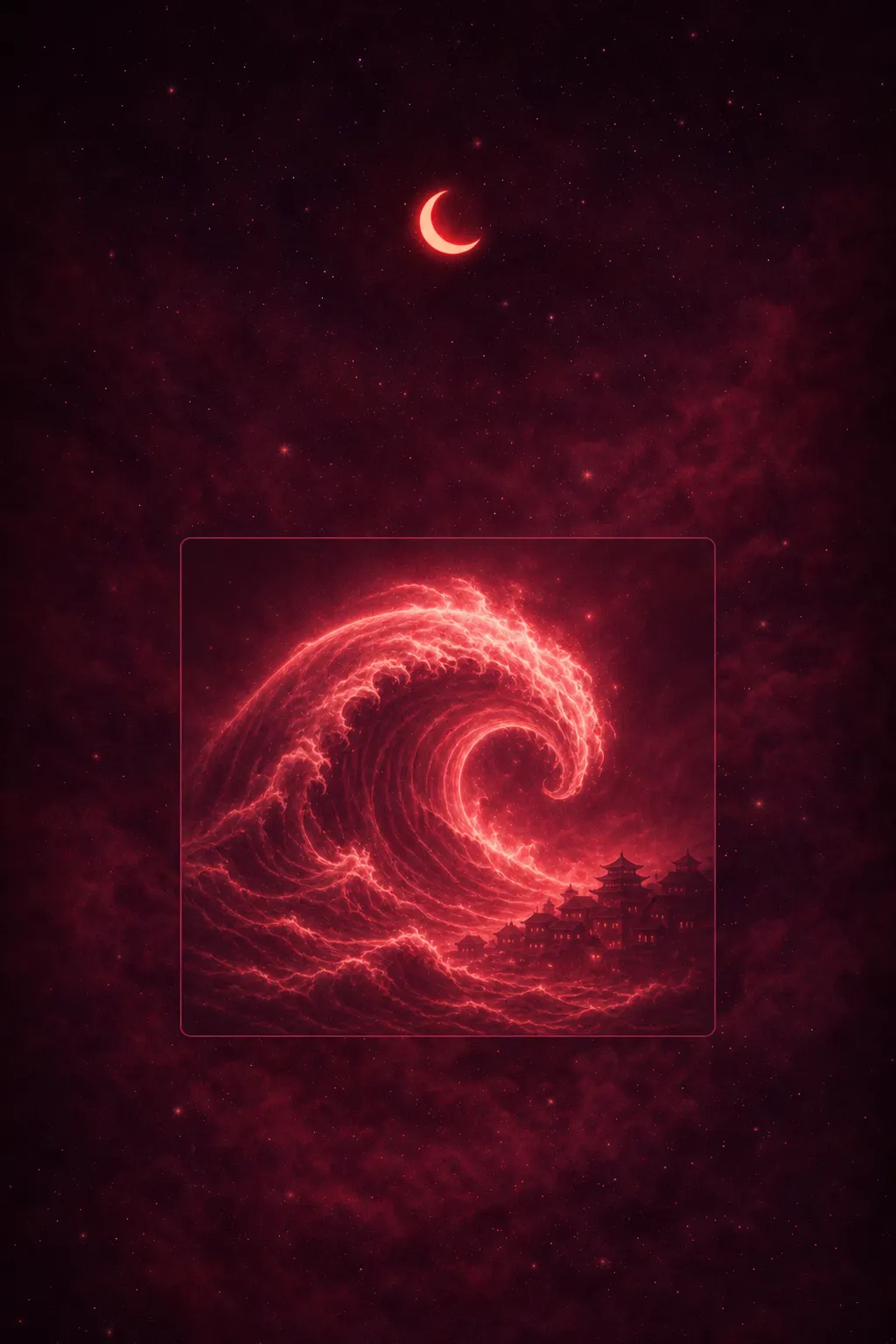

Dreaming of a tsunami usually reflects intense emotional overwhelm, a fear of losing control, or an awareness of powerful forces reshaping your life. The wave often symbolizes suppressed feelings — grief, anxiety, or stress — that have built to a breaking point. It can also signal that a major transition is coming and your psyche is bracing for impact.
In under a minute you could read what your exact dream means for you, and see a picture of it. Free.
Bad dream? See exactly what you dreamed — turned into a picture.
Just describe it and Dream Book paints your dream as a real image, plus a reading of what it means for you. Free, and it takes under a minute.


A dream still on your mind? Get your personal reading.
Describe your dream in a line or two. In seconds you get a reading of your exact dream, a picture drawn from your own words, and every symbol explained.
Free. No sign-up. Takes 10 seconds. Your dream stays private.
0%
Analyzing your dream…
Something went wrong. Please try again in a moment.
Your dreams deserve more than a dictionary
Common Tsunami Dream Scenarios
Watching a Tsunami Approach But Not Being Hit
You're standing on shore. The horizon darkens. The water pulls back in that eerie, unnatural way — and then the wall rises. You watch it come, frozen. This is one of the most reported versions of the dream, and it almost always reflects anticipatory dread rather than present crisis. You know something is coming. You can feel it.
This version tends to surface when you're in a waiting period — a medical result, a relationship on the edge, a job situation that hasn't broken yet. The tsunami hasn't hit because the thing you fear hasn't happened yet. Your mind is rehearsing it, processing the emotional weight of possibility.
A bad dream isn't a bad sign.
Being Swallowed or Swept Away by the Wave
When the wave actually takes you — when you feel the cold rush and the loss of ground — the dream is speaking about surrender, whether forced or necessary. You're not watching the overwhelm anymore. You're inside it. If you also find yourself drowning in the dream, the emotional stakes are even higher: your subconscious is telling you it doesn't know how to breathe through this.
Strangely, many people report feeling calm once they're inside the wave. That detail matters. Calm within chaos often means part of you has accepted a change you've been resisting on the surface. The destruction is also a clearing.
Surviving a Tsunami
Survival dreams carry a quiet power. You make it through — you're standing in the aftermath, water receding, everything changed. This isn't a nightmare in the traditional sense. It's your psyche running a test and passing it. Dreams about big waves that you survive tend to appear at turning points — when you're on the other side of something hard, or when your unconscious is trying to convince you that you can survive what's coming.
Pay attention to what's left standing in the dream. A house still upright. A person beside you. These surviving images are rarely random — they represent what your subconscious trusts to hold.
A Tsunami of Dark or Black Water
When the water in the dream is dark — murky, black, impossible to see through — the symbol shifts. Dark water in dreams traditionally represents the unknown, the unconscious, the parts of yourself you haven't examined. A black tsunami isn't just overwhelming force. It's overwhelming force you can't read or predict.
This version often accompanies periods of genuine uncertainty, grief, or identity disruption. The darkness of the water is the darkness of not knowing what's coming or who you'll be when it passes. If you've also been having ocean dreams recently, the two are almost certainly connected — the ocean is the source, and the tsunami is the moment it stops being containable.
What this dream could look like
Tap an image to open it full screen
Example images. Only you can see what you write in Dream Book.
Psychological Interpretation
Freud would have looked at the tsunami and asked: what are you refusing to feel? His model of the unconscious as a pressure system — desires and memories pushed down until they erupt — maps almost perfectly onto the tsunami image. The wave isn't external. It's everything you've submerged, finally cresting. For Freud, water in dreams was intimately connected to the womb, to birth, to the primal emotional states we carry before language. A tsunami, then, is that primal force breaking through the ego's careful management.
Jung took a different angle. He'd recognize the tsunami as a manifestation of the collective unconscious — not just your personal repression, but the vast, impersonal forces that move through all of us. The tsunami in Jungian terms is the Self overwhelming the ego, the larger psyche demanding integration. If you've been ignoring your Shadow — the parts of yourself you've labeled unacceptable — the wave is what happens when that Shadow runs out of patience. Jung often wrote about the necessity of being flooded before you can be remade.
But what does your version mean?
Calvin Hall spent decades analyzing over 50,000 dream reports and found that disaster dreams — floods, storms, catastrophic events — were disproportionately common in people experiencing major life transitions. His content analysis showed these weren't random anxiety noise; they tracked closely with actual waking-life pressures. The water rising in your dream is almost certainly rising in proportion to something specific in your life. Ernest Hartmann, whose work on emotional memory processing changed how we understand nightmares, would add that the tsunami dream is your brain doing urgent emotional work — using the extreme image of the wave to process feelings too large for waking thought to hold. The more vivid and terrifying the dream, Hartmann argued, the more important the emotional material being processed.
Hobson and McCarley's activation-synthesis model offers a grounding counterpoint: the dreaming brain, they argued, is partly just making narrative sense of random neural signals. But even within that framework, the brain reaches for the tsunami image because it already carries enormous emotional charge. The image isn't random — it's the most available container for the feeling of being overwhelmed. Neuroscience and depth psychology, for once, agree on the result.
General meanings end here. Read your own dream.
Describe your dream in a line or two. In seconds you get a reading of your exact dream, a picture drawn from your own words, and every symbol explained.
Free. No sign-up. Takes 10 seconds. Your dream stays private.
0%
Analyzing your dream…
Something went wrong. Please try again in a moment.
Your dreams deserve more than a dictionary
Every dream you log starts to connect.
Dream Book keeps your dreams in one place and reveals the threads between them over time — your private dream journal. Free to start.
Cultural & Spiritual Meaning
In Western dream traditions, the tsunami sits alongside tornado and earthquake dreams as a symbol of forces beyond human control — divine judgment, natural reckoning, the limits of human will. Historically, flood imagery in the Western imagination carries deep biblical resonance: the flood as both destruction and renewal, the world washed clean to begin again. To dream of a tsunami in this tradition is to stand at a threshold between what was and what must be.
In Islamic dream interpretation, Ibn Sirin — the 8th-century scholar whose dream texts remain foundational — wrote that seeing a great flood or overwhelming water in a dream could signify a trial sent by God, or alternately, an abundance of blessing so great it overwhelms the dreamer's current capacity to receive it. The meaning, Ibn Sirin held, depended entirely on the dreamer's emotional state within the dream: fear pointed toward tribulation, while awe or wonder pointed toward divine gift. This nuance — the same image carrying opposite meanings depending on felt experience — is one of the most sophisticated interpretive frameworks in any tradition.
In many Pacific Island and East Asian cultures, where tsunamis are not metaphor but lived memory, the dream carries ancestral weight. To dream of the great wave in these traditions can be a visitation — a warning from ancestors, a message from the land itself. The ocean is not separate from the community; it is kin. A tsunami dream, in this context, is the ocean speaking. Indigenous Hawaiian traditions, for instance, hold that the sea communicates through dream, and that a wave dream demands respect and attention, not analysis alone.
Related Dream Meanings
nightmares
Drowning Dream Meaning: Overwhelm, Fear & Hidden Stress
5 min read
common dreams
Big Waves Dream Meaning: Emotions & Loss of Control
5 min read

common dreams
Dreaming of Dark Water Meaning: What Your Dream Reveals
6 min read
common dreams
Ocean Dream Meaning: Emotions, Change & the Subconscious
5 min read

common dreams
Water Dream Meaning: Emotions, Intuition & Growth
5 min read
nightmares
Water Rising Dream Meaning: Overwhelm, Emotion & Change
5 min read

common dreams
Tornado Dream Meaning: Chaos, Turmoil & Warnings
5 min read
nightmares
Earthquake Dream Meaning: Instability & Loss of Control
5 min read
What to Do After This Dream
First: don't dismiss it. Tsunami dreams that wake you up or stay with you through the morning are doing something. They're not background noise.
Was yours a sign? Find out.
Sit with the specific feeling the dream left behind — not the image, the feeling. Was it helplessness? Awe? Grief? That emotional residue is the actual message. The wave is just the messenger.
Ask yourself what in your waking life feels like it's building. Not exploding yet — building. Tsunami dreams almost always arrive before the breaking point, not after. They're early warning systems. If you've been avoiding a conversation, a decision, or a feeling, the dream is telling you the water is already pulling back from the shore.
Journaling the dream in detail helps — especially the sensory specifics. What color was the water? Were you alone? Did you run or stand still? These details carry meaning that generic interpretation can't reach. If this dream keeps returning, it's worth exploring with a personalized interpretation — Dream Book lets you describe your dream and ask follow-up questions to understand what your subconscious is really saying.
And if the dream is connected to real grief, real crisis, or real fear — not just symbolic overwhelm — let it point you toward support. Dreams don't create problems. They illuminate them.
A bad dream isn't a bad sign.
Understanding your tsunami dream is the first step. The next is asking what it means for your life right now — that's where a personalized interpretation goes deeper than any dictionary.
If it keeps coming back, the app helps you understand the pattern.
Log each recurring dream and the free app shows you what's underneath — calmly, over time. Free to start.
People Also Ask
Dreaming of a tsunami approaching usually means you're aware of something overwhelming heading your way — a change, a confrontation, or an emotion you've been avoiding. The fact that it's coming but hasn't hit yet suggests you're in an anticipatory state, bracing for impact. Your subconscious is processing the dread before the event itself.
Tsunami dreams are intense, but they're not omens of literal disaster. They're emotional signals — your mind using extreme imagery to flag something that needs attention. In many traditions, including Ibn Sirin's Islamic interpretation, a flood dream can point toward either trial or overwhelming blessing depending on how it felt.
Recurring tsunami dreams usually mean there's an unresolved emotional pressure in your waking life that keeps building without release. Ernest Hartmann's research on emotional memory processing suggests that recurring disaster dreams are the brain's way of returning to unfinished emotional work. The dream keeps coming back because the underlying feeling hasn't been addressed yet.
Surviving a tsunami in a dream is generally a positive sign — your subconscious running a scenario and coming out the other side. It often appears during or after major life transitions, suggesting resilience and the capacity to endure what feels catastrophic. Pay attention to what and who survived with you, as those details point to your deepest sources of stability.
Curious what your dream would look like?